Fluorescence Microscopes
How to Choose the Best Fluorophore for Your Fluorescence Microscopy Experiments

In fluorescence microscopy, the choice of fluorophore (or fluorochrome) can make or break your experiment. Selecting the best fluorescent molecule affects not only the clarity and specificity of your results but also the reliability of your data. Whether you're performing live-cell imaging, immunostaining, or Förster Resonance Energy Transfer (FRET) analysis, choosing the right fluorescent probe is crucial for optimal signal, minimal background, and accurate interpretation.
Key Factors in Choosing a Fluorophore
When evaluating which fluorophore to use, consider the following critical parameters:
Excitation and Emission Spectra
Excitation and emission spectra describe how a fluorochrome interacts with light—specifically, how it absorbs and then emits light. The excitation spectrum shows the range of wavelengths of light that a fluorophore can absorb to become excited. The emission spectrum shows the range of wavelengths the fluorescent probe emits after it has been excited.
You want to ensure that your fluorophore's excitation and emission wavelengths match the capabilities of your microscope’s light source and filters or that your microscope can work with a filter set that is best suited for a particular fluorophore. Using a fluorochrome with poorly matched spectra can result in weak signals or high background fluorescence.

GFP

TexasRed
The BZ-X is able to accommodate any available filter set to provide a broad range of usable fluorophores.
Get detailed information on our products by downloading our catalog.
View Catalog

Brightness and Photostability
A bright fluorescent molecule improves sensitivity and enables detection of low-abundance targets. Having a fluorophore with high brightness helps provide a higher signal-to-noise ratio, better image contrast, and shorter exposure times, which prolongs the lifetime of the sample and speeds up imaging. Photostability—the ability to resist fading under illumination (i.e. photobleaching)—is essential for long exposures or time-lapse imaging. Balancing brightness and stability will ensure consistent imaging throughout your experiment. Some fluorescent probes are very bright but bleach quickly (e.g., FITC), while others are more stable but less intense. Ideally, you want a balance:
- For fixed-cell imaging, brightness may be more important.
- For long-term live-cell studies, photostability often takes priority.
Compatibility with Filters and Lasers
Not all fluorophores are universally compatible across microscopy systems. To ensure you achieve optimal performance from your fluorescent dye, it’s essential to match it with your system’s filters, dichroic mirrors, and excitation sources—whether they are LEDs, lasers, or mercury lamps.
For example, if you are using a laser confocal microscope, your fluorophore must be excitable by the laser lines on your microscope. A fluorophore that excites at 561 nm won't work efficiently if your system lacks that specific laser line.
If you are using a filter set, then you need to make sure that you have the appropriate filters for excitation and emission to match your fluorescent dye, and a dichroic mirror that passes and reflects the appropriate wavelengths.

Filter sets in a filter cube configuration

Filters designed for a filter wheel configuration
The BZ-X integrates both filter cubes and a filter wheel to provide users with up to 11 configurable channels. By incorporating both filter types, users are able to prioritize high-sensitivity imaging or high-speed imaging based on their experiment requirements.

Types of Fluorophores
There are three major categories of fluorophores commonly used in microscopy:
Organic Dyes
Traditional organic dyes, such as Alexa Fluor, FITC, and Cy dyes (Cy3, Cy5, and other cyanine dyes), are widely used for fixed samples, in situ hybridization, and immunostaining. These small molecules offer a broad range of excitation/emission properties and are relatively easy to conjugate to antibodies or probes. However, these types of dyes are also more susceptible to photobleaching and not the best choice for some types of live-cell imaging.
Fluorescent Proteins
Genetically encoded tags like GFP, RFP, and mCherry are ideal for live-cell imaging. These tags are fused to proteins of interest, enabling real-time tracking of biological processes and cellular dynamics without the need for external staining. Some drawbacks are that these proteins may not fluoresce as brightly compared to synthetic dyes and may have more spectral overlap, making it difficult to use a wide range for multi-color imaging.
Quantum Dots
These advanced nanocrystals offer exceptional brightness and photostability, making them useful for long-term imaging and multiplexed assays. They have narrow emission spectra, which help reduce bleed-through in multi-labeling experiments. Quantum dots are larger in size compared to organic dyes or proteins, which may present issues with uptake and potentially interfere with some biological processes. Additionally, these can be more difficult to work compared to other available methods.

General excitation spectra for BZ-X LED lamp
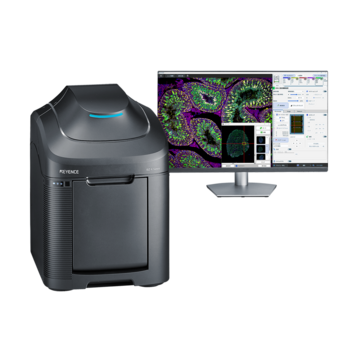
Regardless of the type of fluorophore used, the BZ-X All-in-one Fluorescence Microscope has a high-intensity LED lamp for exciting a broad spectrum of wavelengths. The system also accommodates any commercially-available filter set for detecting nearly any emission wavelength.

Spectral Overlap and Multiplexing
Choosing Fluorochromes for Multi-Labeling
When labeling multiple targets, it’s important to select fluorophores with minimal spectral overlap. Choose fluorescent dyes with well-separated emission peaks to avoid signal confusion and enable clear distinction between channels.
Avoiding Bleed-Through
Spectral bleed-through occurs when a fluorochrome emits in the detection range of another channel. This can lead to false-positive signals. It’s best to use appropriate filters and carefully spaced fluorophores to minimize cross-talk, especially in quantitative applications.
Top Fluorophores by Application
Certain fluorophores are better suited for specific microscopy techniques:

Image captured with BZ-X with 5-color fluorescence (DAPI, Alexa Fluor 488, CoraLite 594, CoraLite 647, and CoraLite 750)
- Immunostaining: Alexa Fluor 488, Cy3, and DyLight 550 are popular for fixed-tissue labeling.
- Live-Cell Imaging: GFP, mCherry, and CellTracker dyes offer low toxicity and real-time visualization.
- FRET Studies: CFP/YFP and mCerulean/mVenus pairs are commonly used for analyzing protein-protein interactions.

Tools for Fluorophore Selection
Selecting the best fluorophore doesn’t have to be overwhelming. A variety of tools can simplify the process:
- Online Spectra Viewers: Tools like FPbase or Chroma’s Spectra Viewer allow you to visualize excitation and emission overlap.
- Manufacturer Comparison Charts: Side-by-side performance data for brightness, photostability, and spectral properties help you identify the optimal dye for your needs.
Conclusion
Choosing the best fluorophore for microscopy is a strategic decision that affects the quality and reproducibility of your research. By considering factors like spectral properties, photostability, and application-specific needs, you can maximize your imaging outcomes. Take time to plan your labeling strategy and use selection tools to make informed decisions.
For more resources and guidance on fluorescence microscopy and compatible fluorophores, contact our microscopy specialists today.