We don’t know how to choose a data logger for temperature measurement.
Selecting a Data Logger for Temperature Measurement
Selection points
-
1
Determine the maximum number of input channels, maximum sampling cycle, and maximum record time.
-
2
Check the data logger specifications.
-
3
Determine how to use the data logger.
(Will it be installed or carried for use?)
-
4
Select the data logger based on its ability to receive signals other than temperature signals.
(Voltage, current, strain, acceleration [vibration], pulse, CAN, etc.)
-
5
Select the data logger according to how easy it is to set and its compatibility with PCs.
(Whether the data logger can be readied for measurement smoothly.)
(Whether the data logger can be used by new operators.)
How to read temperature recorder specifications
After determining the expected maximum number of input channels, maximum sampling cycle, and maximum record time, check them against the specifications.
Measurement accuracy
This specification indicates the accuracy of a temperature recorder.
Measurement accuracy is indicated using full scale (FS), the maximum measurement range, or reading (rdg).
If they have the same value, rdg is usually more accurate than FS.
Many data loggers indicate their actual measurement accuracy by adding “± ** digit(s) (**°C °F),” the amount of variation, to the above measurement.
Example) Comparison between “±0.1% of FS” and “±0.1% of rdg” when a type K thermocouple measures “100°C 212°F” in its measurement range:
1. ±0.1% of FS,
FS = 1572°C 2829.6°F
The measurement accuracy is ±0.1% × 1572°C 2829.6°F = ±1.572°C ±2.8296°F.
2. ±0.1% of rdg,
rdg (reading) = 100°C 212°F
The measurement accuracy is ±0.1% × 100°C (212−32)°F = ±0.1°C ±0.18°F.
Reference junction compensation accuracy
This specification indicates the accuracy of temperature measurement using a thermocouple.
To measure temperature at a junction of two different types of metals (a measuring junction), a thermocouple measures the difference in temperatures at this measuring junction and a junction connected to a temperature recorder (the reference junction) and adds the temperature at the reference junction to the measured difference in temperatures. Reference junction compensation accuracy indicates the accuracy of the temperature at the reference junction.
This section explains the temperature recorder technology used to measure temperature precisely.
Delta-sigma A/D conversion
A delta-sigma ADC uses a combination of oversampling and integration. This method was developed to convert analog signals to digital signals more precisely than the conventional A/D conversions such as successive approximation ADC and flash ADC.
Delta-sigma ADC excels at reproducing input signals and reducing noise at the commercial power supply frequencies.
This ADC is believed to be particularly effective for temperature measurement and other such measurement using a low sampling cycle.
Insulation between channel grounds
This technology reduces the effect of common mode noise by using high-voltage semiconductor relays to insulate channels from each other in the input circuit.
A combination of this technology and the delta-sigma A/D conversion introduced on the previous page eliminates both common mode noise and normal mode noise, enabling highly precise temperature measurement.
When the channels are insulated from each other in the input circuit, a potential difference between the signal grounds does not affect measurement.
When the grounds of input channels are not insulated from each other, a potential difference between the signal grounds causes current to flow between them, affecting measurement.
Other points to check
Can data other than temperature be measured?
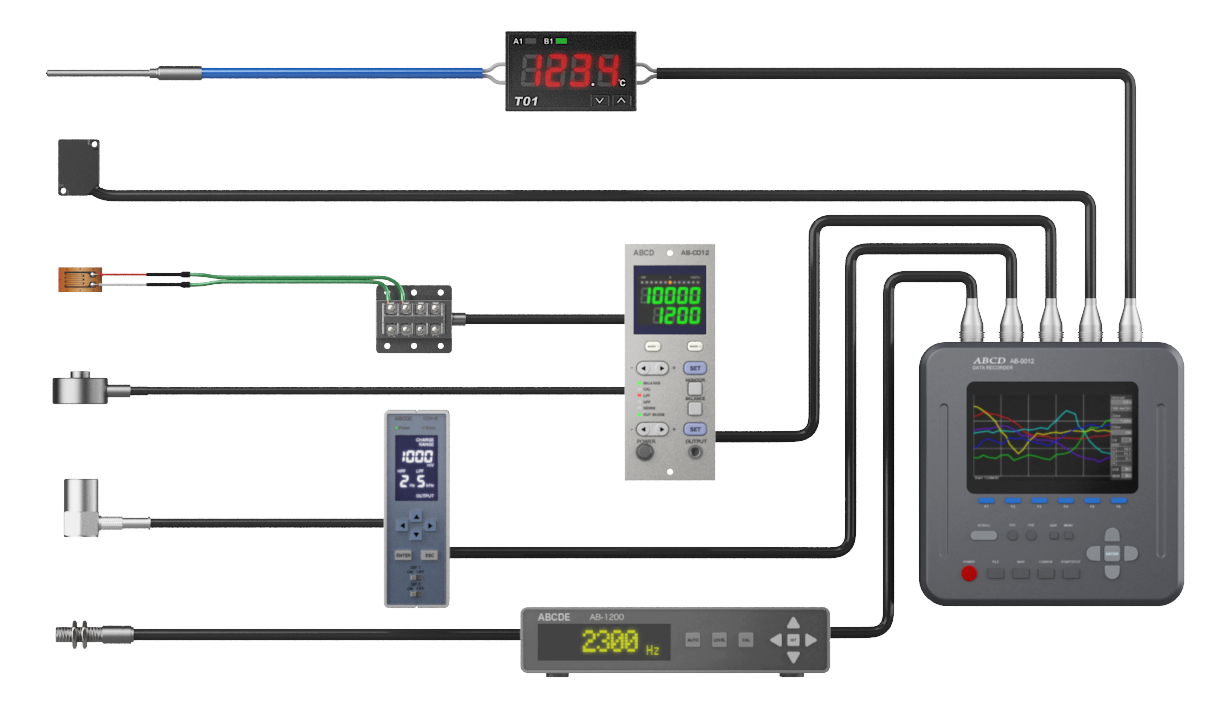
Many temperature measurement data loggers use relatively low measurement cycles, which may not be high enough to measure data other than temperature. Predict which devices will be used and select a data logger that can support the highest measurement cycle. Additionally, to measure strain and vibration simultaneously, multiple data loggers may be necessary. If various measurements will be performed, a data logger that can support multiple measurements is recommended.
Easy setup and compatibility with PCs
A data logger is likely to be used by more than one person, so it needs to be operated easily by anyone.
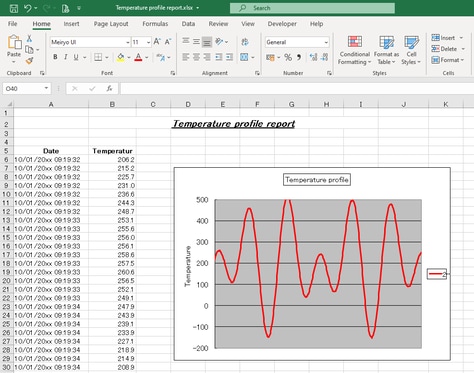
Therefore, it is important to select a data logger that allows for the instant setting and starting of measurement and the instant creation of reports.
Function indispensable for long-term data loggingBehaviors during power outages
The loss of logged data due to an unexpected power outage arising from a problem such as an instantaneous voltage drop is a major issue. Select a temperature recorder that can protect logged data in these situations.
KEYENCE’s multi-channel data logger
NR-X
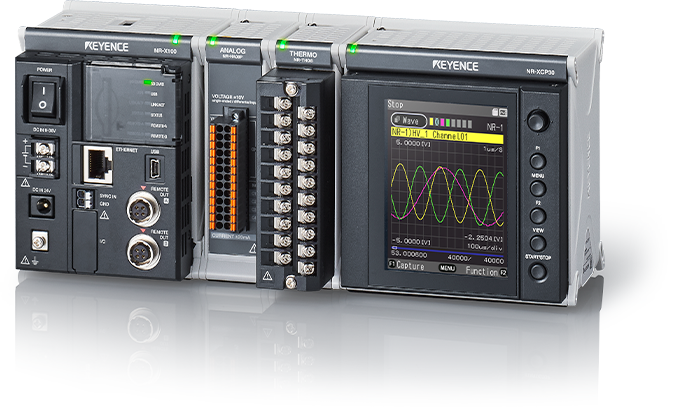
KEYENCE’s NR Series multi-channel data logger meets all the selection points.
KEYENCE NR Series
A circuit combining a supercapacitor and a micro uninterruptible power supply (UPS) using KEYENCE’s original algorithm significantly improves the reliability of measurement data storage. The NR Series finishes storing data to the CF card even when the power supply shuts down unexpectedly.
This highly reliable design reduces the risks of data loss and file system damage.
5 features of the NR Series
- (1) Capable of receiving data from 11 types of thermocouples and resistance thermometers.
- (2) Capable of measuring up to 576 channels simultaneously.
- (3) Compact but capable of multiple measurements.
- (4) Equipped with a wiring reduction system that significantly reduces the amount of wiring work.
- (5) Setup can be completed in 10 seconds. Easy operation for anyone.
Supports various thermocouples
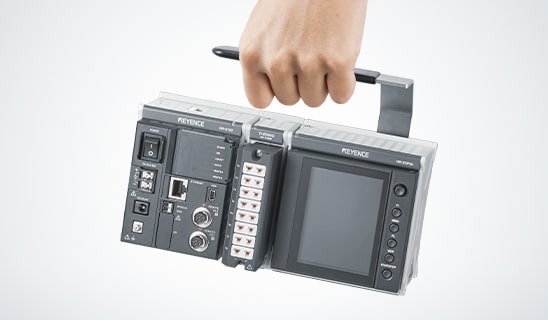
Supports lithium ion batteries
Measure 256 channels simultaneously with the multi-channel link mode.
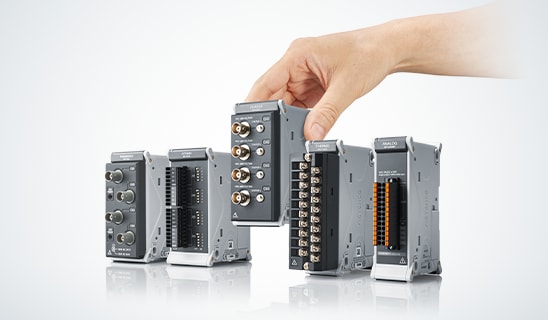
A single unit can measure voltage, strain, and acceleration
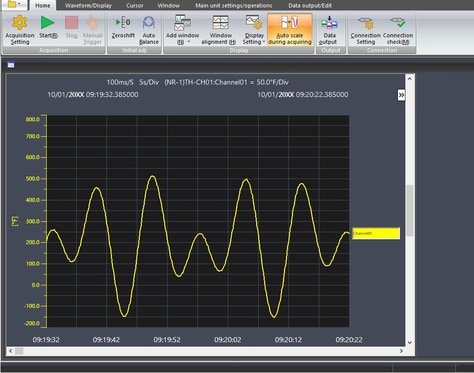
Easy setup from a PC! Start logging in just three steps.
Measurement data is transferred to an Excel spreadsheet in real time.