When to Use Manual vs. Automated Testing

Testing is important to ensure the quality of developed products.
Software testing can be broadly divided into manual testing and automated testing. Even as test automation advances, manual testing remains necessary because each approach has different advantages and disadvantages.
This article provides a detailed explanation of manual software testing to help optimize your testing process.
- What is Manual Testing?
- Advantages of Manual Testing
- Disadvantages of Manual Testing
- When to Use Manual vs. Automated Testing
- Situations Where Manual Testing is Required
- Summary

What is Manual Testing?

Manual testing is a method in which a tester directly operates the software and confirms whether it works as expected based on visual observation and how it feels to use. Instead of relying on test programs or automation tools, the quality of the product is verified based on the tester’s judgment.
Testers play the role of end users and check the operation of all software functions. Since operation, confirmation, and judgment are all performed by humans, this method allows testers to make full use of their knowledge and experience and respond easily to changes in specifications and environments as needed. When bugs are discovered through testing, fixing them so that the software operates correctly helps ensure that users can use it with confidence and without stress.
Advantages of Manual Testing
This section explains four advantages of manual testing. Each offers value that automated testing cannot replace and can help when planning tests.
Advantage 1: High Flexibility
Even if test requirements change, minor modifications can be accommodated by quickly revising the plan. There will likely be little confusion regarding the test procedures as well. Even if unexpected problems occur, testers can respond flexibly, allowing testing to continue without significantly increasing the workload.
Advantage 2: Low Initial Cost
Unlike automated testing, manual testing does not require the creation of test programs. Therefore, the initial cost is lower than that of automated testing. For tests that will only be run a few times, adopting manual testing will allow you to start with a short preparation period.
Advantage 3: Evaluation Based on Human Senses
Many usability issues can only be noticed through manual testing. For example, visual issues such as the colors, fonts, and button sizes of a software interface are difficult to assess without human observation. In order to improve product usability, human judgment through manual testing is crucial.
Advantage 4: No Programming Skills Required
Manual testing does not require programming skills. Since testers are expected to work from a perspective close to that of end users, team members other than engineers who write code can also participate in testing. Testing itself takes more time than coding, so having engineers who do not write code handle testing can optimize team resources and help projects move forward efficiently.

Disadvantages of Manual Testing
This section explains three disadvantages of manual testing. Understanding these disadvantages makes it more likely that manual and automated testing can be combined effectively.
Disadvantage 1: Time-Consuming
In manual testing, the same test items often have to be repeated, and the more they are repeated, the more effort and time are required from the tester. This is because anyone repeating the same task will gradually find it boring and become easily fatigued. As a result, manual testing tends to require more effort than automated testing, which can affect project progress. In large-scale software development, more manual testers may be required.
Disadvantage 2: Risk of human error
With manual testing, human errors such as overlooked bugs and operational mistakes will occur to some extent. If concentration decreases during long testing sessions, mistakes will become even more likely to occur. Even for experienced personnel, it is not easy to continuously and accurately verify a large number of test items.
Disadvantage 3: Difficult to ensure reproducibility
In manual testing, results may change due to subtle differences such as variations in procedures or operational timing. Especially in embedded software, even if you intend to accurately record the steps to reproduce a defect, the reproducibility may change depending on the state of the hardware. If the defect cannot be reproduced, identifying the cause will be difficult, and fixing and reconfirming it may take time.
When to Use Manual vs. Automated Testing
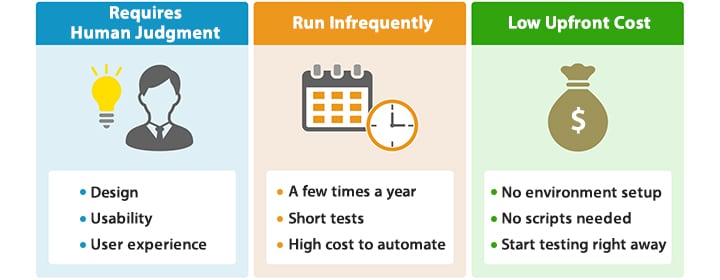
There are three main cases where manual testing is more suitable than automated testing.
The first is when human senses and judgment are important. Usability for users (such as design and ease of use) is difficult to judge with automated testing. In addition, when adopting a development method that assumes frequent specification changes, manual testing, which allows for flexible changes to test procedures, is more suitable. When new features are added, it is efficient to first perform manual testing for quick verification.
The second is when the frequency of execution is low. Even if you automate a test that is performed only a few times a year and finishes in a short time, the effort to change and update the test program will be greater, and efficiency cannot be improved as expected. It is reasonable to perform such tests manually.
The third is when you want to keep initial costs down. Automated testing requires costs for building the test environment and creating test programs. Recently, methods for reducing development costs by using AI and other technologies have begun to emerge, but it is still necessary to secure engineers who can write test programs. For projects with limited time, budget, and human resources before starting testing, manual testing is more suitable.
Situations Where Manual Testing is Required
Here, we introduce situations where test automation is difficult and manual testing is required.
Exploratory testing
Exploratory testing is a method in which tests are performed while the test content is developed. Without defining detailed test cases in advance, testers discover bugs while considering the necessary tests. Exploratory testing is a method based on intuition and experience, and is useful for discovering unexpected behavior. This method is often used for initial verification of new features and verification of functions with complex operations.
Usability testing
Usability testing is a method of observing how actual users operate a product and evaluating its usability. It applies insights into human behavior and psychology to the discovery and improvement of UI/UX issues. It is effective for understanding issues that are difficult to express with numbers or specifications alone, such as “where users get lost” or “which operations take time.” If room for improvement is found, higher-quality product development can be expected.
Ad-hoc testing
Ad-hoc testing is a method in which software experts execute tests as they think of them. By intentionally leaving it to the intuition and experience of the tester, the tester performs operations likely to reveal defects, helping uncover bugs that exceed the developer’s expectations. This method is often used when time and resources are limited.
Summary
Both manual and automated testing are necessary to ensure product quality. Although manual testing tends to take time and carries the risk of human error, there may be bugs that can only be discovered by conducting exploratory or ad-hoc testing. Let’s optimize the test plan according to the project and aim for higher-quality product development.