Continuous Inkjet Printers / Case Coder
Print-and-Apply Labeler vs. Continuous Inkjet Printer (CIJ): Which Is Best for Your Production Line?
Key Takeaways
- The best printing solution depends on your production speed, packaging materials, and whether your application requires direct printing or adhesive labels.
- Continuous Inkjet (CIJ) printers print directly onto products or packaging, making them ideal for high-speed manufacturing and durable product coding.
- Print-and-apply labelers are best suited for applications that require physical labels, custom branding, or variable label designs.
- Non-contact CIJ printing improves efficiency by eliminating label handling and supporting applications such as conveyor lines and heat-seal packaging.
- Modern CIJ printers can help reduce maintenance, consumable use, and environmental impact through efficient operation and MEK-free ink options.
Manufacturers often compare continuous inkjet (CIJ) printers and print-and-apply labelers when selecting a product coding solution. The right choice depends on production speed, packaging materials, and whether you need to print directly on packaging or apply adhesive labels. This guide compares both technologies to help you determine the best fit for your production line.
Print-and-Apply Labeler vs. Continuous Inkjet Printer
Handheld labeling equipment is popular for its high operability and ease of use, while label printers can offer users high flexibility to change print layouts and create updated barcodes and codes quickly. This is why both devices are commonly used in supermarkets and other retail stores. This section addresses some of the problems when using handheld print-and-apply labelers and label printers, as well as the advantages of using inkjet printing for certain label printing applications.
Comparing Print-and-Apply Labelers to Inkjet Printers
Dual-side printing can be accomplished by an Inkjet printer or Case Coder for products and applications that require printing on both sides of the packaging. Changing print content for both sides is easy and convenient and can be done via the touchscreen interface without the need for complex programming or multiple control panels.
| Feature | CIJ Printer | Print-and-Apply Labeler |
|---|---|---|
|
Speed
|
CIJ Printer
High (continuous)
|
Print-and-Apply Labeler
Slower
|
|
Consumables
|
CIJ Printer
Ink only
|
Print-and-Apply Labeler
Labels & ribbons
|
|
Maintenance
|
CIJ Printer
Lower
|
Print-and-Apply Labeler
Higher
|
|
Best for
|
CIJ Printer
High-volume lines
|
Print-and-Apply Labeler
Label-driven packaging
|
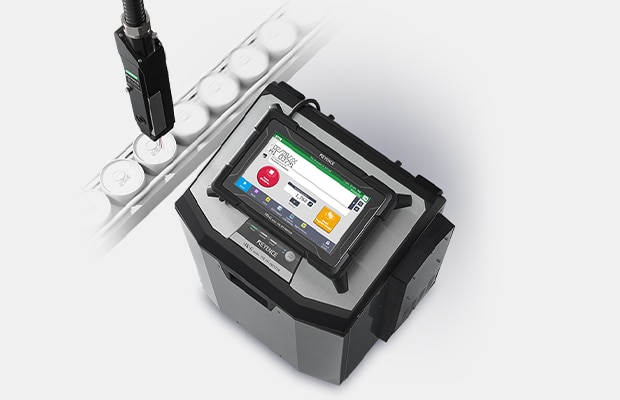
Limitations of Print-and-Apply Machines
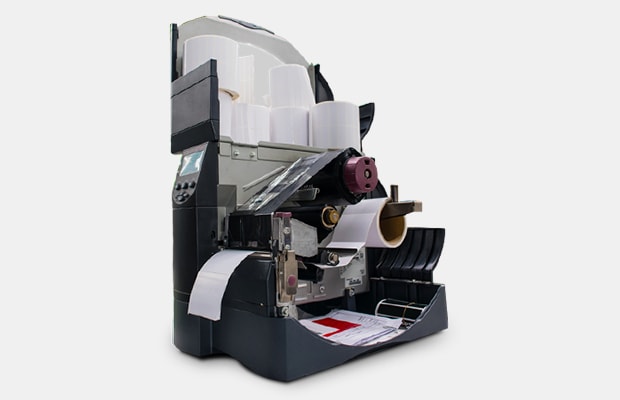
With handheld print-and-apply labelers or label printing machines, production can slow whenever labels need to be replenished. Operators must also configure print content and manually apply labels, increasing labor requirements and the potential for human error.
Continuous inkjet (CIJ) printers eliminate these extra steps by printing directly onto the product or packaging. Because they use a non-contact printing method, they produce consistent, high-quality codes without smudging or bleeding. This is especially important for barcodes, date codes, and lot codes, where reliable contrast and alignment improve downstream scanning accuracy.
Which Should You Choose?
The right solution depends on your production process, packaging requirements, and line speed.
Choose a Continuous Inkjet (CIJ) printer if:
- You need high-speed, continuous production
- You want to eliminate label inventory and handling
- You print directly on packaging (cartons, bottles, bags)
Choose a Print-and-Apply Labeler if:
- Your process requires physical labels
- You need flexible label designs or branding
- Your line speed is lower or intermittent
Industrial Inkjet Printing Applications
Continuous inkjet printers can be integrated into a wide range of manufacturing lines, from conveyor-based packaging to heat-sealing applications.
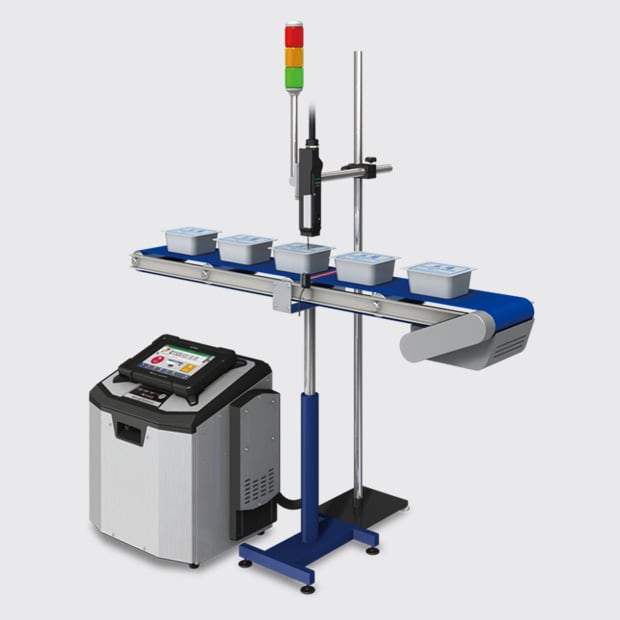
Printing with a Compact Belt Conveyor
A date-printing station can be set up using an inkjet printer paired with a compact conveyor to produce clear, readable codes. Because inkjet systems do not require physical contact, they can print reliably once sufficient space is available, without complex mechanical integration.
Inkjet printing also supports marking on the top or sides of products, making it well suited for cartons, bags, and bottles. Non-contact marking helps maintain print quality on uneven or delicate surfaces where traditional contact methods may cause smudging or damage.
KEYENCE continuous inkjet printers can be configured to fit any conveyor width or length, including custom integrated installations.
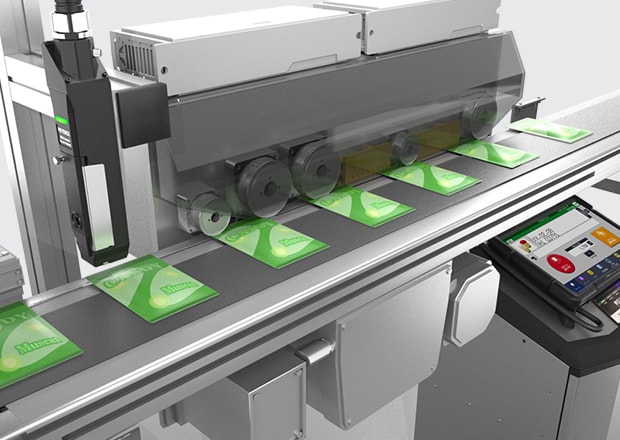
Printing During Heat Sealing
Printing can be performed simultaneously with heat sealing when closing bagged products. In these applications, traditional contact printing methods can damage packaging materials or lead to inconsistent marking.
Because inkjet printing is non-contact, it helps prevent packaging damage while maintaining consistent print quality. KEYENCE provides a comprehensive solution, including continuous inkjet printing systems with sensors that ensure stable detection on various film types, such as transparent films and colored films.
MEK Free Ink Is a Safer Option
Traditional industrial inks may contain methyl ethyl ketone (MEK), while MEK-free inks use alternative formulations that can reduce operator exposure to hazardous solvents.
Many MEK-free inks are ethanol-based, using renewable raw materials such as corn or sugarcane. This makes them a more environmentally conscious option while still delivering durable industrial marking performance.
For manufacturers focused on workplace safety and sustainability, MEK-free inks can offer an effective alternative without compromising print durability.

Inkjet Printing on Labels FAQs
What Distinguishes Inkjet Printers From Print-and-Apply Labelers?
Inkjet printers and print-and-apply labelers serve different marking needs. Print-and-apply systems use thermal printing to produce adhesive labels, which are then automatically applied to products or packaging. Depending on the application, they use either direct thermal or thermal transfer printing.
Continuous inkjet (CIJ) printers work differently. They print directly onto packaging using a continuous stream of electrically charged ink droplets, eliminating the need for labels. Because they're a non-contact printing solution, CIJ printers are ideal for high-speed production lines where durable, permanent codes are required.
What Are the Benefits of Inkjet Printers in Industrial Manufacturing?
Industrial inkjet printers are designed for fast, continuous production environments. They deliver consistent print quality at high speeds while requiring minimal operator intervention, making them well suited for 24/7 manufacturing.
They also print on a wide variety of packaging materials, helping manufacturers standardize coding across multiple product lines. Depending on your application, technologies like Continuous Inkjet (CIJ) or Thermal Inkjet (TIJ) can produce clear text, barcodes, QR codes, and graphics with the speed and resolution your operation requires.
Can Inkjet Printers Print on Labels?
Yes. Industrial inkjet printers can print directly onto many label materials before or after they are applied, depending on the production process. However, many manufacturers use continuous inkjet (CIJ) printers to print directly onto product packaging instead, eliminating the need for separate labels in applications where only variable information such as date codes, lot numbers, or barcodes is required.
How Do Inkjet Printers Support Sustainable and Eco-Friendly Labeling?
Inkjet printing can help reduce waste by printing variable information directly onto products or packaging instead of relying on pre-printed labels. On-demand printing also minimizes excess inventory and reduces material waste.
Compared with print-and-apply systems that require labels and ribbons, inkjet printers can lower consumable usage while simplifying the production process. The result is a more efficient labeling workflow with less material to purchase, store, and dispose of.
How Do You Choose the Right Industrial Label Printing Solution?
The best printing solution depends on your production line, packaging materials, and coding requirements.
Continuous inkjet (CIJ) printers are ideal for high-speed industries like beverage, food, and consumer packaged goods, where durable codes must be applied directly to a variety of surfaces. Print-and-apply systems are often a better fit when products already require adhesive labels, such as apparel, pharmaceuticals, or logistics packaging.
When evaluating a solution, consider print speed, substrate compatibility, code durability, print quality, maintenance requirements, and environmental conditions. If you're comparing technologies, it may also be worth evaluating laser marking for permanent, high-contrast codes on compatible materials.
Why Choose the MK-G Series?
The KEYENCE MK-G Series combines high-speed continuous inkjet printing with simple operation and low maintenance. Smart Startup, automatic cleaning, low solvent consumption, and durable MEK-free inks help manufacturers maximize uptime while producing clear, reliable codes on a wide variety of packaging materials.

Related Products
Related Downloads
-
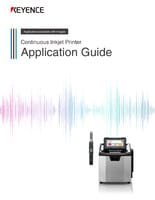
Continuous Inkjet Printer Application Guide
This guide explains continuous inkjet (CIJ) printer applications together with pictures and illustrations. It contains many installation examples in various industries divided into food, medicine, and cosmetics; electrical machinery and electronics; and automotive, metal, and others. These examples show printing on targets specific to each industry.