Continuous Inkjet Printers / Case Coder
Continuous Inkjet (CIJ) Printer Guide: Working Principle
Key Takeaways
- CIJ prints by continuously forming charged droplets and electrostatically deflecting them to create characters.
- Unused droplets are collected in a gutter, filtered, recirculated to the main tank, and reused.
- KEYENCE MK‑G Series uses an MK Dock for automated self‑diagnosis, cleaning, and easy part replacement.
- Knowing CIJ mechanics improves print quality, uptime, and enables faster troubleshooting and maintenance.
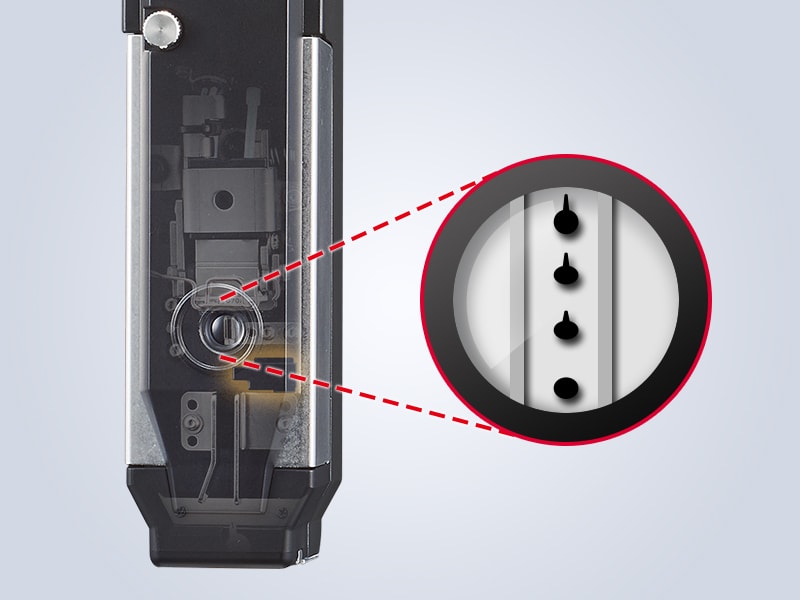
CIJ printers are commonly used to print expiration dates, lot numbers, barcodes, and traceability codes on products and packaging. Knowing CIJ printing technology mechanics improves print quality, uptime, and enables faster troubleshooting and maintenance. Continuous inkjet printers (CIJ) are industrial inkjet systems that use a continuous, pressurized flow of ink to print on products and packaging. The CIJ working principle continuously feeds ink to the print head, where droplets are directed onto the substrate while unused ink is recirculated back into the system.
KEYENCE continuous inkjet printer, the MK-G Series, consist of two main components: a controller and a print head. Inside the controller, a pump draws ink from the main tank, containing a mixture of ink and solvent, and pressurizes it before sending it to the print head. A piezoelectric crystal vibrates to form a steady stream of ink droplets, which are expelled through the nozzle.
Each droplet is then electrically charged by a charging electrode. As the droplets pass between high-voltage deflection plates, an electrostatic field precisely controls their trajectory, allowing accurate placement of codes, text, or markings onto the target surface.
When Should You Use a Continuous Inkjet Printer?
- High-speed production lines
- Printing on uneven or curved surfaces
- Applications requiring non-contact printing
- Date/lot code printing for traceability
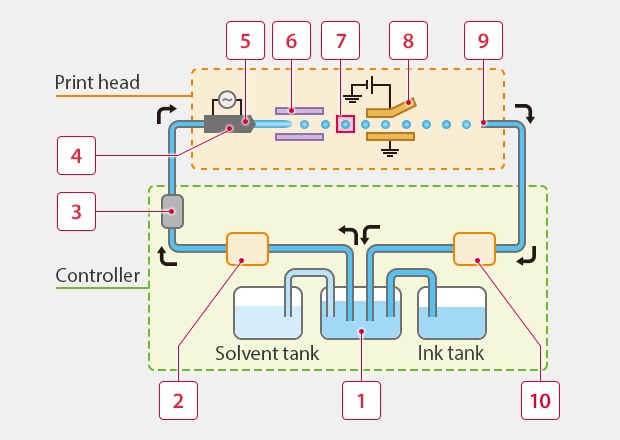
Circulation path
-
1Main tank
-
2Pump
-
3Pressure-reducing valve
-
4Piezoelectric element
-
5Nozzle
-
6Electrostatic electrode plates
-
7Electrostatic sensor
-
8Deflecting electrode plates
-
9Gutter
-
10Pump
The bending force acts on the ink particles according to the level of their charge to change their trajectory, the direction in which they travel. Simultaneously, the target substrate, or the print head, is moved perpendicularly to the travel direction of the ink droplet to print the desired content. In short, the variable voltage droplets create the Y height of the text, while the lateral or X movement of the substrate creates the width of the text.
The ink droplets not used for printing aren’t electrostatically charged or deflected by the electrodes toward the substrate. Instead, they’re collected in a pipe called the gutter, where they’re pulled by the recirculation pump, filtered, and pushed back into the main tank, where it’s reused for printing.
Printing Principle
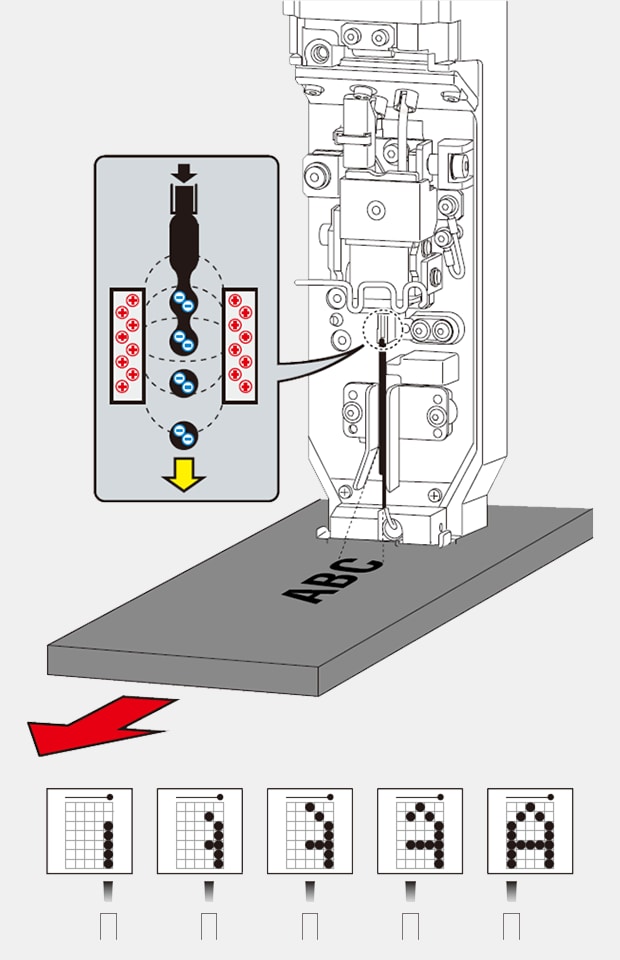
- Step 1: Pressurized ink is supplied to the print head from the controller.
- Step 2: Ink is fed to the nozzle which has the piezoelectric oscillator and discharge hole.
- Step 3: The ink is discharged while being oscillated by the piezoelectric oscillator, and it is simultaneously given a negative electrostatic charge. The ink is formed into an ink column, but when saturated with the negative charge, the ink becomes particles, and those particles separate from the ink column.
- Step 4: The electrostatic detection sensor monitors the ink particles to ensure they receive the appropriate electrostatic charge. This prevents malfunction.
- Step 5: The ink particles that fly from the nozzle pass between two deflecting electrodes where an electrical field is generated by a voltage of around 7000 V. At this time, a bending force acts on the ink particles according to their electrostatic charge to change the direction they fly in. Together with this, the target or print head is moved in the vertical direction to print by creating the shapes of text and numbers.
- Step 6: Ink not used for printing is collected in a pipe called the gutter and reused.
Why Understanding the Continuous Inkjet (CIJ) Working Principle Matters
Understanding how a continuous inkjet (CIJ) printer works helps optimize print quality, production efficiency, and uptime. By knowing how ink is generated and controlled, operators can fine-tune settings for consistent, reliable printing, especially important in regulated industries like food, beverage, and pharmaceuticals where traceability is critical.
It also supports maintenance and troubleshooting. A basic knowledge of CIJ operation helps identify common issues, such as clogged nozzles, dirty print heads, or poor print quality, ultimately extending equipment life and reducing downtime.
KEYENCE’s MK-G Series Eliminates the Need for Deep Technical Expertise
Operators can easily clean, maintain, and troubleshoot the system without specialized training. Traditional CIJ systems often require frequent manual cleaning and adjustment to prevent print issues such as clogging or inconsistent codes.
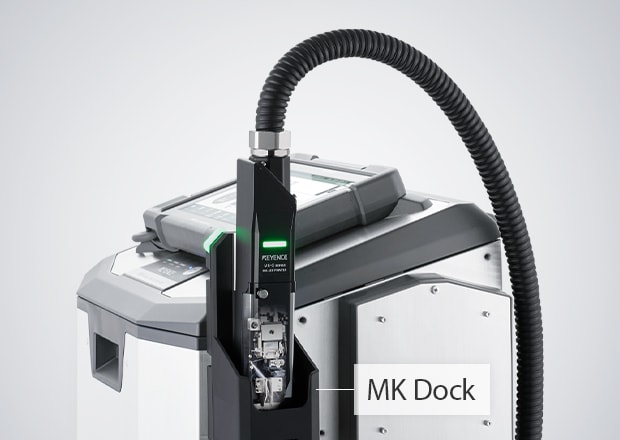
The MK Dock simplifies maintenance by:
- Performing automatic self-diagnosis
- Detecting and resolving issues
- Completing cleaning for stable startup
- Providing clear status visibility with LED indicators
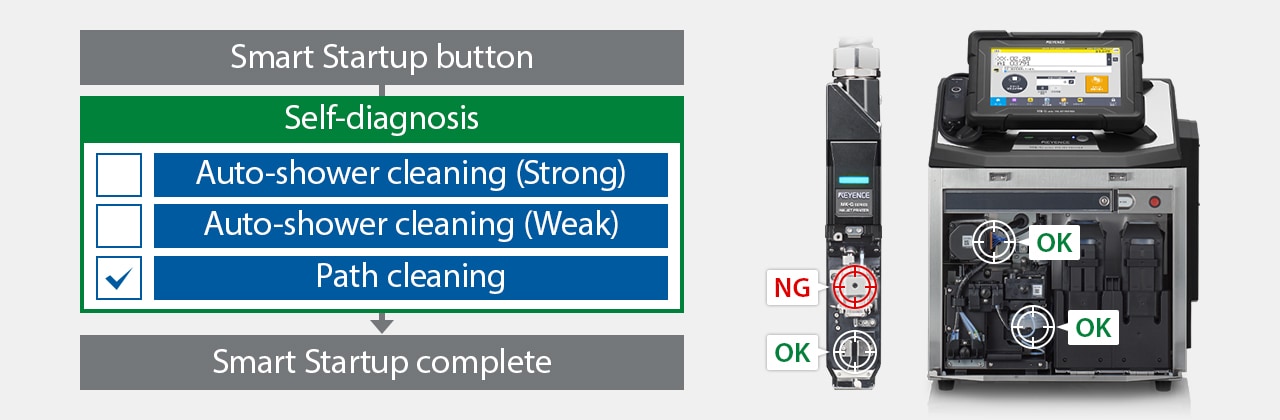
Using the MK Dock enables self-diagnosis and cleaning to ensure stable startup
This shifts CIJ printing from reactive maintenance to a more reliable, turnkey solution, reducing manual intervention and improving overall productivity.
Are you looking to enhance your print quality and streamline maintenance for your industrial printing requirements? Explore how the KEYENCE MK-G Series can improve print quality, reduce downtime, and simplify maintenance.
Contact Us today!

Frequently Asked Questions About a Continuous Inkjet Printer
Why Do CIJ Printers Use Ink Recirculation?
Ink recirculation improves efficiency by reducing waste and maintaining a stable ink flow. Unused droplets are filtered and reused, which helps ensure consistent print quality and reliable operation.
What Are the Main Components of a CIJ Printer?
A CIJ printer typically consists of:
- A controller unit (ink system and pump)
- A print head (nozzle, charging electrode, and deflection plates)
These components work together to generate, charge, and direct ink droplets for printing.
What Is Electrostatic Deflection in CIJ Printing?
Electrostatic deflection is the process of using an electric field to control the path of charged ink droplets. This allows the printer to precisely place droplets on the product surface to create text, codes, or graphics.
What Are the Advantages of Continuous Inkjet Printing?
- High-speed printing on moving production lines
- Non-contact printing prevents smudging or damage
- Works on a wide range of materials (plastic, metal, cardboard)
- Reliable for printing dates, lot numbers, and barcodes
How Do I Choose the Right Inkjet Printer for My Application?
The best printer depends on factors such as production speed, substrate type, print size, and required durability. Continuous inkjet printers are typically recommended for high-speed, non-contact printing across diverse materials.

Related Products
Related Downloads
-

Continuous Inkjet Printer Application Guide
This guide explains continuous inkjet (CIJ) printer applications together with pictures and illustrations. It contains many installation examples in various industries divided into food, medicine, and cosmetics; electrical machinery and electronics; and automotive, metal, and others. These examples show printing on targets specific to each industry.
-
![Inkjet Printer Tech Guide [BASIC KNOWLEDGE EDITION]](/img/asset/AS_114378_L.jpg)
Inkjet Printer Tech Guide [BASIC KNOWLEDGE EDITION]
Continuous inkjet (CIJ) printers work by discharging ink particles to print information such as characters and figures on targets. This document describes the differences between industrial use inkjet printers and office-use printers, as well as their structures, circulation principles, and application examples.