Optical Comparator (Profile Projector)
How to Choose an Optical Measurement Device
Key Takeaways
- Choose automated vs manual optics: automation reduces human error and speeds inspection.
- Evaluate field‑of‑view, working distance, magnification, resolution, accuracy, and precision.
- Ensure system compatibility with CAD, software, and existing workflows before purchase.
- IM‑X suits small‑part, high‑throughput checks (place‑and‑press, multi‑part measurement).
- LM Camera Head targets ultra‑tight tolerances: multisensor, non‑contact Z, highest resolution.
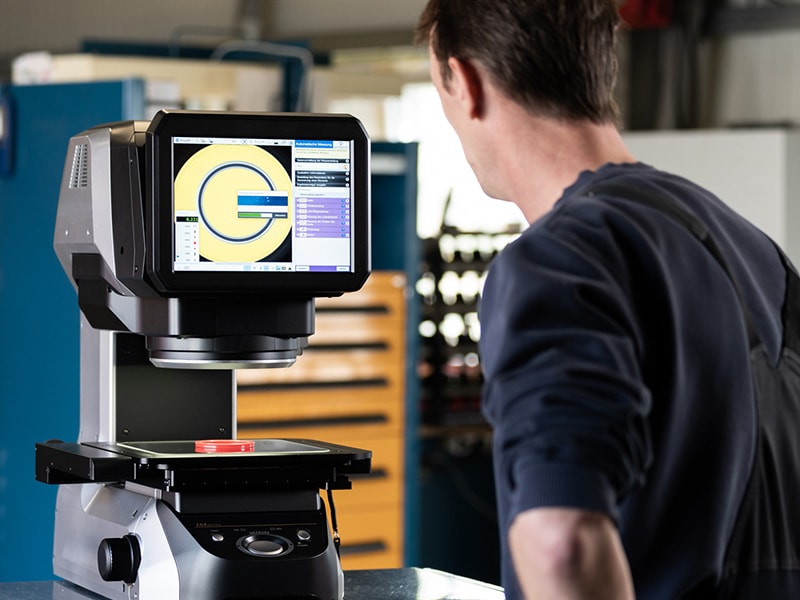
An optical measurement device is a measuring instrument that uses optics like illumination, a lens, and a mirror to create an image that is measured. These devices can measure dimensions such as a part’s length, width, radius, etc. Because of their impressive capabilities, optical measurement devices and related tools have grown in popularity and are used across a range of industries.
In this blog, we’ll analyze the differences between optical measurement system processes and optical measurement machines. In addition, we will discuss which of KEYENCE’s optical measurement instruments will work best for your production needs. To do determine which system is best, we will look at several important factors including part size, part volume, accuracy and more.
What Is an Optical Measurement Device?
The latest optical measurement equipment significantly advances manufacturing quality control by combining precise imaging technology with accurate measurement capabilities, which are frequently present in traditional measurement techniques.
Non-contact measurement tools keep a distance from the object being measured, in contrast to contact-based instruments that make physical contact with parts during examination. This technique prevents damage to delicate components while ensuring dependable results. Key quality assurance responsibilities in manufacturing facilities across a variety of industries depend on these systems.
Production lines can easily incorporate optical measurement devices, providing real-time feedback on part quality. They use sophisticated software algorithms to process the intricate photos they take of the components. The result is accurate dimensional data that helps manufacturers maintain strict quality standards.
Manual vs Automated Optical Measurement Devices
There are two categories of optical measurement devices: manual and automated. KEYENCE provides software-based optical measurement instruments. However, it is important to acknowledge manual devices and their history to understand how we got here today.
Manual
Manual optical measurement instruments have been used as the standard dating back to the 1920s. These devices are commonly known as optical comparators. Optical comparators use illumination, lenses, and mirrors to project a magnified shadow or silhouette of a part for measurement.
The shadow is then manually analyzed for defects and/or measured by a metrologist or quality control technician. The common processes that technicians use are either silhouette measurement or point comparison. These processes are tedious, subject to error, and require detailed metrology expertise.
Automated
A software-operated optical measurement machine is the newest version of optical measurement equipment and the type of device that KEYENCE manufactures. It is known as the fastest and most accurate because of the automation and elimination of human error.
The process is exponentially shorter than manually measuring because it often only requires the push of a button. Once the measuring button is pushed, a software-based optical measurement machine will analyze a part and immediately report all measurement dimensions.
Key Factors to Consider When Choosing a Device
Choosing measurement equipment requires evaluation of your specific manufacturing needs. Production volume helps determine which type of system works best for your facility. High-volume operations benefit from fully automated solutions that can process parts continuously without operator intervention.
The choice of measurement equipment is also influenced by part complexity. Basic geometric components might merely require basic measurement capabilities. Complex components with intricate details require sophisticated imaging systems that can capture unique dimensional callouts and full GD&T measurements.
The budget takes into account more than just the system's initial purchase price. Training costs, software licenses, and ongoing maintenance should factor into your decision. However, increased productivity and shorter inspection times frequently make the investment in a high-quality optical measurement machine worthwhile.
When to Use Optical vs Contact Measurement
Contact measurement methods work well for simple parts with robust surfaces that can withstand physical pressure. The basic dimensions of robust components are best measured using conventional instruments, such as calipers and coordinate measuring machines. For components that are resistant to deformation under measuring stresses, these techniques yield accurate findings.
Optical systems shine when measuring delicate, soft, or complex parts that could be damaged by contact methods. They're particularly valuable for inspecting plastic components, thin materials, or parts with intricate surface features. KEYENCE instant measurement systems offer excellent solutions for these challenging applications.
The need for speed often dictates the best measuring approach. Contact methods typically measure one feature at a time, whereas optical systems can record hundreds of measurements simultaneously. Because of this speed advantage, optical measuring is the obvious choice for high-volume manufacturing settings
Factors to Consider When Choosing Optical Measuring Devices
With a number of optical measurement options available, choosing the right one can be challenging. Your industry, type and size of parts and components being measured, speed, and other similar details will contribute to a decision. By understanding and breaking down the important factors to consider, we can help you narrow down your choices.
Accuracy & Repeatability Requirements
Manufacturing tolerances determine the level of precision your optical measurement device must deliver. While typical manufacturing parts can tolerate looser tolerances, critical aircraft components could need measurement accuracy down to the submicron.
When measuring the same part more than once, repeatability guarantees reliable findings. This characteristic is particularly important for statistical process control and quality certification requirements. Even in demanding industrial settings, top-notch optical measurement equipment maintains exceptional repeatability.
When choosing equipment, environmental elements should be taken into account as they can impact measurement accuracy. The performance of measurements is affected by vibration, temperature changes, and lighting. Choosing systems designed for your specific operating conditions ensures reliable long-term performance.
Field of View and Working Distance
When choosing an optical measuring device, consider the size and shape of the objects you'll measure. How big are the objects? How close can you get to them? The working distance is the distance between the device and the object. You need a device with a field of view that lets you see the whole object and a working distance that allows you to use it comfortably. For example, if needed, an optical comparator can help you measure the X and Y axes simultaneously.
Magnification and Optical Resolution
Magnification lets you zoom in for a closer look, like a built-in microscope. Resolution, on the other hand, is like having super sharp vision, allowing you to see the finest details. Higher magnification and optical resolution are necessary for measuring small features accurately. Machines like the IM-X Series with the LM Camera Head, have a 3x greater resolution than conventional imaging sensors.
Accuracy and Precision
Accuracy and precision are essential for reliable measurements, but these can vary with optical measurement equipment. Accuracy refers to how close a measurement is to the true or accepted value. Precision refers to how close measurements of the same item are to each other. You need a device that's both precise and accurate. Look for optical measuring devices, like a multisensor measurement system, with the right degree of accuracy and precision to fit your applications.
Material & Surface Considerations
Optical measurement systems face distinct challenges depending on the material. Measurement inaccuracies and glare can result from improper handling of reflective objects, such as polished metals. By offering controlled illumination from various angles, sophisticated lighting systems and specialized optics aid in overcoming these difficulties.
Specific measurement techniques are required for transparent and translucent materials in order to obtain accurate results. Using traditional optical techniques to evaluate transparent materials like glass and plastic can be difficult. To efficiently manage these difficult materials, specialized multisensor measurement systems integrate several measurement technologies.
The way light interacts with the part during measurement is influenced by surface polish and texture. The accuracy of measurements may be impacted by the differing ways that rough and smooth surfaces scatter light.
Compatibility with Existing Systems
Does your new device play well with others? Consider whether the optical measuring device is compatible with your existing systems and software. If you already use specific software or other measuring tools, ensure your new device can integrate seamlessly. By doing so, you can streamline your workflow and save time. For instance, if you're already using CAD software or other measurement tools, having a device that can sync with these systems will make your job much easier.
Automation and Data Integration Needs
Today’s manufacturing operations require seamless data flow between measurement systems and other production equipment. Statistical process control software, quality databases, and industrial execution systems can all be directly communicated with by automated optical measurement instruments. By doing away with human data entry, this integration lowers the possibility of mistakes.
Real-time data collection enables immediate response to quality issues before they become costly problems. These technologies automatically identify, allowing one to fix items quickly that don't match the criteria. Data storage becomes more crucial as quality standards increase. For the purposes of tracking and compliance, systems keep thorough records. Measurement data may be securely accessed from any location within your company using cloud-based data management solutions.
Cost Considerations
Cost is always a factor when looking at optical measurement options. Consider the initial purchase price as well as any ongoing maintenance and operating costs. While it is essential to stay within budget, remember that investing in a high-quality optical measuring device can lead to long-term cost savings. How? This equipment can immediately impact your operations' efficiency while saving valuable time.
By considering these factors, you'll be well on your way to choosing the perfect optical measurement system for your needs.
KEYENCE’s Optical Measurement Devices
When considering KEYENCE’s different optical measurement instruments, it’s helpful to consider your priorities and the parts you’re working with. Do you have big or small parts? Do you require maximum accuracy for strict regulations? How experienced with metrology are your technicians? What does your shop floor look like? Let’s dive into the different types for your consideration.
IM-X Series - Image Dimension Measurement System
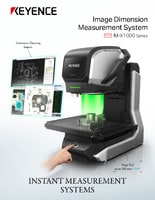
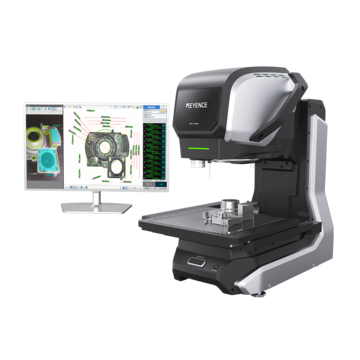
The IM-X Series is known as an upgraded version of a classic optical comparator. It is a compact unit with an 12x8x3 (X,Y,Z) inch measurement range. This makes it optimal for smaller part measurements. But that doesn’t mean it doesn’t have with up to a 19x15x7—the IM-X Series can measure up to 300 dimensions on up to 100 parts at once.
The IM-X follows a “place and press” 5000 dimensions on up to 1000 parts at once. Once the button is pushed, the system will instantaneously measure, create an inspection report, and produce statistical analysis. Hardly any metrology expertise is required with this easy tool.
Some part applications of the IM-X include:
- Lathe process parts
- Screw and bolts
- Pressed parts
- Springs
- Injection mold parts
- Transparent parts
The IM-X Series can also run inspections, including:
- Prototypes/first-off tool part inspections
- CAD creation and comparison of samples and parts
- Pre-shipment inspections
- Incoming inspections
Choosing the IM-X Series optical measurement system is ideal for anyone wanting a user-friendly and accurate machine for measuring or inspecting small parts.
The IM-X Series with the LM Camera Head - High Accuracy Image Dimension Measurement System
The IM-X Series with the LM Camera Head is the most accurate optical measuring machine that KEYENCE’s Quality and Metrology Systems group has. Because of this, it is recommended for industries with strict regulations, like the medical device industry. The IM-X Series is a multisensor measurement device that can detect and measure up to 5,000 dimensions on up to 1,000 parts at the same time. With its highly magnified camera, autofocus, and strong lighting conditions, the system is capable of analyzing items less than the width of a human hair!
The LM Series also has non-contact Z-height measurement capabilities, making it ideal to measure parts that can deform with pressure, like silicon or thin plastic parts.
Some applications of the IM-X Series with the LM Camera Head includes:
- Clear checks of surface edge cuts
- Edge detection for resin-molded parts
- Precision metal parts (end faces and hole pitches)
- Teeth and overall dimensions of a connector
The IM-X Series is user-friendly, requiring only two steps—placing parts down and pressing a button—so it’s ideal for productions that require a straightforward and highly accurate optical measurement system.
Ready to Request a Demo?
Want to learn more about KEYENCE’s optical measurement machines? Demos help you understand how our products work with your needs. Request a demo today, and our team will contact you immediately to set up a demo of any optical measuring machine you are interested in!
Related Products
Related Downloads
-
We asked our customers why they switched from conventional technologies to the IM Series Instant Measurement System. See how this system adds value to any inspection process.
-
IM-X SERIES IMAGE DIMENSION MEASUREMENT SYSTEM: APPLICATION EXAMPLES
See common optical comparator application examples measured on the IM Series Instant Measurement System. Application examples include: turned parts, machined parts, springs, stampings, fasteners, gaskets, etc.
-
![IM Series Q&A: Frequently Asked Questions [Summary]](/img/asset/AS_124476_L.jpg)
IM Series Q&A: Frequently Asked Questions [Summary]
FAQ about the IM Series next-generation optical comparator and how it compared to conventional technology including vernier calipers, micrometers, and optical comparators.