3D Optical Profiling Microscope
3D Optical Profiling Microscope
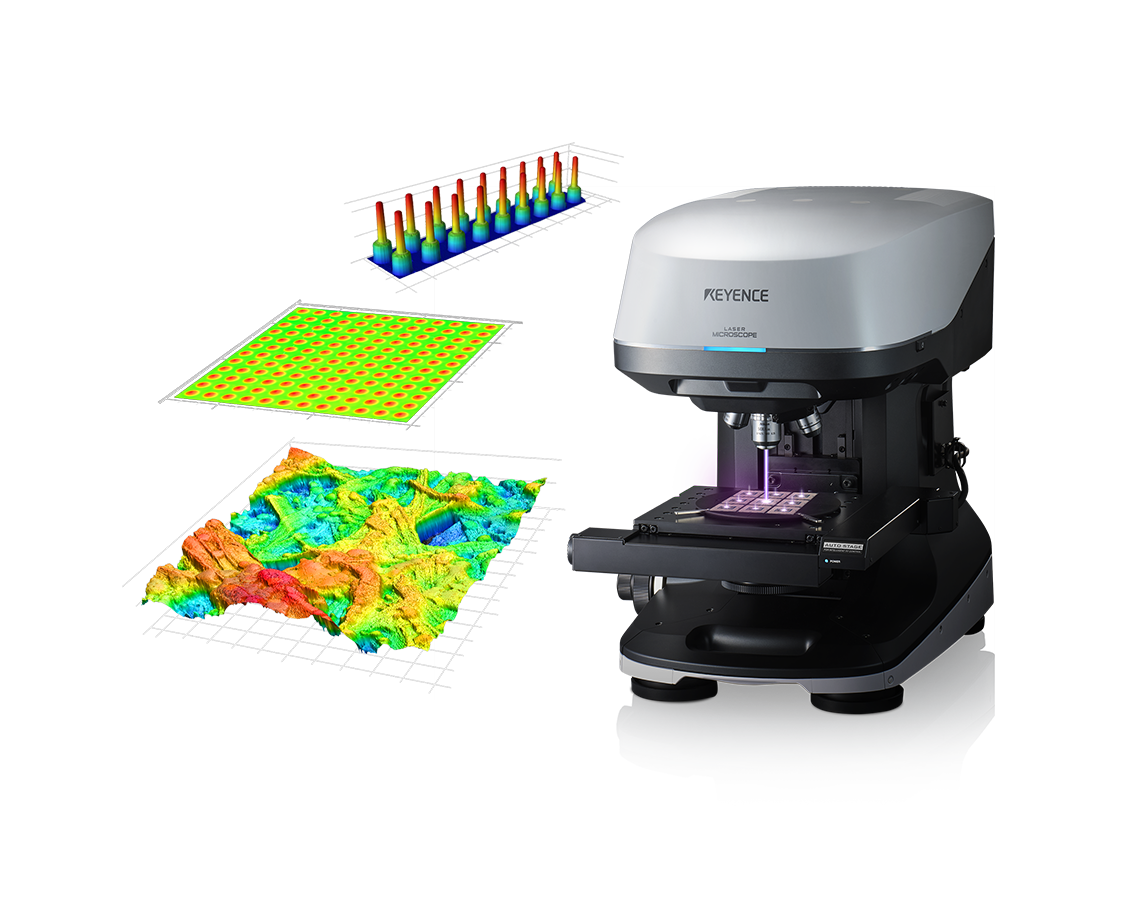
Product Lineup
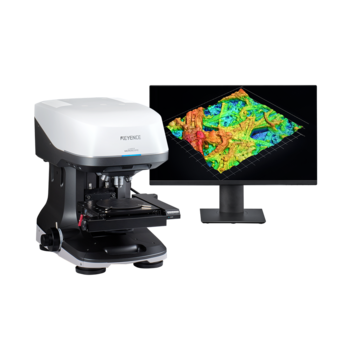
The VK-X4000 Series 3D Optical Profiling Microscope combines laser confocal, white light interferometry, and focus variation methods into a single metrology system, enabling highly accurate, non-contact measurements on nearly any material and surface geometry. Its newly-developed multi-point measurement function further streamlines the analysis process by automating measurements across multiple locations and samples—eliminating complex setup or programming while delivering greater usability, throughput, and repeatability.
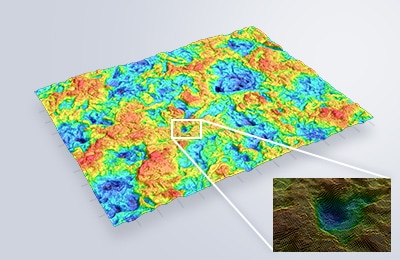
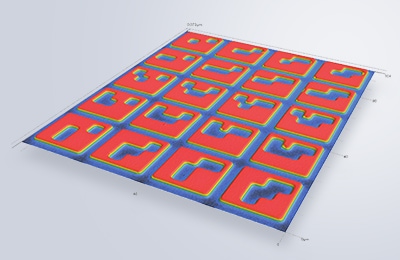
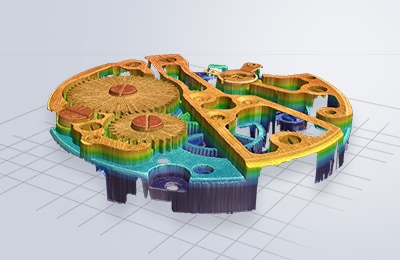
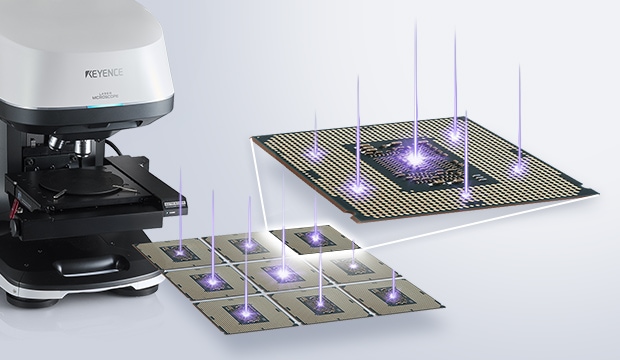
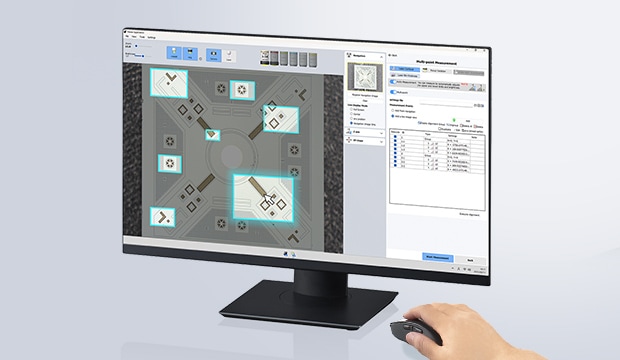
A 3D optical profiling microscope is an instrument that captures 3D data on the surface of a target, typically for measuring surface roughness. 3D optical profiling microscope can use a stylus probe, white light, a laser, or other methods as a means to capture data. Conventionally, stylus probes made of diamond were used, however most industries are shifting to optical systems due to the surface being scratched, and potentially damaged, when using a physical stylus probe.
Common applications for 3D optical profiling microscope include checking for wear on metal surfaces, checking cut surfaces, and checking painted/coated finishes.
How to Use a 3D Optical Profiling Microscope for Measuring Surface Roughness
1. With a contact-type 3D optical profiling microscope, surface roughness is measured by tracing the probe across the surface of the target. In contrast, a laser-based non-contact 3D optical profiling microscope emits a laser beam onto the target and detects the reflected light to measure the roughness.
2. The direction of measurement is the key to successful measurement. For example, a processed metal product is generally measured perpendicularly to the processing direction so that the profiler can capture the surface characteristics more reliably.
3. Measurement speed is also a key element for accurate measurement. Measurement is first performed slowly, and the speed is increased until no fluctuation occur in the measured values.
Benefits of 3D Optical Profiling Microscopes
3D measurement systems fall within two main categories: contact and non-contact systems. Contact systems utilize a probe or stylus that physically makes contact with the surface being measured. The VK-X Series is a non-contact measurement system, that overcomes common limitations of contact systems.
Contact systems generally suffer from several limitations, including causing damage to certain surface types, inability to measure viscous or adhesive materials, and an inability to measure surface features smaller than the tip of the stylus. Because the VK-X Series is a non-contact measurement system, there are no issues in regards to damaging a sample, or difficulty measuring adhesive or viscous materials. Additionally, the VK-X is equipped with a laser with a beam spot radius of 0.2 micron, enabling even the smallest surface features to be detected.
Optical microscopes are generally the standard for imaging, but these systems have a shallow depth-of-field and limited spatial resolution (approximately 500 nm). On the other end of the spectrum, SEMs can provide extremely high resolution and magnification, but can only produce monochrome images and are unable to view larger objects without destroying them. Additionally, SEMs are difficult to operate, and require samples to be coated in a conductive material and scanned within a vacuum. KEYENCE's 3D Optical Profiling Microscope can capture high-definition color images at up to 28800× magnification.
The VK-X is equipped with a white light source and a laser source in conjunction with a focus stacking algorithm, enabling high resolution, fully-focused images to be captured. Additionally, because a laser is used, a spatial resolution of 120 nm can be achieved. From an operation standpoint, the VK-X Series requires no sample preparation, and even large objects can be accommodated for non-destructive imaging.
Many measurement systems use a single measurement principle to obtain data from a target. While this allows the system to be used for the measurement of some targets, others targets will require the use of a different measurement system. For example, white light interferometers struggle to obtain data on very rough surfaces, or surfaces with steep angles. In this instance, the user would be required to use a laser confocal microscope to obtain accurate data on the target.
Equipped with laser confocal scanning, white light interferometry, and focus variation, KEYENCE’s 3D Optical Profiling Microscope can measure nearly any target. Measurement and analysis can be flexibly performed from the millimeter scale to the micrometer and nanometer scale. Typically, users would need three different measurement systems to measure such a wide-range, but KEYENCE's triple scan approach allows for nearly any target to be measured with just one device, no matter the material or shape.
Stylus-Based Profilometers for Roughness Measurement
With contact-type surface roughness instruments, a stylus tip makes direct contact with the surface of a sample. The detector is equipped with a stylus, which traces the surface of the sample and electrically detects the vertical motion of the stylus.
The electrical signals go through an amplification and digital conversion process to be recorded.
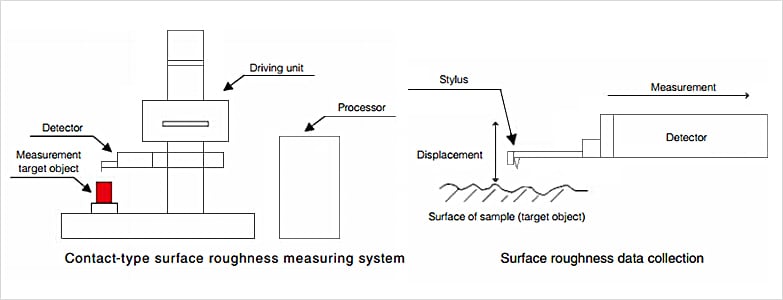
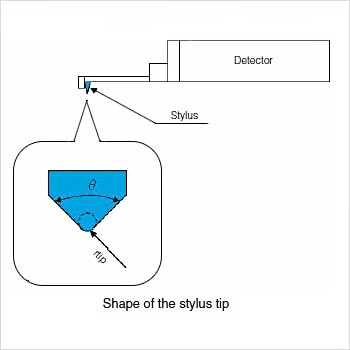
To precisely measure delicate shapes and roughness with a stylus profilometer, the radius of the stylus tip must be as small as possible with low contact pressure.
Styluses are made of sapphire or diamond, and their tip radius is usually about 10 µm 0.39 mil or smaller. A conical shape with a ballpoint tip is considered ideal for a stylus.
Tip radius: r tip = 2 µm 0.08 mil, 5 µm 0.20 mil, 10 µm 0.39 mil
* Cone taper angle: 60º, 90º
* Unless otherwise specified, cones have a 60º taper.
Stylus Profilometer Characteristics
Stylus-based roughness gauges provide reliable measurements because they directly touch the sample. However, direct contact to a sample often has many disadvantages as outlined below.
Advantages
- Clear wave profile
- Capable of long distance measurement
Disadvantages
- Stylus wear
- Measuring pressure can cause scratches on the sample surface
- Inability to measure viscous samples
- Measurement limited by radius of stylus tip
- Time consuming
- Difficulties in positioning and identification of subtle measuring points
- Requires sample cutting and processing for tracing by the detector
3D Optical Profilometers for Roughness Measurement
A 3D optical profilometers uses light instead of a stylus for measuring a surface. There are several types of these instruments, such as laser confocal microscopes and white light interferometers, and each can vary depending on the principle(s) used. There are also a variety of stylus profilometers that have been adapted into non-contact systems by replacing the probe with optical sensors or other devices. We will use KEYENCE's 3D Optical Profiling Microscope, the VK-X Series, as an example to explain the principles of the different technologies available.
A 3D optical profiling microscope integrates three different measurement principles - laser confocal, interferometry, and focus variation - to accommodate and measure any type of surface. Let's take a look at each of these technologies to better understand how they work.
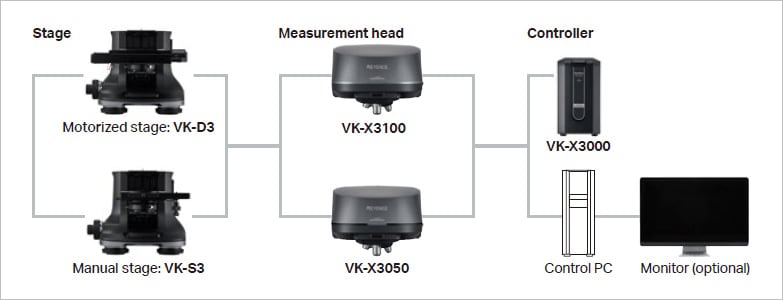
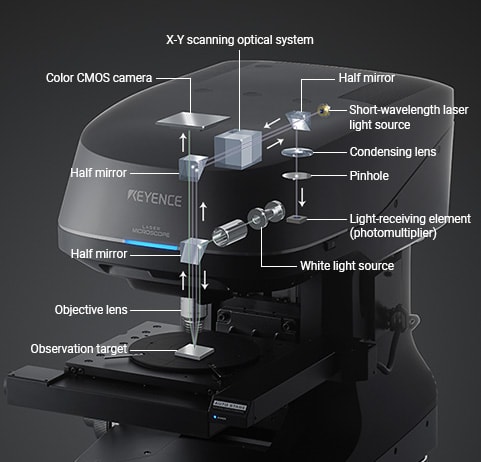
With KEYENCE's VK-X Series, a galvanometric scanner is embedded in the measurement unit. The laser light source scans across the surface of the target in the X and Y directions and acquires the surface data.
The scanning principles are explained below.
Laser Confocal Scanning Measurement Principle
Laser microscopes utilize a specialized optical system consisting of a laser light source, objective lens, half mirror, pinhole, and laser light receiving element (PMT) to perform both magnified observation and surface shape analysis.
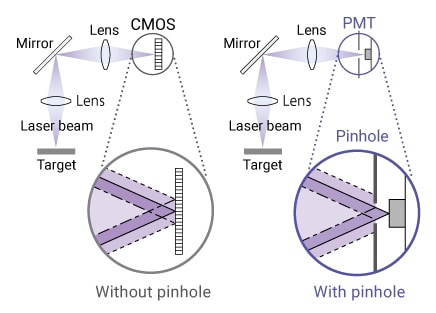
In this system, laser light from the source is concentrated by the objective lens onto the measurement target positioned at the focal point. The reflected light from the target surface then passes back through the objective lens and is focused once more at a precisely positioned pinhole directly in front of the light receiving element.
When the target is correctly positioned at the focal point, the reflected laser light concentrates into a tight beam that passes completely through the pinhole, allowing all of the light to reach the receiving element. However, when the target is out of focus, the laser light spreads and becomes less concentrated—causing the pinhole to block a portion of the reflected light and reducing the intensity received by the detector.
By monitoring the intensity of this reflected light, laser microscopes can accurately determine whether the sample is at the focal position. This optical configuration—featuring a pinhole positioned before the light receiving element—is known as a confocal optical system, and its detection method is called the confocal principle.
Laser Confocal Scanning Methods
Laser microscopes employ various scanning techniques to acquire surface data, each offering distinct trade-offs between speed, accuracy, and versatility. The three most common approaches are the Galvano scanner, acousto-optic device (AOD), and Nipkow disk methods.
Galvano scanner method:
This method uses servo-controlled mirrors to direct laser light across the sample surface. The mirrors, mounted at the ends of servo motors, rotate to precisely adjust their angles and sweep the laser beam in both X and Y directions. This mechanical approach delivers high-quality data with excellent accuracy, though the physical movement of the mirrors results in slower scanning speeds.
Acousto-Optic Device (AOD) Method:
The AOD method takes a fundamentally different approach by using light diffraction rather than mechanical movement. An electric signal applied to a piezoelectric element generates ultrasonic waves within a glass acousto-optic medium. These waves diffract the passing laser light, effectively steering the beam across the sample. This enables significantly faster scanning speeds compared to mechanical methods, though the data quality can suffer from distortion artifacts.
Nipkow disk method:
This technique employs a rotating disk containing spirally-arranged pinholes to create multiple scanning beams simultaneously. As the disk spins, numerous light beams pass through the pinholes and sweep across the sample surface in parallel. This parallel scanning approach maintains relatively high data quality while improving speed, but the method struggles with samples that have low reflectivity, as the divided light intensity may be insufficient for clear detection.
White Light Interferometry and Focus Variation
In recent years, advanced 3D optical profiling microscope that combine multiple different measurement principles have garnered increasing attention. By combining multiple measurement principles into one device, each measurement principle's weak points can be compensated for. KEYENCE's VK-X4000 Series 3D Optical Profiling Microscope integrates three different principles in a single unit: white light interferometry, laser scanning confocal, and focus variation. This makes it possible for a single unit to measure and analyze a variety of targets, regardless of their material, shape, or surface conditions.
Principle of white light interferometry:
White light interferometry captures 3D shape data through the observation of light interference patterns using an image sensor, such as a CMOS. Using an interference objective lens with a built-in reference mirror, white light from an LED or other light source is used to illuminate the reference mirror and the target (measurement surface). The light reflected from each object interferes with one another, and the interference pattern appears as contour lines at each half wavelength. This corresponds to the shape of the target surface with respect to the reference mirror. The interference stripes are then captured by the image sensor and processing is used to determine the 3D shape of the target.
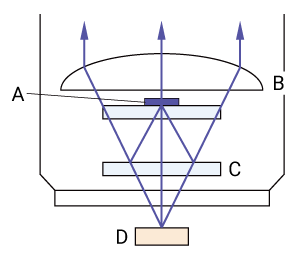
A: Reference mirror, B: Objective lens, C: Beam splitter, D: Sample
Principle of focus variation:
Focus variation determines surface height by analyzing how image sharpness changes at different focal positions. The technique uses a high-resolution image sensor to identify the precise focal point for each pixel across the sample surface.
The measurement process involves capturing a series of images while incrementally moving the lens in the Z direction. As the lens shifts through different heights, various portions of the sample come into and out of focus. The key to detection lies in analyzing the brightness contrast between adjacent pixels in each image.
When an area is in sharp focus, edges and details appear crisp, creating strong brightness differences between neighboring pixels. Conversely, when that same area is out of focus, the image becomes blurred—causing these brightness differences to diminish as pixel values blend together.
By tracking where the brightness contrast reaches its maximum value for each pixel location, the system identifies the exact lens position where that point is in sharpest focus. This focal position corresponds directly to the surface height at that location, allowing the system to construct a complete 3D height map of the sample.
Non-Contact 3D Optical Profiling Microscope Characteristics
In addition to the points that have already been explained, the characteristics of non-contact types can be summarized as shown below.
Advantages
- No sample surface damage
- Able to measure smaller changes than contact types
- Quick measurements
- Simultaneous observation of surface image and height profile
- Able to acquire high-definition, fully-focused images that rival those of SEMs
3D Optical Profiling Microscope Case Studies
Surface roughness measurement
Surface roughness has many standardized parameters; the more the parameters, the more complicated measurement becomes, which tends to mean more time spent to complete an evaluation. Quantification on its own is not sufficient to make a judgment, and pass/fail tests and quality control can be challenging. KEYENCE’s VK-X4000 Series 3D Optical Profiling Microscope can scan the surfaces of targets with high definition and provide quantitative 3D measurements. The measurement results can be subjected to pass/fail tests by comparing them across multiple samples using 42 roughness parameters. Surface roughness is quantified and roughness distribution can be visualized in graphs, which enables instantaneous quantification of differences in material, finish, texture, feel, and other appearance characteristics.
SEM-like imaging
The VK-X4000 is equipped with a color CMOS camera and a 16-bit PMT for capturing the returned laser light. Due to the increased resolution when using a laser over white light, the VK-X is capable of capturing high magnification images with a higher resolution than standard optical microscopes. With a maximum achievable magnification of 28800×, the VK-X can capture high-resolution color images that rival an SEM. Additionally, no sample prep is required when using the VK-X, so images can be captured instantaneously.
Measuring large targets
Generally, 3D optical profiling microscope cannot measure targets that cannot be placed on the XY stage. However, VK-X4000 Series 3D Optical Profiling Microscope are structured so that it is possible to separate the microscope into a measuring head and base. This allows for the measurement head to be integrated with larger stages, allowing for a nearly limitless measurement range.
Related Products
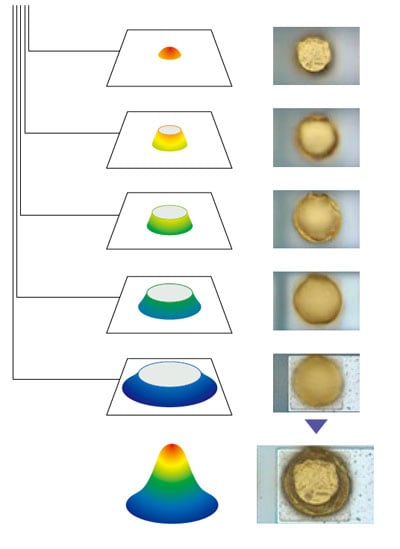
Confocal microscopes incorporate a pinhole in front of the light receiving element to block ambient and out-of-focus light. This allows the microscope to use the position that has reflected the most intense light as the true height. The following section describes the individual steps of the detection process of the KEYENCE 3D Laser Scanning Confocal Microscope.

This website provides information on how 3D optical profiling microscope can be used to quantify surface texture and roughness, including relevant terminology, roughness parameter definitions, and the pros and cons of different measuring instruments.
Frequently Asked Questions About 3D Optical Profiling Microscopes
Unlike SEMs and conventional microscopes that require extensive training and expertise, the VK-X4000 Series 3D Optical Profiling Microscope is designed for intuitive operation by users of any skill level.
The key to this accessibility is the AI-Scan function, which automates the entire data acquisition process. Advanced algorithms intelligently adjust multiple scan settings in real-time, eliminating the need for manual optimization. Operators simply place the sample on the stage and press the measure button—the system handles the rest.
This automation delivers consistent, accurate results regardless of the operator's background or experience. By removing the dependency on specialized skills, the VK-X4000 Series provides access to high-quality measurements across your organization and eliminates the need for lengthy training programs.
The maximum magnification provided by VK-X4000 Series 3D Optical Profiling Microscope is 28800× (with a 23-inch monitor full display). We provide a wide-ranging lineup of dedicated lenses from 2.5× to 150×, all of which undergo rigorous inspection before being shipped. Long working distance lenses are available for measuring targets with large height changes and high aspect ratios.
No—the VK-X4000 Series employs a flexible company license system that removes this limitation entirely. The software can be installed and used on multiple computers throughout your organization at no additional cost, providing unprecedented access and collaboration capabilities.
This licensing approach enables true operational flexibility. Users can work remotely from home, access data from different office locations, or even review measurements while traveling. The multi-computer capability also facilitates instant data sharing among team members, accelerating project workflows and enabling faster decision-making across your organization.

A must-read document for anyone using a scanning electron microscope (SEM). This guide introduces the full extent of the capabilities of the latest 3D surface profilers, using many measurement and observation images. A rich source of information that helps you understand and solve problems you may experience with an SEM.