10 Things to Consider Before Choosing a Barcode Reader
Barcode readers look simple from the outside: point, scan, decode. But the reader that works flawlessly in a bright, clean office environment can fail constantly on a factory floor, in a freezer, or on a high-speed conveyor. Choosing the wrong reader usually doesn't show up as a total failure — it shows up as slow scan rates, frequent re-scans, unplanned downtime, and frustrated operators.
Before you compare model numbers or specs sheets, it helps to work through the questions that actually determine whether a barcode reader will perform in your application. Here are 10 things worth considering.
Key Takeaways
- Match the reader to the code, not the other way around. 1D readers can't decode 2D symbols like Data Matrix or QR — confirm which symbologies your parts, packaging, or documents actually use before shortlisting hardware.
- Read range and depth of field matter more than raw speed. A reader with a wide, forgiving depth of field reduces retries and operator fatigue far more than a marginal increase in decode speed.
- Environment drives the housing spec. Washdown areas, dusty warehouses, and cold storage each demand different IP ratings, temperature tolerances, and mounting options.
- Connectivity and integration determine time-to-value. A reader that plugs into your existing PLC, WMS, or ERP with minimal custom scripting gets to production faster than one that requires a systems integrator.
- Poor-quality or damaged code performance separates entry-level from industrial-grade readers. If labels get scuffed, low-contrast, or printed on curved/reflective surfaces, decoding algorithm quality becomes the deciding factor.
- Total cost of ownership includes more than the unit price. Cabling, mounting hardware, software licensing, training, and long-term support all factor into the real cost.
- Ease of setup and tuning affects who can maintain the system. Tool-free focusing and intuitive configuration software mean line operators — not just engineers — can adjust and redeploy readers.
1. What symbologies do you actually need to read?
Barcodes aren't one format. 1D (linear) barcodes — like UPC, Code 128, and Code 39 — are common in retail and simple inventory tracking. 2D barcodes — Data Matrix, QR Code, PDF417 — pack more data into a smaller footprint and are standard in electronics manufacturing, medical device traceability, and direct part marking.
Before selecting hardware, audit the labels and marks you need to read today and the ones you're likely to need in 12–24 months. Many facilities that start with 1D barcodes eventually add serialized 2D codes for traceability — choosing a reader that supports both from the start avoids a costly second purchase.
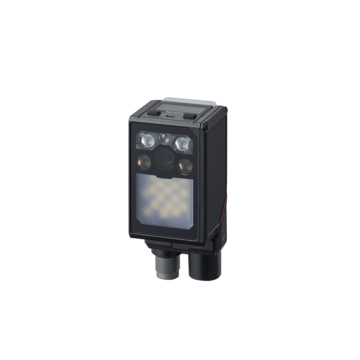
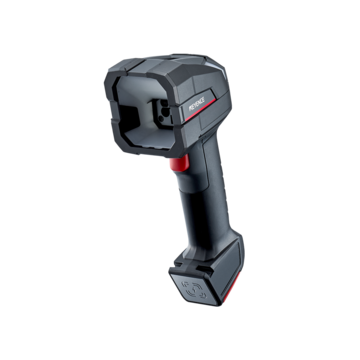
How KEYENCE addresses this: KEYENCE's barcode reader lineup — including its fixed-mount 2D readers and handheld models — supports multi-symbology reading out of the box, decoding common 1D and 2D formats without manual reconfiguration. Many models can also read and distinguish multiple codes within a single frame, which matters if a package or part carries more than one code type.
2. What's your required read range and depth of field?
Read range is the distance between the reader and the barcode; depth of field is the range across which the reader can reliably decode regardless of small distance variations. A reader mounted on a fixed bracket scanning boxes on a conveyor has very different depth-of-field needs than a handheld reader used at arm's length for varying package sizes.
Look for readers that specify depth of field, not just maximum range. A reader that's rated to read at 12 inches but only in a narrow band (say, ±0.5 inches) will require frequent adjustment. A wider depth of field tolerates the natural variation in part height, packaging, or hand positioning.
How KEYENCE addresses this: KEYENCE fixed-mount readers are designed with an emphasis on wide depth of field and field of view, which allows a single unit to cover varying part heights or multiple lanes without repositioning or refocusing every time a product changes. That reduces the number of units needed on a line and cuts down on the fine-tuning required after installation.
3. What environment will the reader operate in?
Environment is one of the most overlooked factors in reader selection. Consider:
- Washdown or wet environments — need an appropriate IP rating (IP65/IP67 or higher) and stainless or sealed housings.
- Dusty or particulate-heavy environments — need sealed optics and enclosures rated for the debris present.
- Extreme temperatures — cold storage and near-oven applications need readers rated for the operating range, not just "room temperature typical."
- Vibration and shock — readers on mobile equipment or high-vibration lines need a housing built to withstand it, not a consumer-grade shell.
A reader that performs well in a lab demo but isn't rated for your actual floor conditions will fail prematurely.
How KEYENCE addresses this: KEYENCE offers barcode readers built for industrial duty, including sealed, high-IP-rated housings for washdown and dusty environments and models rated for extended temperature ranges for cold storage or near-oven use. Application engineers can help match a specific housing and rating to your floor conditions rather than guessing from a spec sheet alone.
4. How will the reader connect to your systems?
Barcode readers rarely operate in isolation — they need to pass decoded data to a PLC, WMS, ERP, MES, or a simple PC application. Common connectivity options include:
- Ethernet/IP, PROFINET, or other industrial protocols for direct PLC integration
- USB or RS-232 for simple point-of-sale or PC-connected setups
- Wireless/Bluetooth for handheld or mobile use cases
Confirm the reader supports the protocol your existing infrastructure uses, and check whether integration requires custom programming or can be configured through built-in software. The fewer custom scripts and middleware layers required, the faster you'll get the system into production — and the fewer points of failure you'll have later.
How KEYENCE addresses this: KEYENCE barcode readers support common industrial protocols (such as Ethernet/IP and PROFINET) alongside USB and serial connections, and are designed to integrate with existing PLCs, WMS, and ERP systems using configuration software rather than custom code. This is intended to shorten the path from unboxing to running production data through your existing systems.
5. How well does it read damaged, low-contrast, or poor-quality codes?
In a controlled test, almost any reader can decode a clean, high-contrast barcode. Real-world performance is determined by how the reader handles:
- Scuffed, torn, or partially obscured labels
- Low-contrast codes (white-on-white, direct part marks on metal)
- Codes printed on curved, reflective, or textured surfaces
- Codes with inconsistent print quality from thermal printers running low on ribbon
This is where decoding algorithm quality — not just optical hardware — makes the biggest difference. Industrial-grade readers typically use more advanced decoding algorithms specifically tuned for damaged or low-quality codes, which translates directly into fewer re-scans and less line downtime.
How KEYENCE addresses this: This is one of the areas KEYENCE emphasizes most in its barcode reader design — decoding algorithms tuned specifically to read scuffed, low-contrast, and direct part marked (DPM) codes on metal, curved, or reflective surfaces. For traceability-critical industries like electronics and medical device manufacturing, this consistency in reading imperfect codes is often the deciding factor over a lower-cost alternative.
6. How fast does it need to decode, and at what line speed?
Decode speed matters most in high-throughput applications — sortation, high-speed packaging lines, or pick-and-pack operations where a single missed read can create a bottleneck. For most manual scanning applications (retail checkout, mobile inventory counts), decode speed is far less critical than read range and depth of field.
Match decode speed requirements to your actual application speed. Buying a reader rated for extreme throughput when your line moves at a moderate pace adds cost without adding value; under-speccing for a fast line creates a chokepoint.
How KEYENCE addresses this: KEYENCE offers barcode readers spanning both high-speed, high-throughput models for sortation and packaging lines and more moderate-speed models suited to manual or lower-volume scanning. Talking through your actual line speed with a KEYENCE application engineer helps avoid paying for throughput capability your process doesn't need — or under-provisioning for a line that will bottleneck.
7. How easy is it to set up, configure, and adjust?
A reader that requires a specialist to focus, aim, or reconfigure every time a product changes creates ongoing labor cost and downtime. Look for:
- Tool-free focus adjustment rather than readers requiring disassembly to refocus
- Intuitive configuration software that line operators or technicians can use without deep programming knowledge
- Auto-sensing or auto-configuration features that reduce manual tuning when switching between products or code types
The easier a reader is to set up and adjust, the less it depends on a single specialist being available whenever something changes.
How KEYENCE addresses this: Ease of use is a core design principle across KEYENCE's barcode reader lineup — many models feature tool-free autofocus and configuration software built to be operated by line technicians rather than requiring a dedicated vision or controls engineer for every changeover. That lowers the ongoing dependency on specialized staff to keep the reader tuned.
8. Does it offer diagnostics and data for troubleshooting?
When a reader starts missing scans, you need to know why — quickly. Readers with built-in diagnostics (read-rate statistics, image capture of failed reads, signal strength indicators) let you troubleshoot the actual cause — a dirty lens, a labeling issue, an alignment drift — instead of guessing.
For traceability-critical applications, this diagnostic data can also support quality audits and root-cause investigations after the fact.
How KEYENCE addresses this: KEYENCE barcode readers commonly include built-in read-rate monitoring and image logging of failed or marginal reads, so a maintenance team can see exactly what the reader saw at the moment of a miss — whether that's a labeling defect, an alignment issue, or lens contamination — instead of troubleshooting blind.
9. What's the total cost of ownership, not just the sticker price?
The reader's unit price is only one line item. Also factor in:
- Cabling, brackets, and mounting hardware
- Software licensing (if required for configuration or data management)
- Installation and integration labor
- Training time for operators and maintenance staff
- Expected service life and failure rate in your environment
- Availability of replacement units and support
A less expensive reader that requires frequent replacement or generates ongoing re-scan labor can cost more over its lifecycle than a higher-quality unit purchased upfront.
How KEYENCE addresses this: Because KEYENCE readers are designed for tool-free setup and minimal ongoing tuning, the labor cost of installation, changeovers, and troubleshooting tends to be lower over the reader's lifecycle — an important consideration when comparing total cost of ownership rather than sticker price alone.
10. What support and warranty options are available?
Barcode readers are often mission-critical — when they go down, a line stops or an order doesn't ship. Before purchasing, understand:
- Warranty length and what it covers
- Availability of technical support and typical response times
- Whether local application engineering support is available for setup and troubleshooting
- Lead time on replacement units if a reader fails
A manufacturer with strong local support and application engineering resources can significantly shorten the time between "something's wrong" and "back in production."
How KEYENCE addresses this: KEYENCE provides direct application engineering support rather than routing customers solely through third-party distributors, which typically means faster access to someone who can troubleshoot a specific reading issue or help validate a reader against your actual parts and labels before purchase.
Bringing It Back to KEYENCE
Every one of the 10 factors above — symbology support, depth of field, environmental rating, connectivity, damaged-code performance, decode speed, ease of setup, diagnostics, total cost of ownership, and support — is a design consideration KEYENCE engineers its barcode reader lineup around. Rather than a single general-purpose reader, KEYENCE offers fixed-mount and handheld 1D/2D barcode readers built for the range of conditions found on real production floors: washdown areas, cold storage, high-speed sortation, and low-contrast direct part marking among them.
The practical benefit of that range is that you're less likely to need to compromise on any one factor above to get acceptable performance on the others. And because KEYENCE provides direct application engineering support, you can validate a reader against your own codes and environment — rather than relying on a generic spec sheet — before making a purchasing decision.
Selecting the right barcode reader comes down to matching the device to your actual codes, environment, and integration needs — not simply choosing the fastest or cheapest option on a spec sheet. If you're evaluating options, consider requesting a hands-on evaluation with your own parts and labels rather than relying on published specs alone.
Frequently Asked Questions
Q What's the difference between a 1D and 2D barcode reader?
A
A 1D (linear) reader can only decode barcodes that store data in a single line, such as UPC or Code 128. A 2D reader can decode both 1D barcodes and 2D symbols like Data Matrix and QR Code, which store more data in a smaller space and are commonly used in manufacturing and traceability applications. Most industrial buyers choose a 2D-capable reader even if current needs are 1D-only, to avoid a future hardware swap.
Q Do I need an industrial-grade barcode reader, or will a commercial one work?
A
It depends on the environment and code quality, not just the industry. If codes are consistently clean, high-contrast, and read at close range in a controlled setting, a commercial-grade reader may suffice. If you're reading damaged labels, direct part marks, or operating in harsh environments (washdown, dust, temperature extremes, vibration), an industrial-grade reader with a sealed housing and advanced decoding algorithms will produce far more reliable results.
Q How important is depth of field compared to maximum read range?
A
Depth of field is often more important for real-world reliability. Maximum read range tells you the farthest distance a reader can decode a code under ideal conditions, but depth of field tells you how much variation in distance the reader tolerates while still reading reliably — which matters more when part height, packaging, or hand position naturally varies.
Q Can one barcode reader handle both 1D and 2D codes, and multiple symbologies within each?
A
Yes. Most current-generation 2D barcode readers are multi-symbology, meaning they can decode a range of 1D and 2D formats without reconfiguration, often auto-detecting the symbology type on the fly. This is worth confirming during evaluation, since older or entry-level models may support only a limited symbology set.
Q What causes barcode readers to miss scans in production environments?
A
The most common causes are low-contrast or damaged codes, insufficient depth of field for the application, poor lighting or reflective surfaces, lens contamination in dusty environments, and misalignment between the reader and the code. Readers with built-in diagnostics can help identify which of these is the actual root cause rather than requiring trial-and-error troubleshooting.
Q How does KEYENCE help evaluate the right barcode reader for a specific application?
A
KEYENCE application engineers can review sample parts, labels, or codes from your actual production environment to assess read rate, depth of field, and decoding reliability before you commit to hardware. This kind of application-specific evaluation is especially useful when dealing with damaged, low-contrast, or direct part marked codes, where performance can vary significantly between reader models.