AI Agents vs. Supported Automation: Why Software Is Only Half the Project
The short answer
AI assistants and agent tools have made it easy to start an automation. They have not made it easy to finish one. Most automation projects stall between a promising first draft and a reliable process: one that runs every day, survives software updates, and can be fixed by someone other than its builder. Automation software that includes hands-on support from a real specialist closes that gap. KEYENCE AI Navigation RPA pairs AI-assisted building with Free Premium Support: a dedicated KEYENCE specialist, at no extra cost, who helps you build, troubleshoot, and improve your automations.
Why are so many teams experimenting with AI agents right now?
General-purpose AI tools can turn a plain-language description into a working draft of a script, workflow, or set of steps in seconds. For an individual trying to save an hour a week, that flexibility is a real win.
The challenge shows up when a team tries to turn that win into an operational process. MIT's 2025 research on enterprise generative AI found that roughly 95% of company AI pilots were not delivering measurable results, and the researchers pointed to a "learning gap" in tools and organizations rather than the quality of the AI itself. Gartner has predicted that over 40% of agentic AI projects will be canceled by the end of 2027 because of escalating costs, unclear business value, and inadequate risk controls.
None of that means AI is the wrong direction. It means the tool is only half the project.
What Does an Automation Project Need Beyond the Software?
The other half is everything that happens after the first draft:
- Mapping the real process. Most business processes have exceptions, workarounds, and steps nobody wrote down. Someone has to find them before the automation does.
- Building for reliability. An automation that fails whenever a screen loads slowly or a file name changes does not save time.
- Fixing it when something changes. ERP updates, new form layouts, and new vendors all break automations. Someone needs to diagnose the problem quickly.
- Making it understandable. An automation that only one person understands becomes an operational risk the moment that person is out or leaves.
- Expanding with confidence. The first automation should lead to the second and third, not to a pile of half-finished experiments.
When this half is left to a busy operations team with no automation background, projects stall. The same MIT research found that AI tools purchased from specialized vendors and built through partnerships succeeded about 67% of the time, while internal builds succeeded about one-third as often.
AI agents vs. supported automation: how do they compare?
| What you need | DIY AI tools and agents | Supported automation (KEYENCE AI Navigation RPA) |
|---|---|---|
|
A fast first draft
|
DIY AI tools and agents
Yes, from a text prompt
|
Supported automation (KEYENCE AI Navigation RPA)
Yes, AI Scenario Generation drafts a scenario from a plain-language description
|
|
Someone who learns your process
|
DIY AI tools and agents
You, on your own
|
Supported automation (KEYENCE AI Navigation RPA)
A dedicated KEYENCE specialist works with you
|
|
Help when it breaks
|
DIY AI tools and agents
Search forums or re-prompt
|
Supported automation (KEYENCE AI Navigation RPA)
AI Troubleshooting plus direct help from your specialist
|
|
Documentation others can follow
|
DIY AI tools and agents
Usually up to you
|
Supported automation (KEYENCE AI Navigation RPA)
AI Documentation explains each scenario step
|
|
Predictable, rule-based execution
|
DIY AI tools and agents
Varies by prompt and model
|
Supported automation (KEYENCE AI Navigation RPA)
Scenarios run the same steps the same way every time
|
|
Cost of expert help
|
DIY AI tools and agents
Often a separate consultant
|
Supported automation (KEYENCE AI Navigation RPA)
Free Premium Support at no extra cost
|
Why does support matter more in the AI era, not less?
As automation tools get more capable, more of the value comes from people who can apply them to processes full of exceptions and workarounds. KEYENCE has built its business on that idea for decades: direct relationships, specialists who visit customer sites, and solutions designed around the problem the customer actually has. Analysts who study KEYENCE often describe it less as a hardware manufacturer and more as a consulting company that delivers its expertise through its products.
AI Navigation RPA applies the same model to software. The AI handles the tedious parts of building. The specialist makes sure what you build fits your process and keeps running.
What does hands-on support look like in practice?
With KEYENCE AI Navigation RPA, support is part of the product rather than an add-on:
-
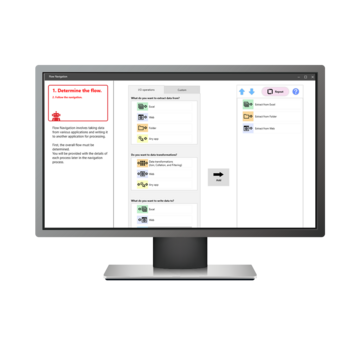
1.Guided first build. Flow Navigation and Smart Process Recording guide you through building, so many teams have a working automation in their first session.
-
2.A dedicated specialist. Instead of a rotating support queue, you get direct access to one KEYENCE specialist who learns your processes and helps you build automations.
-
3.AI assistance on demand. AI Scenario Generation, Optimization, Troubleshooting, and Documentation help between conversations.
-
4.Ongoing improvement. As your processes change, your specialist helps you adjust and expand.
One customer, American Furniture Outlet, reduced a daily task from 45 minutes to under five minutes, saving upwards of 20 hours each month.
Frequently asked questions
Q Can I use AI agents and RPA together?
A
Yes. Many teams use general AI tools for ad hoc, individual tasks and use RPA for repeatable, high-volume processes that need to run the same way every time. RPA is often the more dependable choice for structured work like data entry between systems, report generation, and order processing.
Q Do I need programming experience to use KEYENCE AI Navigation RPA?
A
No. It is a no-code tool with guided building, process recording, and AI assistance, and your KEYENCE specialist helps you through your first automations.
Q Is support really included at no extra cost?
A
Yes. Free Premium Support with a dedicated KEYENCE specialist is included at no extra cost.
Q What happens if an automation stops working?
A
AI Troubleshooting diagnoses errors in plain English, and your specialist is available to help resolve issues so the process gets back up and running.
See the support model in action
Book a virtual demo to see how KEYENCE AI Navigation RPA and a dedicated specialist can help your team build its first automation and keep it running.
Sources: MIT NANDA, "The GenAI Divide: State of AI in Business 2025," as reported by Fortune (August 18, 2025); Gartner press release on agentic AI (June 25, 2025); KEYENCE AI Navigation RPA announcement (April 22, 2026).