Common Static Eliminator Problems (And How to Avoid Them)
Static control systems are installed on manufacturing and production lines to help stabilize product handling, reduce contamination, and prevent damage to sensitive components. When problems appear, the symptoms of static electricity show up in the production process instead of at the static eliminator itself.
Ionizers are installed to help eliminate electrostatic discharges from occurring and to reduce any static charge on the surface of a material. Most static eliminator troubleshooting approaches need to begin with static measurements being taken along the surface of the material where the static discharge occurs. Any voltage in this area can provide more information than sensors alone.
Why Your Ionizer Is Not Neutralizing Static
When an ionizer is not neutralizing static, the issue is rarely due to a simple power failure. Instead, and in most cases, the device remains online; it's just the surface voltage that does not dissipate at the targeted location. This outcome can point to a variety of causes, but commonly, it is due to the type of ionizer not being a good fit for the task.
An offset imbalance can also prevent production lines from becoming neutral. Ionizers only work if they produce a balance of positive and negative output to bring the charged surface as close to zero as possible. As ionizers age or operate without regular static bar maintenance (or go without cleaning), the device may still neutralize some static, but the electrostatic charge will still remain. Even relatively small offset deviations can increase particle attractions or raise the risk of an electrostatic discharge.
The condition of the ionizer can directly influence its ability to help static decay and its ion balance stability. Particulate buildup and vapors from processes can change ion density at the emission point of the ionizer. The result is a reduced efficiency in neutralizing output, and operators may see a drift in performance. This type of industrial static eliminator problem develops over time, which can make it harder to isolate and fix early.
Inadequate grounding can also prevent a full neutralization and is frequently identified during static eliminator troubleshooting. Ionizers generate high voltages from their emitter electrodes, and that ground connection helps stabilize the electric field as it produces ions. If the housing or power supply is mounted to painted steel, anodized aluminum, oxidized hardware, or a non-conductive structure, the electrical connection between the ionizer and grounding point experiences more resistance.
Environmental changes may play a significant role as well. If there are extended periods of low humidity on the production floor, it can slow the rate of decay because ions rely on moisture in the air to form. In areas with extreme climates, a seasonal shift can help explain when an ionizer's performance may appear stable during the spring and fall, but struggle in the winter.
Ionizing Bar Not Working: Causes and Fixes
Static ionizers not working as expected is frequently an issue with where they have been placed on the production line. The distance between the emitter and the charged surface directly affects ion density at the target location. Increasing the distance between the ionizer and where the charge occurs will reduce the speed of neutralization. In high-speed paper sheet or rubber mat production lines, the smallest increases in mounting height can result in product moving through the line while maintaining static electric charge.
Ionizers, at least those that use air for their operation, require an unobstructed airflow to evenly distribute ions. In materials that pass too tightly against a grounded roller or a backing plate while under the bar-type ionizer, the electric field cannot fully defuse the surface of the material. If there is any metal located too close to the emitter, it can distort the field and redirect ions away from the intended target.
The quality and health of the cable also contribute to long-term ionization. High-voltage cables that are exposed to vibrations or mechanical stress are more likely to degrade quickly. Cables may also experience longevity issues if they use connectors that are not seated properly at the power supply, which can introduce an inconsistent power output that appears as intermittent neutralization.
Rapid Static Decay Failure in High-Speed Production
How quickly a production line moves directly influences how long the surface of the materials is exposed to an ionizer. If a sheet of film passes through equipment at 200 feet per minute, it may remain within range for close to a second. However, if that speed is increased to 800 feet per minute, then the exposure window drops to a fraction of that time. If the ionizer's decay rate requires more time than the material receives, the static charges on the surface do not reach neutrality before the next process step. While the ionizer is operational, any material passing under it will continue through the production run with the charge.
High-speed lines are also responsible for generating new static charges throughout production. Whether the material is undergoing tension, is coming into contact with rollers, or being rewound, wherever the material comes into contact with equipment, it can generate an electric charge. This is not an instance of an ionizer failing, merely that rapid static decay has failed.
Changes in material can also reduce the likelihood of static decay. Materials with glossy coatings have higher resistivity, or films with different triboelectric behavior can generate more charges per contact event if the size of the material changes. An ionizer that is built for a narrower material may struggle to fully neutralize a wider product run.
Choosing the Right Static Eliminator for Your Application
The selection of an ionizer should begin with how it is needed to perform. Operators need to consider how quickly voltage needs to be reduced and establish an acceptable residual static electricity level for the specific product.
Airflow conditions also have to be considered, as some environments may not be suitable for all ionizers. Some production lines, like cleanrooms, require an airless solution to help dissipate static electricity from materials. For lines that can use them, the ionizer must have adequate airflow and must be mounted in an area where it can provide consistent coverage of the intended area.
Maintenance Problems with Ionizing Points and Emitter Tips
Emitter tips help determine ion density and keep the ionizer balanced. In molding, converting, machining, and assembly environments, subject emitter tips to particulates that can accumulate and reduce the output over time.
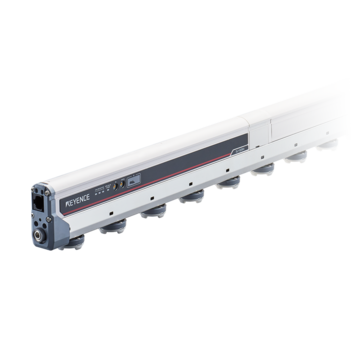
Static eliminator maintenance should include regularly scheduled inspections and cleaning with the power source turned off. Many of the static eliminators by KEYENCE offer a maintenance-free product, but these still need to be checked and evaluated on a regular basis.
Maintenance also has to extend beyond emitter cleaning, as ground connections and mounting hardware have to be inspected regularly to make sure that the ionizers remain online and in working condition; they are subject to more movement through mechanical vibrations and machinery adjustments that can alter or loosen connections, which gradually affects the ionizers' ability to neutralize a static charge efficiently.