How to Select the Right Digital Microscope
Understanding the magnification range, imaging requirements, and inspection needs will help you decide how to choose a microscope for your particular application when it comes to inspection and analysis duties. The proper setup is crucial whether you're measuring tiny parts, inspecting surface flaws, or recording production procedures. The technical factors and useful characteristics that are important to take into account while weighing your alternatives are covered in this guide.
Key Takeaways
- The best digital microscope depends on your inspection needs, magnification range, and imaging requirements.
- A high-resolution digital microscope improves defect detection and quality control accuracy.
- Depth of field plays a major role in capturing clear images of uneven surfaces and complex parts.
- Software automation and reporting tools can improve workflow efficiency and repeatability.
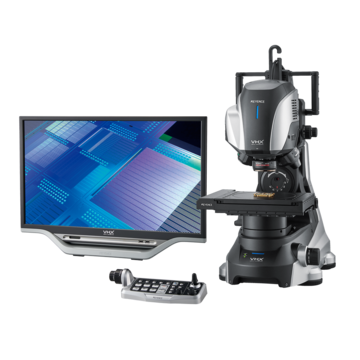
- KEYENCE VHX microscope models combine high image quality, ease of use, and advanced measurement capabilities for industrial applications.
Best Digital Microscope for Industrial Inspection
Knowing your inspection needs is the first step in selecting an industrial digital microscope. Understanding what is needed to properly inspect your samples is critical. Are users microscope experts that can operate more complex microscopes, or is ease of use more important so anyone can use the system? What types of samples are you going to be inspecting? What type of illumination is needed to view your samples? What measurement capability is needed? Considering these questions when selecting the right digital microscope is important.
The most robust digital microscopes can accommodate a variety of samples without requiring ongoing modifications. It shouldn't be necessary to switch equipment or spend hours setting up parts with varying heights, angles, or surface textures. By combining the advantages of digital imaging with strong magnification, digital microscopes provide versatility that is unmatched by conventional optical systems.
It takes more than basic specs to find the best digital microscopes. Even when a system has high magnification, it may not be able to handle real-world samples. Some claim to be simple to use, but they lack the measurement accuracy your applications require. The ideal decision strikes a compromise between workflow integration, functionality, and image quality.
Why Depth of Field Matters in Digital Microscopy
Users of standard microscopes must operate inside a razor-thin focus plane, especially at high magnification. Samples that vary in height appear somewhat blurry, making it difficult to discern important information. This limitation results in incomplete records and impedes inspections.
Depth of field relates to how much of the vertical range or depth of the sample is in sharp focus at once. As users increase magnification, the depth of field decreases, requiring users to constantly adjust focus to properly inspect their sample. Microscopes with a large depth of field allow you to inspect threaded holes, weld beads, and machined surfaces without constantly refocusing. Advanced systems use focus stacking to combine numerous focal planes into a single, sharp image, making it easy for users to clearly inspect their samples.
The ability to stack multiple images together and create a fully focused image enhances productivity. Operators spend less time adjusting the focus and more time evaluating the samples. Every feature is clearly visible, independent of height changes throughout the part. The VHX Series Digital Microscope uses the Depth Composition function to scan a part from the bottom up and create a fully focused image in seconds. So even at high magnification, users can view a sample in full focus.
Camera Quality and Image Clarity Comparison
Image sensors differentiate appropriate systems from extraordinary ones. In addition to resolution, sensor size, dynamic range, and the camera's ability to adapt to different lighting conditions are all crucial. Clean images should be produced by a high-resolution digital microscope at all magnifications.
Certain systems provide high-quality images at low magnification, but as magnification increases, they lose clarity. Others have trouble handling challenging samples like dark polymers and shiny metals. The camera needs to be sensitive enough to capture faint details without producing noise that blurs them out.
Color reproduction is important, especially when recording faults or comparing samples. If an image does not accurately depict what you see, it is not useful for quality documentation or analysis.
Camera quality and lighting capabilities are critical when selecting the right digital microscope. The camera lenses need to be able to provide the right resolution for your sample. Lighting is one of the most important aspects of microscopy, as it strongly determines image quality. There are various types of lighting to choose from, and choosing the right lighting is sample-dependent.
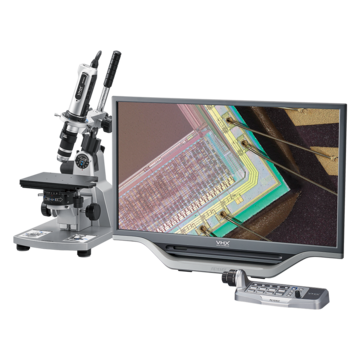
The VHX Series Digital Microscope uses a 4K CMOS image sensor paired with the highest quality lenses to capture images with the highest resolution. The system also allows users to easily adjust lighting and offers several different illumination methods.
Ease of Use and Workflow Efficiency
Users shouldn't need a lot of training to use a digital microscope. Operators are required to capture images, take measurements, and create reports. Having an easy-to-use digital microscope allows operators to inspect samples without consulting manuals or calling for help. The speed at which teams adopt new equipment is directly influenced by interface design.
Intuitive interfaces and automatic features shorten the learning curve. Auto-focus, auto-lighting, and automatic calibration eliminate the factors that impede traditional microscopy. Understanding the key distinctions between microscopes allows you to better match technology to your workflow.
Systems that integrate with current processes provide benefits beyond their solo capabilities. Can photos be exported to your quality management software? Is the system generating reports in the formats that your team is already familiar with? These questions determine if a microscope will improve processes or introduce new bottlenecks.
Key Factors to Consider When Choosing a Digital Microscope
Whether a system meets your needs depends on several technical parameters. Creating a checklist based on your real inspection requirements—rather than theoretical capabilities—is the first step in selecting a microscope.
Describe the most typical inspection duties first. Which sample sizes do you deal with? What is the required resolution? How frequently will comparable components be measured again? Compared to generic feature lists, these questions will help you define your requirements more explicitly.
The overall cost of owning a microscope is just as important to consider as the initial cost of purchase. A less expensive system that needs to be recalibrated frequently, produces inconsistent results, and limits your inspection capabilities can wind up costing more in terms of lost productivity than making a larger initial investment in more reliable equipment.
Magnification Range and Measurement Needs
The magnification range directly influences what you can inspect. Low magnification (20x-100x) is ideal for general part examination and large flaw identification. The majority of quality control applications benefit from mid-range magnification (100x to 500x). Microstructural characteristics and small flaws are revealed under high magnification (500x or more).
Being able to easily change magnification is important when considering daily usage of the system. If your inspection needs have a wide range of part sizes, users might need to switch from low to high magnification frequently. Consider the magnification range that a microscope offers and how often you will need to change objectives to get your required magnification. Systems with integrated lenses that allow you to automatically switch from low to high magnification are great choices for operators with a wide variety of samples. How easy is it to change magnification? Will you need to manually change lenses, or can this be done automatically? Does the system offer the magnification you need to view your target area?
If you need to capture accurate measurements with a microscope, this should be considered in your evaluation. Certain inspections just require visual verification. For others, accurate measurements are required, and being able to verify calibration is needed. Consider what measurement accuracy is needed for your work and what microscopes can verify to that degree. Another aspect to consider is the type of measurement required. Can the microscope capture 2D measurements? 3D measurements?
High-Resolution Imaging for Quality Control
A digital microscope for quality control must offer consistent, reproducible results. Operators should obtain comparable photos and measurements of the same feature regardless of who is conducting the inspection or when it occurs.
For comparative quality assessments, lighting homogeneity is very important. Compared to halogen bulbs, which have a tendency to wander over time, LED lighting systems have a longer lifespan and a more consistent output. With programmable lighting, you can eliminate guesswork by storing the optimal settings for each type of sample.
The establishment of reference libraries, which promote quality initiatives, is facilitated by image preservation and retrieval capabilities. When a problem occurs, you can quickly compare it to good components or prior failure situations. Corrective action and root cause analysis are made easier by this contextual information.
Software, Automation, and Reporting Features
The software determines how efficiently you can use the hardware. An easy-to-use software determines if even a novice microscope user can capture high-resolution images and accurate measurements. Consider the advantages provided by the microscope's software and whether that will work for your team. What automations can be done with the software? How easy is the software to use? Does the software save image and measurement data that can be placed into a report easily?
Microscopes with software that allow users to document their inspections by saving images and measurement data save time. Systems that automatically complete reports with images, measurements, and pass/fail results reduce the need for manual data entry. Templates allow for consistency in documentation between operators and shifts.
KEYENCE's VHX-X1 Digital Microscope provides high-end capabilities in a small, easy-to-use package. The easy-to-use interface allows operators to streamline inspection by automating XYZ movement, imaging, lighting, measurements, and more.
Frequently Asked Questions
Q What is the best digital microscope for industrial inspection?
A
The ideal microscope type depends on your specific requirements, but your organization should seek systems with a wide magnification range, outstanding depth of field, intuitive software, and reliable measurement tools. The KEYENCE VHX microscope platform enables these capabilities with minimal training. The VHX microscope has been utilized by over 20,000 companies worldwide because of its easy-to-use interface combined with advanced imaging, lighting, measurement, and automation capabilities.
Q What features should a high-resolution digital microscope include?
A
A high-resolution image sensor, a wide magnification range, adjustable LED lighting, greater depth-of-field capabilities, and calibration-traceable measurement software are among the top features. Automated features decrease operator variability and improve repeatability.
Q How do digital microscopes improve quality control processes?
A
They accelerate inspection procedures, improve flaw identification through enhanced imaging, ensure reliable measurement repeatability, and simplify documentation with automated reporting. A digital microscope can also reduce operator fatigue when compared to traditional eyepiece-based inspection methods.
Q Is KEYENCE the best overall choice for digital microscopy?
A
KEYENCE systems excel in combining picture quality, usability, and workflow integration for industrial applications. The VHX series digital microscope offers capabilities that address major pain points in manufacturing inspection: an easy-to-use interface, automation capabilities, a 4K resolution CMOS image sensor, superior lenses, a large depth of field, and 2D/3D measurements.