SEM vs Optical Microscope: What's the Difference?
Scanning electron microscopes (SEMs) and optical microscopes are powerful imaging tools designed for different applications. Optical microscopes use visible light and glass lenses to magnify specimens, making them ideal for observing live samples, biological tissues, and routine laboratory analysis. In contrast, SEMs use a focused beam of electrons to produce highly detailed images of a sample's surface, offering significantly higher magnification, resolution, and depth of field. Understanding the differences between SEM and optical microscopes—including their imaging methods, sample preparation requirements, and typical applications—helps researchers, engineers, and manufacturers select the most appropriate tool for their analysis needs.
Choosing between an SEM vs optical microscope comes down to what you need to see. Both tools magnify samples so you can study things the naked eye can't catch, but they work in very different ways. Optical microscopes rely on visible light and glass lenses, while scanning electron microscopes fire a beam of electrons at a sample to build an image. That single difference shapes everything else: magnification range, resolution, cost, and the prep a sample needs before you can look at it.
Key Takeaways
- Optical microscopes use visible light, while SEMs use a focused electron beam to generate images.
- SEMs provide much higher magnification and resolution, allowing users to observe microscopic surface details beyond the capabilities of optical microscopes.
- Optical microscopes are ideal for routine inspections, while SEMs are best suited for detailed surface analysis and material characterization.
- Sample preparation differs significantly, as SEMs often require conductive coating and operation in a vacuum, whereas optical microscopy typically requires minimal preparation.
- Choosing between an SEM and optical microscope depends on the sample, desired image quality, analysis requirements, and application.
What Is an Optical Microscope?
An optical microscope, sometimes called a light microscope, uses lenses and visible light to enlarge a sample so your eye (or a camera) can view small features.. Light passes through or bounces off the sample, then travels through glass lenses that bend and focus the light. This design has been around for centuries, and it's still the go-to choice in classrooms, clinics, research and development, and quality control labs because it's fast, affordable, and gentle on the sample.
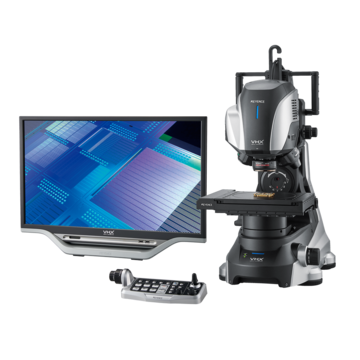
You can observe samples without much setup. KEYENCE's line of digital microscopes builds upon this by pairing optics with digital sensors for higher resolution images and an easy-to-use interface with measurement and analysis capabilities.
What Is a Scanning Electron Microscope (SEM)?
A scanning electron microscope skips light altogether. It scans a sample with a narrow beam of electrons inside a vacuum chamber. When those electrons strike the surface, they knock loose secondary electrons, and a detector picks up the pattern to build a picture. Because electron wavelengths are so much shorter than light wavelengths, an SEM can resolve details a light-based system simply can't reach. SEMs also have the ability to detect what materials a part is made of. A specialist is usually needed to operate a SEM because of the sample preparation required and setting up the correct capture settings.
An SEMs ability to capture details that optical microscopes miss make it a favorite for engineers and researchers who need to inspect fracture surfaces, coatings, identify materials, or tiny particles up close. Learn more about how the technology works on our SEM overview page.
SEM vs Optical Microscope: Key Differences
The gap between an optical microscope vs SEM starts with the imaging source. Light versus electrons sounds like a small detail, but it drives nearly every other difference on this list. Optical systems max out around 1,000 to 2,000 times magnification before the image blurs. SEMs push well past that, often reaching magnifications in the hundreds of thousands. Optical microscopes also produce color images right away, since they capture the natural color of the sample.
SEM images come out in grayscale because electrons carry no color information; any color in an SEM photo has usually been added afterward for clarity. Cost and footprint differ too. A basic optical microscope sits on a benchtop and costs between a few hundred dollars to a couple hundred thousand, while an SEM needs a dedicated room, a vacuum pump, and a much larger budget.
Comparing Magnification, Resolution, and Imaging
Beyond the broad strokes, a few specific factors separate these two tools in daily use.
Magnification Capabilities
Optical microscopes are limited by the wavelength of visible light, so there's a ceiling on how far they can magnify before the picture loses clarity. Most lab-grade units top out well below what an SEM offers. An SEM isn't bound by that same limit, so operators can magnify features measured in nanometers rather than microns.
Resolution and Image Quality
Resolution describes how well a system separates two points sitting close together. Optical microscopes typically resolve down to around 0.5 microns. SEMs can resolve features under 10 nanometers, sometimes far less. That gap matters when you're checking weld seams, semiconductor layers, or fiber coatings for flaws a light microscope would blur together.
Sample Preparation Requirements
Optical microscopy is forgiving as there is not much sample prep needed. Optical microscopes, like KEYENCE's VHX Series, allow users to just place a sample on the stage and start imaging immediately. Scanning Electron microscopes require significant sample preparation. Non-conductive samples usually need a thin metal coating, such as gold or platinum, so the electron beam doesn't distort the image. The sample also sits inside a vacuum so the sample size is limited. That extra prep takes time, but it's what lets the SEM deliver such sharp surface detail.
Common Applications for SEM and Optical Microscopes
Optical microscopes show up in R&D, quality, and failure analysis labs - anywhere someone needs to quickly check a part. Manufacturing floors also lean on optical and digital microscopes for quick part inspection, since they're fast and need no special training.
SEMs, on the other hand, tend to be used in research facilities, semiconductor plants, and forensic labs. Engineers use them to study fracture patterns in metal, examine coatings at the nanoscale, or verify that a microchip's circuitry meets spec. The difference between SEM and optical microscope applications comes down to scale. Need to see a whole cell dividing? Light works fine. Need to trace a fracture line atom by atom? Only an SEM gets you there.
How to Choose the Right Microscope
Start with the question you're actually trying to answer. If you need color, high resolution imaging at lower magnification, or a fast daily inspection routine, an optical or digital microscope will likely cover it, and it costs far less to buy and run. If your work demands nanometer level detail or elemental analysis, a scanning electron microscope vs optical microscope comparison usually tips toward the SEM despite the higher price and slower workflow.
Budget, sample type, and turnaround time are all factors to consider when determining if a SEM or optical microscope is best.. Some labs keep both tools on hand, using the optical microscope for routine screening and saving SEM time for samples that need a closer look. For teams wanting strong optical performance with digital flexibility, KEYENCE's VHX-X1 series is worth a look, it's an optical microscope that is easy to use and can capture high resolution images from 5x to 6,000x magnification.
Frequently Asked Questions
Q When should you use an SEM instead of an optical microscope?
A
When deciding between an SEM vs optical microscope, reach for an SEM when you need very high magnification or fine surface detail that light microscopy can't capture, such as inspecting a weld fracture or a coating layer at the nanoscale. If you need elemental analysis, an SEM would be the right choice. If you have a KEYENCE VHX Series Digital Microscope with the elemental analysis capability - that may be the right choice vs an SEM but it depends on the type and quantity of elements.
Q Can an optical microscope achieve the same magnification as an SEM?
A
No. Optical microscopes are limited by the wavelength of visible light, which caps magnification well below what an SEM can reach.
Q Which microscope is better for material analysis?
A
It depends on the detail you need. For surface texture, microscopic defects, or material identification, an SEM usually gives clearer answers. For general structure or color-based inspection, an optical microscope often does the job faster.
Q What industries use SEM and optical microscopes?
A
Many different industries use SEMs and optical microscopes - some labs have both types of microscopes. It all depends on what the microscopes are being used for. Many manufacturing companies lean on optical microscopes for routine inspections. Some companies in the aerospace, semiconductor, and material research fields need to use an SEM for more detailed surface and elemental analysis.