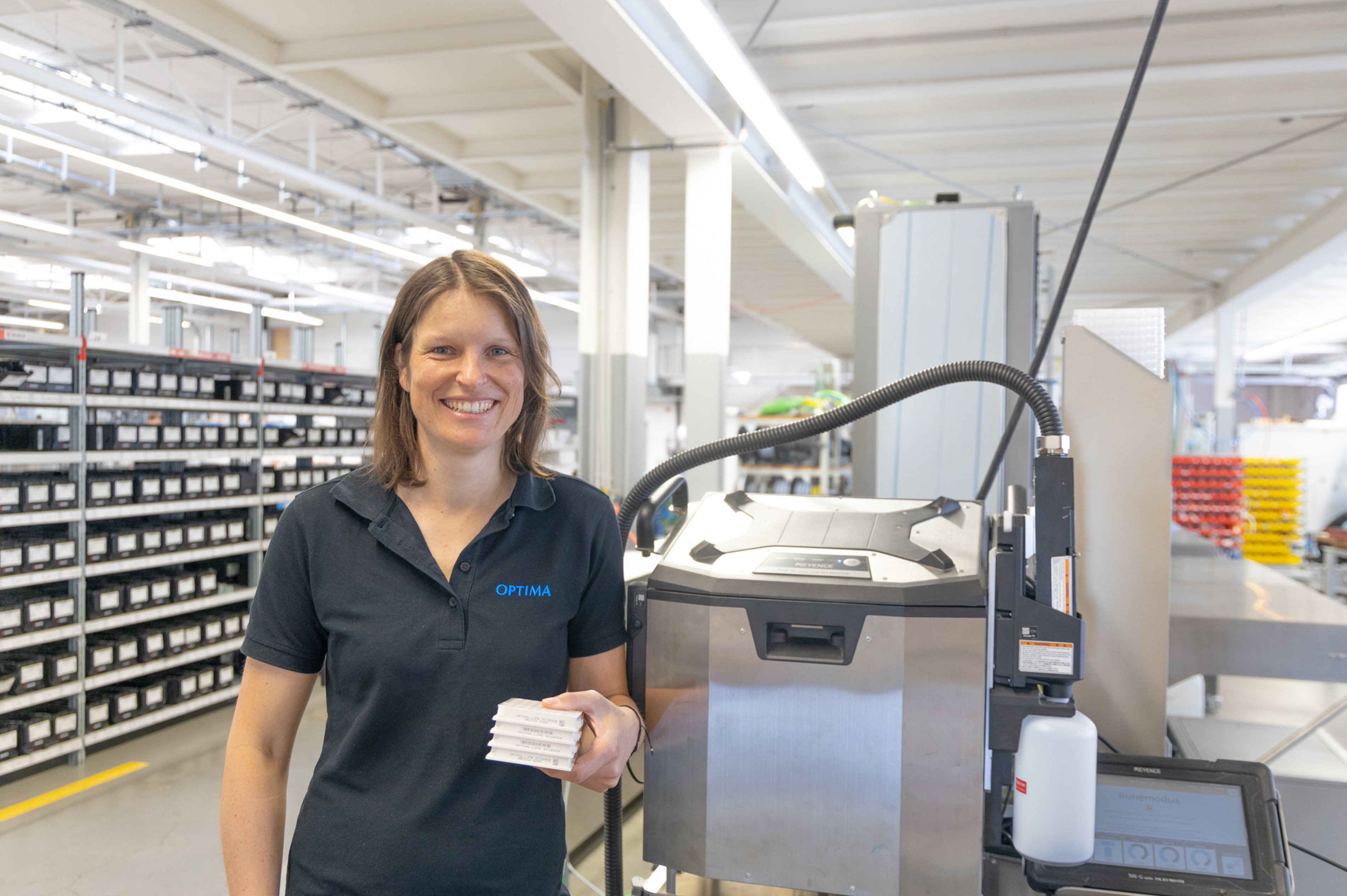
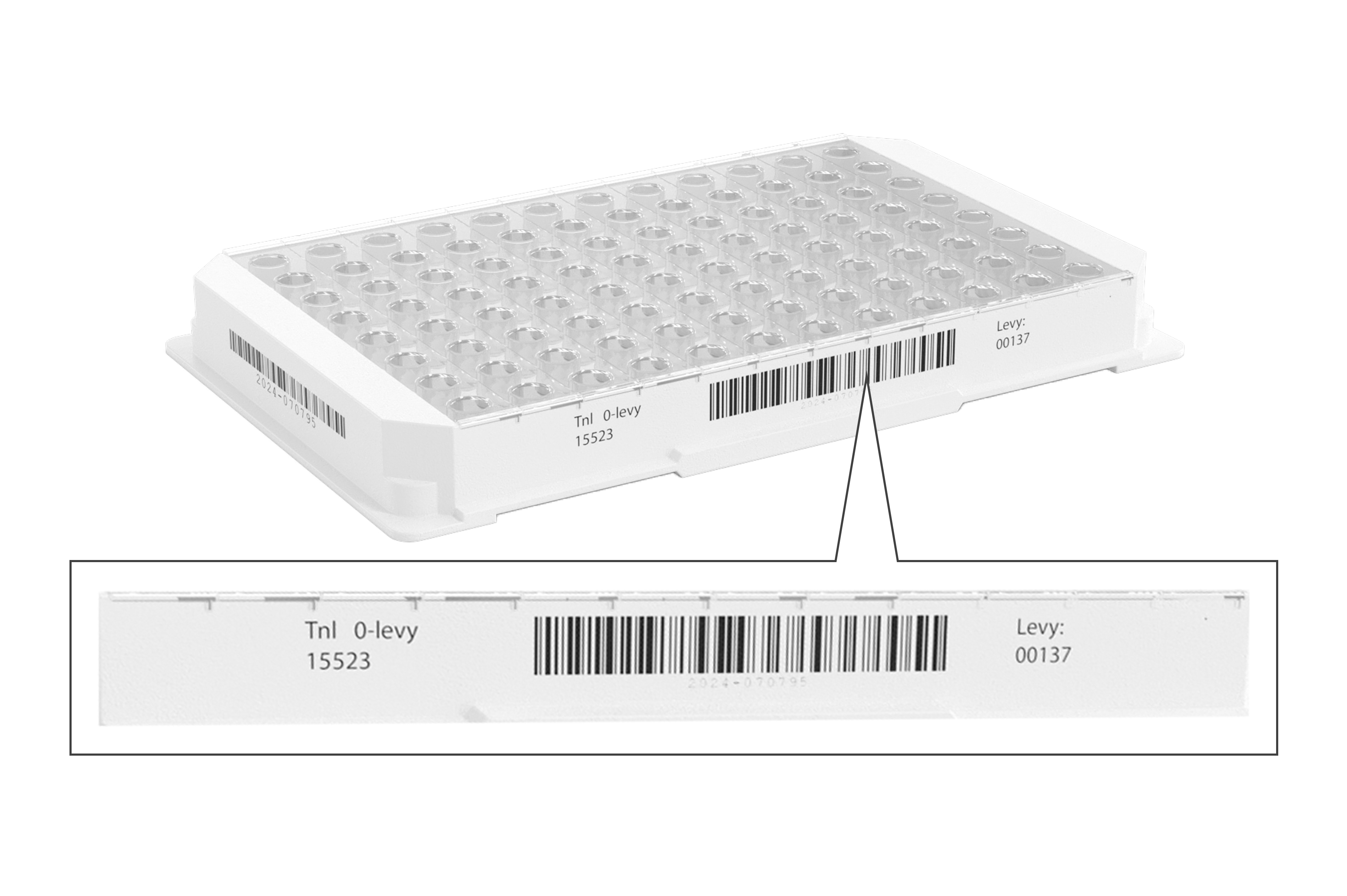
The Optima Group builds flexible and customized filling and packaging systems for demanding and sensitive goods. In the diagnostics division at the Schwäbisch Hall site, the continuous inkjet printer from the KEYENCE MK-G Series has now become the standard system for marking: It marks microtiter plates with batch numbers, barcodes, or logos according to customer requirements. The decisive factors for this were fully automatic cleaning, low-maintenance operation, and a print layout that can be easily adapted to the requirements of end customers.
Key Points in Brief
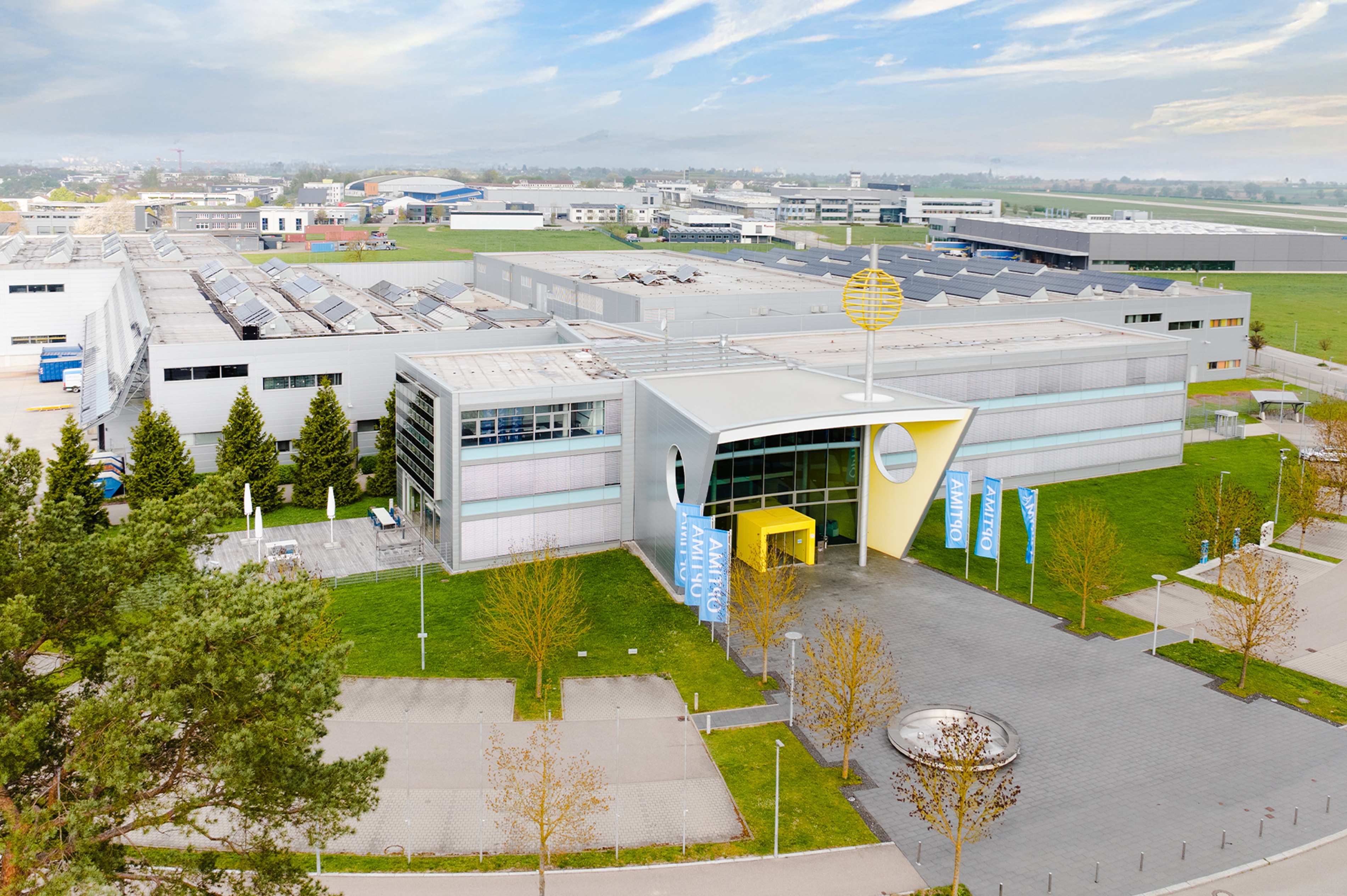
- The Optima Group specializes in flexible and customized filling and packaging systems for demanding and sensitive goods such as pharmaceuticals, hygiene and medical products, food, or cosmetics. The shared mission is “We care for people”.
- In the diagnostics division at the Schwäbisch Hall site, the continuous inkjet printer from the MK-G Series has now become the standard system and marks microtiter plates with batch numbers, barcodes, or logos according to customer requirements.
- Previously, a system from another provider was used that could not provide the required flexibility. The goal was to provide Optima’s customers with a fully automatic and low-maintenance marking solution—implemented with the MK-G1000.
- With smaller production volumes, longer downtimes occur, during which the ink previously often dried in the lines. The integrated, fully automatic cleaning function of the MK-G counteracts this, so that the system remains ready for operation even after longer breaks.
- Because ink lines and the print head are cleaned automatically, many maintenance tasks become unnecessary; a nozzle can be replaced by the user using simple instructions. This ensures high machine availability and a significant cost reduction.
- The MK Touch Panel is described as intuitive to operate and guides users step by step through the settings—even without technical knowledge.
ChallengeWhat triggered the system change?
With digitized system solutions, global service, and high engineering expertise, the Optima Group delivers efficient production processes for its international customers. In the diagnostics division at the Schwäbisch Hall site, this includes the marking of microtiter plates—with batch numbers, barcodes, or logos depending on customer requirements. Marking is therefore not a peripheral issue, but part of what the system must deliver for the end customer.
Before the MK-G, a system from another provider was used, but it could not offer the required flexibility. Two points were particularly important. The first concerns process availability: especially with smaller production volumes of microtiter plates, there are always longer downtimes during which the inkjet printer is not used. Until now, this often led to the ink drying in the lines—with corresponding effort before production could resume.
The second point concerns maintenance. This had also been a major problem; frequent visits by service technicians were to be avoided as much as possible. Operation was a further issue: because Optima’s end customers have different requirements for the print layout, the printing system had to be adaptable—before KEYENCE, however, changing the settings involved a lot of effort.
SelectionWhy choose the MK-G?
These experiences resulted in a clear objective: Optima wanted to provide its customers with a fully automatic and low-maintenance marking solution. So the company was not looking for a printer that works well in an ideal scenario, but a system that can also cope with changing production periods, smaller batch sizes, and different print layout specifications.
High process availability was accordingly a central requirement for Optima’s new printing system. The continuous inkjet printer of the KEYENCE MK-G Series meets these requirements via an integrated, fully automatic cleaning function that counteracts the drying of the ink in the lines. The solution was implemented with the MK-G, which has since been used as the standard system in the diagnostics division at the Schwäbisch Hall site.
ResultsWhat has changed in operation and maintenance?
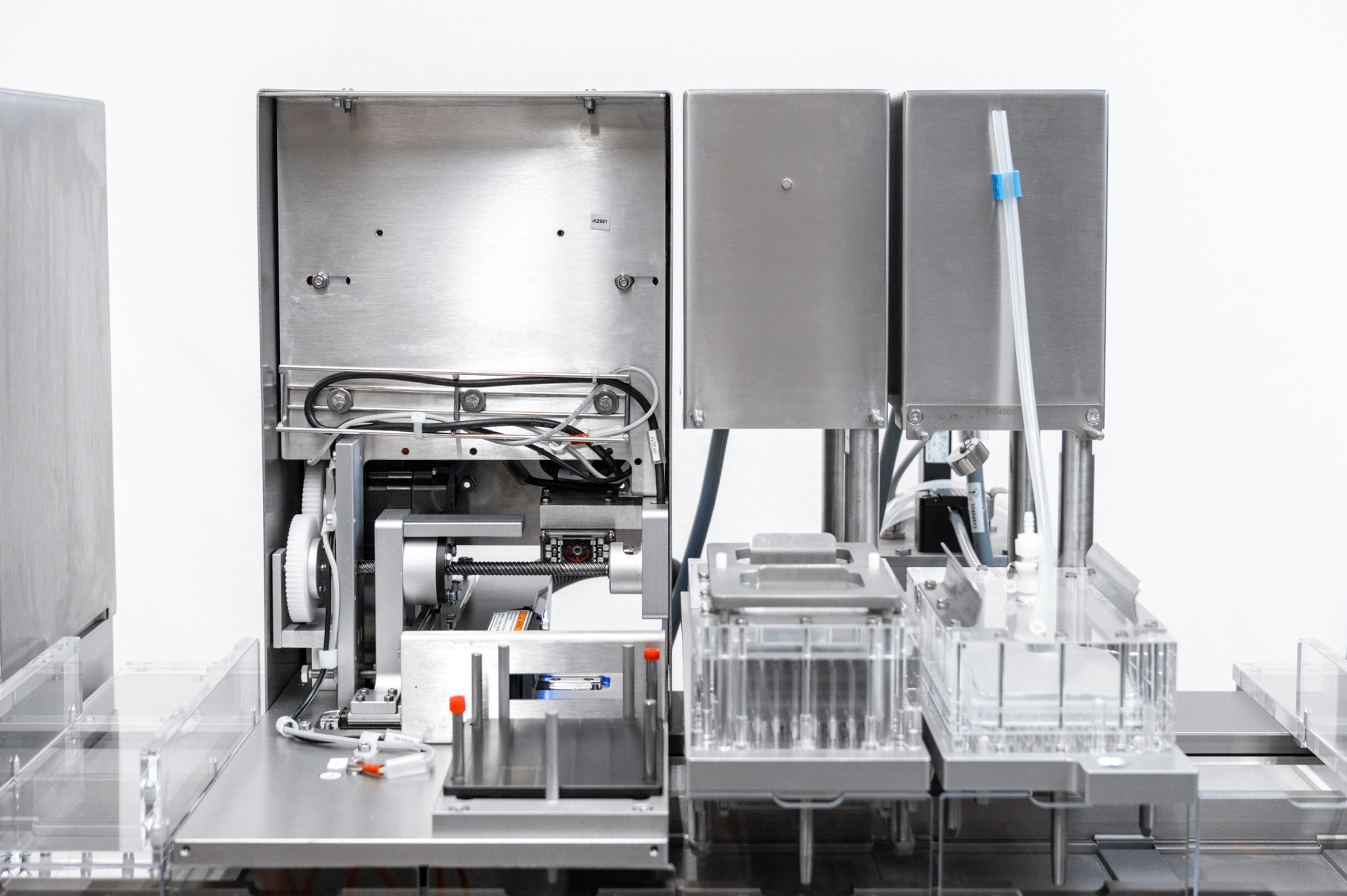
The most visible effect concerns downtimes. Because cleaning is fully automatic, the system remains ready for operation even after longer breaks and can be seamlessly integrated into changing production periods. For a production facility where microtiter plates are produced in smaller quantities, this is the decisive difference: the printer does not have to be brought back into an operational state before the next production run can begin.
The same mechanism works for maintenance. The MK-G automatically cleans the ink lines and the print head, making many maintenance visits unnecessary. Nevertheless, the device is designed in such a way that, for example, a nozzle can be replaced by the user with the help of simple instructions—so the team does not have to rely on a service technician for every task. In the long term, this not only ensures high machine availability, but also a significant cost reduction.
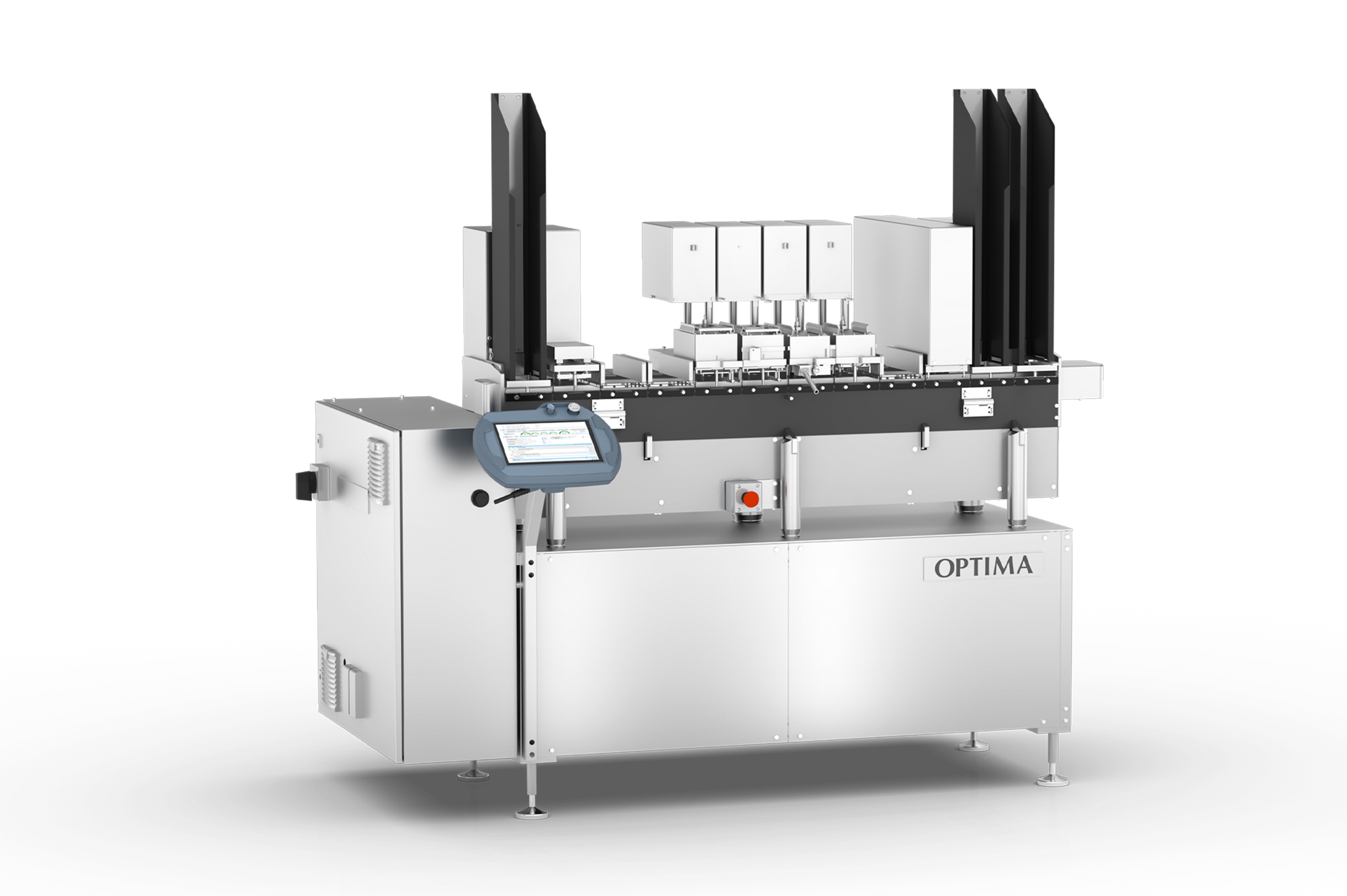
The third point is operation. Flexibility was required here as well, not just for cleaning, because Optima’s end customers have different requirements for the print layout. Where changing the settings used to involve a lot of effort, end customers now have a high degree of design freedom.
“The MK Touch Panel is intuitive to operate and explains everything step by step—even without technical knowledge.”
— Christine Lüdeke, OPTIMA life science GmbH
OutlookWhat does the standard use of the MK-G mean for Optima’s customers?
The fact that the MK-G is now used as the standard system in the diagnostics division at the Schwäbisch Hall site is the actual result of this project: marking is no longer a special case that has to be solved anew for each system, but an established component of the systems that Optima builds for its international customers.
For end customers, this means a marking solution that cleans fully automatically, requires little maintenance, and can be adapted to their own specifications for batch numbers, barcodes, or logos via the MK Touch Panel. In this way, marking contributes to what Optima wants to achieve for its customers with digitized system solutions, global service, and high engineering expertise—and to the shared mission “We care for people”.
Frequently Asked Questions (FAQ)
QWhat does OPTIMA life science GmbH use the MK-G continuous inkjet printer for?
A
In the diagnostics division at the Schwäbisch Hall site, the MK-G marks microtiter plates with batch numbers, barcodes, or logos depending on customer requirements. The printer is now in use there as a standard system and works in the filling and packaging systems that Optima builds for its international customers.
QWhy did Optima choose the MK-G from KEYENCE in the diagnostics division?
A
Previously, a system from another provider was used, but it could not offer the required flexibility. The goal was to provide Optima’s customers with a fully automatic and low-maintenance marking solution. The MK-G from KEYENCE meets exactly these requirements.
QHow does the MK-G prevent the ink from drying during longer downtimes?
A
Especially with smaller production volumes of microtiter plates, there are always longer downtimes during which the inkjet printer is not used. The MK-G has an integrated, fully automatic cleaning function that counteracts the drying of the ink in the lines. As a result, the system remains ready for operation even after longer breaks.
QHow low-maintenance is the MK-G during operation?
A
The MK-G automatically cleans the ink lines and the print head, making many maintenance visits unnecessary. Nevertheless, the device is designed in such a way that, for example, a nozzle can be replaced by the user with the help of simple instructions. In the long term, this ensures high machine availability and a significant cost reduction.
QHow flexibly can the print layout be adapted with the MK-G?
A
Optima’s end customers have different requirements for the print layout. Before the KEYENCE system, changing the settings involved a lot of effort; with the MK-G, end customers now have a high degree of design freedom and can have batch numbers, barcodes, or logos applied according to their own specifications.
QHow does OPTIMA life science GmbH rate the operation of the MK-G via the MK Touch Panel?
A
Christine Lüdeke, Product Manager at OPTIMA life science GmbH, describes the MK Touch Panel as intuitive to operate: It explains everything step by step—even without technical knowledge. This allows the printing system to be set up even by users who are not specialists in marking technology.