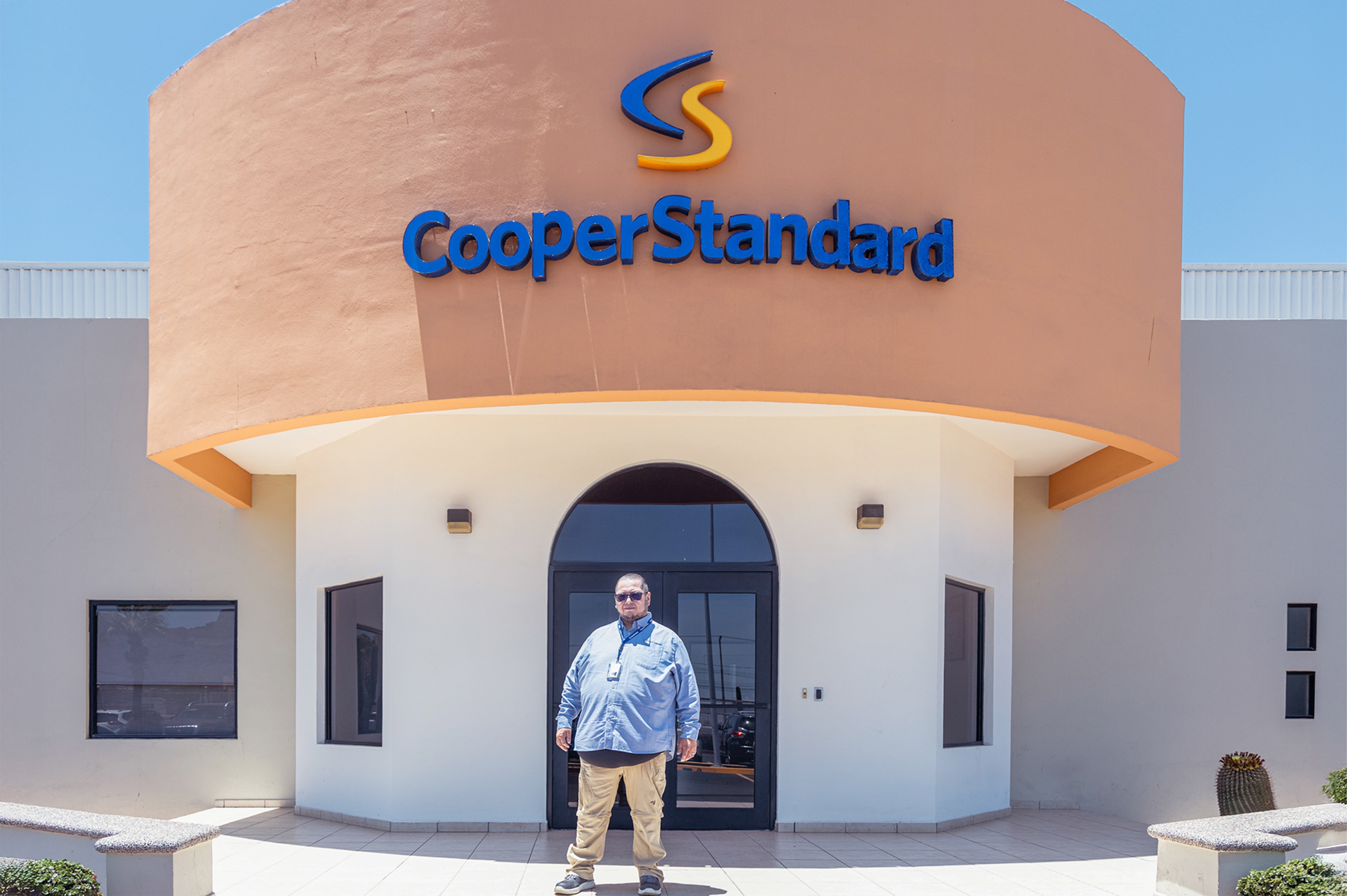
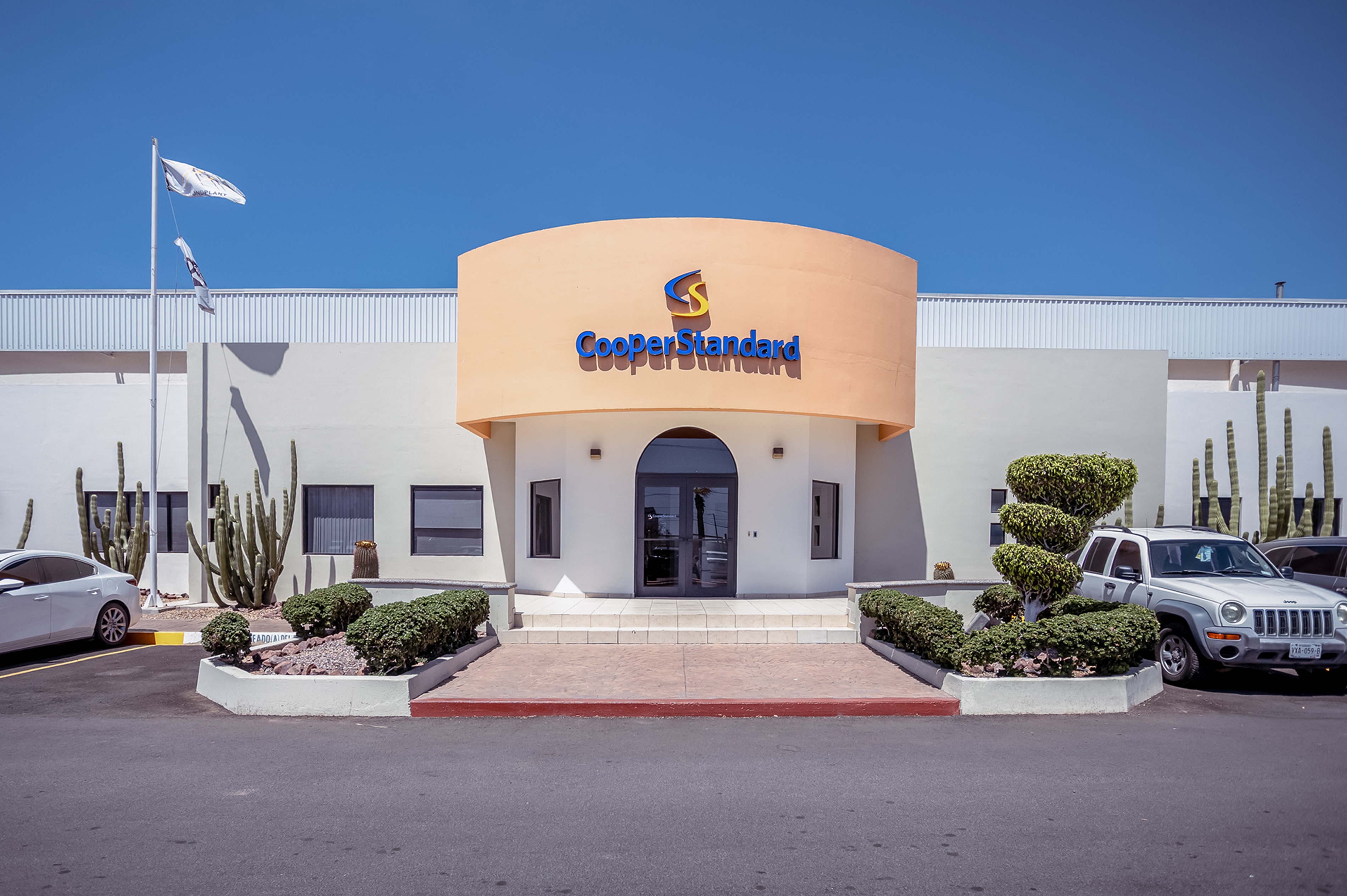
At the Cooper Standard plant in Saltillo, Mexico, the machines that manufacture coolant, gasoline, and brake lines have been working for years, and most of them predate the idea that one day a customer would ask to know exactly when, by whom, and under what conditions a part was produced. Today, all customers ask for it. Martín, who provides technical support to Cooper Standard plants in Mexico and abroad, explains how a KEYENCE KV Series controller became a master PLC that extracts information from machines of any brand and age, writes it to a SQL database, and satisfies an IT department that does not let just any device near the network.
The Project at a Glance
- The Cooper Standard plant in Saltillo produces fluid lines—coolant, gasoline, and brakes—on machines that are mostly old, independent of each other, and were never designed for data acquisition.
- Today, customers demand traceability for each part: manufacturing date and time, operator, and process values, such as the leak test result or the applied torque.
- A KEYENCE KV Series controller was configured as a master PLC, which acquires information from all machines and sends it via SQL to a database on the server.
- Old PLCs, new PLCs, and controllers of all brands in the plant were linked using the KV Series Ethernet communication unit, regardless of the protocol.
- Since the information leaves the production floor, the controller also had to pass the plant’s cybersecurity review—certificates, username and password, defined access—which the KV Series passed.
- Hourly counts that were previously written on whiteboards are now recorded automatically, along with the reason for each stoppage, giving the plant reliable efficiency and quality metrics; today, the site operates around 34 machines with KV controllers.
ChallengeWhy couldn’t a plant full of older-generation machines prove how a part was made?
The Cooper Standard plant in Saltillo manufactures fluid lines: coolant, gasoline, and brake lines. Each of these products goes through a series of machines that, for the most part, operate as islands. “That plant has different products, all of them are fluid lines,” explains Martín. “What was involved was a process where all the machines are independent, and we needed to have the information from those machines and the process generated with the part.”
The reason is straightforward, and it is the same one that any automotive supplier hears from their customers today. If a question arises about a part tomorrow, the plant must be able to tell when it was manufactured, on what date, by which operator, and what the process parameters were: the leak test value, for example, or the applied torque. “You pick up a part and you want to know when it was made, at what time it was made, and what the results were. That is precisely what we wanted that application for.”
The obstacle was the age of the equipment. Traceability is a recent requirement; the machines are not. “Nowadays, all customers want traceability. But what happened 15 or 20 years ago? Most of the machines I have in those plants are already old, so they don’t have that system.” Any solution the plant adopted had to be backward-compatible: it had to integrate equipment that was never designed to be part of a traceability system.
“We needed to involve something that would give us the convenience of pulling the information, saving it, and also presenting it to the customer. It has already been sold to the customer, and they are very happy with the system, with saving and having the information. And besides, nowadays we also have new customers who, from the very first part we manufacture with them, already request to have that information.”
There was a second condition, and Martín is emphatic about it. Sending information from the production floor to a company server is not a decision made solely by the control department. “Another thing that is also very important: that it complies with cybersecurity. That is a very important point. You cannot connect just any device to the internet, you cannot connect just any device to the server.” The control department had to involve the IT department, and both had many discussions before finalizing the choice. “To be able to do that installation, we first have to check that it complies with security certificates, and that it has a username, password, and who will be able to see the information, because at the end of the day, that information belongs to us and the customer.”
SelectionWhy did KEYENCE’s KV Series win the controller evaluation?
Martín has been in manufacturing for more than two decades, mostly in Japanese-owned plants, and had worked with KEYENCE equipment long before joining Cooper Standard. That did not spare the KV Series from an evaluation. Technical proposals arrived from several brands and were compared side-by-side.
“There were very high prices, and there were machines that may have been very capable but whose cost we couldn’t absorb because the initial cost was going to be paid by the plant, not by the customer,” he points out. “So we decided, based on all the reviews, to choose KEYENCE for its capability, price, and the advantages it offered us.”
What separated the finalist options, in the end, was not the hardware. It was what came with it. “In addition, there was one thing that was very important: the technical support and training they provided us. So that inclined us to choose KEYENCE.” The point is as much commercial as it is technical, because the cost of a controller is not just the cost of a controller: it is the cost of every engineer who will ever have to open it.
“There is one thing that is also very important: that we don’t buy things and then get abandoned. We look for them to give us support, to teach us to do things well. And something I really like about KEYENCE is that you don’t have to pay for the training.”
Software licensing followed the same logic. A powerful processor is of little use, Martín points out, if every department that needs to connect to the machine represents another license: “you’ve already bought another PLC almost with just the licenses.” Since the tools needed to configure and control the KV Series did not involve an additional license cost, maintenance and control personnel were able to work on the same equipment. “If you have all the tools to be able to configure and control it, that solves it. So that was the first reason I said: ah, well, with KEYENCE.”
At first, there were some concerns from the floor personnel who were not yet familiar with the KV Series, but today the control departments in Saltillo and Torreón are very committed to it. “We learned many things. In fact, today those control departments have matured a lot thanks to everything they have learned this way.”
ResultsWhat changed when the whiteboard was replaced by a live database?
The architecture built by the team is simple to describe and does a tremendous amount of work. A KEYENCE controller was designated as the master. “We took one of your PLCs and turned it into a master PLC. And that master PLC is in charge of acquiring all the information from all the machines. But we didn’t want to leave it at that. From there, we communicate with a server and are sending all the information via SQL to a database.”
Reaching each machine meant reaching each protocol. Some of the controllers on the floor are decades old; others are current; they come from several different manufacturers. “We linked very old legacy PLCs, new PLCs, PLCs of all brands, thanks to the KV Series Ethernet unit. We linked all that information, and whatever the communication protocol, we connected.”
Before the project, the production record was a whiteboard and a marker. It is worth quoting Martín’s description in full, because it explains precisely why that information could never be reliable: “Every hour: ah, I made 20 parts. This hour I made 5 parts. I went to lunch, came back and it took me 10 minutes longer, ah, 3 parts. Or: I called maintenance and it took them so long to arrive, ah, 5 minutes. So we couldn’t have a person doing all that and have it be reliable.”
Now the machine reports itself. When it stops working, it says so. When the operator needs maintenance, material, or a quality check, the request is raised from the machine, and the time of that request is recorded along with everything else. The team integrated the alarms into a plant-wide Andon, and every event flows into the same SQL database.
“I have my normal hour-by-hour production and I also know why I stop, and without having to go to a computer or grab a radio or look for a cell phone to call the departments, I start addressing the problem right there. What for? So that we have precise data on when we stopped, why we stopped, and it helps us a lot to get the metrics. That has been very good for analysis.”
Those metrics cover both efficiency and quality. A leak test must give a result; torque must reach a specified value; both are now in the record along with the time data. And since the figures come directly from the equipment and not from a person’s memory, they carry a weight that a whiteboard never had. “We made a global system like an Andon, where we can see all the alarms from all departments, but at the same time we send it to the database and we already have transparent times. Everything that arrives comes directly from the machine.”
The final piece was visibility, and it came from a function that the team did not expect to use as much as it does. Typing the controller’s IP address into a browser opens the screens designed by the team itself. “If you develop your own screens, you get that for free: you can set up a dedicated screen to view a process and jump to another screen to see something else, or jump to another screen where you can see your efficiency.” The manager and the support engineer can monitor the same line at the same time, and even write and read machine information while doing so. The format is not fixed: “if the manager says: no, I want it this way, it can be modified. I want this number here, I can put it there.” The team also enabled access from mobile phones.
“Other platforms, other brands, charge you for all of that and tell you: it is limited to 10 or 20 screens. Here, the connection is very broad, all the data is there, and what we really like is that you can also modify the format. It is very versatile. That card is indeed very powerful. The reality is that I would like all projects to come with that card embedded, because it really is a plus.”
In useHow can the cause of a stoppage that no one saw be found?
Collecting data is one problem; understanding a failure is another. A camera recording the line 24 hours a day will show what the stoppage looked like, but not what the machine was thinking at that moment. Martín himself makes the distinction: “the camera only gives you a visual appreciation of the process. What happens when you want to know how the sensor was at that moment? Or how the motor was? Or how the piston was? Or if it took longer to arrive? Or if the signal did not reach it in time?”
The Machine Operation Recorder function of the KV Series responds to this by capturing the video and the ladder program together. “You have time before and after when the error or problem occurred. And you can go back, and you can simulate that time and see how the logic was at that moment and understand the problem.” The unit arrives with the framework already set up, so the team assigns its signals, has the controller learn the normal cycle, and from then on has a reference pattern to compare against. “From one cycle to another you can say: this was wrong, why? Because here it did not behave the same.”
“That was when I said: no, that is a breakthrough. Why? Because for failures and some interesting things, it can give you a good result. And I think many companies or many customers have not understood that. In the future, when they take 5 minutes to understand how the time machine works on a problematic machine, they will say: change it for me, change it for me. Because you will understand everything.”
Traceability also has a physical side, and the plant has been extending it to marking and reading. Ink coding on brake lines is already in production with a KEYENCE MK Series continuous inkjet printer, equipment whose evolution Martín has followed closely. “I had KEYENCE ink coders from 10 or 12 years ago, and I remember how they had to be cleaned and what the maintenance was like. And what about the newer ones? You no longer need to do anything. The machine itself will ask you, when you are going to stop using it, to place it on a pedestal and it performs the cleaning by itself. And when you want to start it, you just start it and put it back on the production line and it is working.”
In parallel, the team has been testing its own traceability marks instead of waiting to be asked for them. A 4 mm (0.16″) QR code laser-marked on a nut was read well at a certain distance with a KEYENCE SR Series code reader in tests, and a consecutive serial number linked to the database is being evaluated. “You have to have protection that your processes are fine and that in the future, if there is a problem, you have the backup of how that part was.”
OutlookHow far can the KV Series go in Cooper Standard plants?
The KV Series is no longer limited to data collection in Saltillo. Where an existing controller does not make the cut, today it is replaced instead of bypassed. “For now, I have several sites in Mexico, and among them, for example, I have four or five machines where we have already changed the controller they had to put in KEYENCE.”
When asked how many machines in Saltillo operate with a KV today, Martín gives an honest estimate instead of a spreadsheet figure: “I think there are at least about 30 machines, and there were four machines that had another controller and we already changed them, so maybe 34 machines.” The units purchased in December are pending installation, and new applications are designed from the start around the controller, including a scale that prints its own label.
What makes this expansion simple is that connectivity is no longer the restriction it used to be. “The most important thing is that you can connect, that you can pull data, that communication is transparent, that you have a way to connect many Ethernet devices to it: in other words, you greatly expand the machine’s capabilities. Today I have a machine that is designed to do something, but tomorrow something happened and I need it to have something new: so you have already made it capable of growing.”
Today, the information feeds an internal Industry 4.0 platform, CS Factory, which was developed by Cooper Standard’s own systems department and is available on the company’s intranet. Connecting KEYENCE controllers to it was, as is often the case, a matter of protocol rather than product: a KV-7500 was linked to the platform using a communication protocol without any additional module, and the team is now working on how all KVs will report information to it. “When you see on your computer in another part of the world that you can view that information in real time, that is really cool. I don’t have to be at my plant to see how it is doing.”
“Nowadays, everything I have been exploring and the solutions they have given us indicate that it is a very, very friendly controller, very powerful, and the cost is very good. At some point, you just had to trust it to use it, because those of us who have been working in the industry for a long time say: it is this brand, or this one, or this one. But KEYENCE arrived with a controller and offers you the same features, and offers you a cost like this, and offers you these connectivity options, and you start to make your evaluation and from there we conclude that it is a very good PLC.”
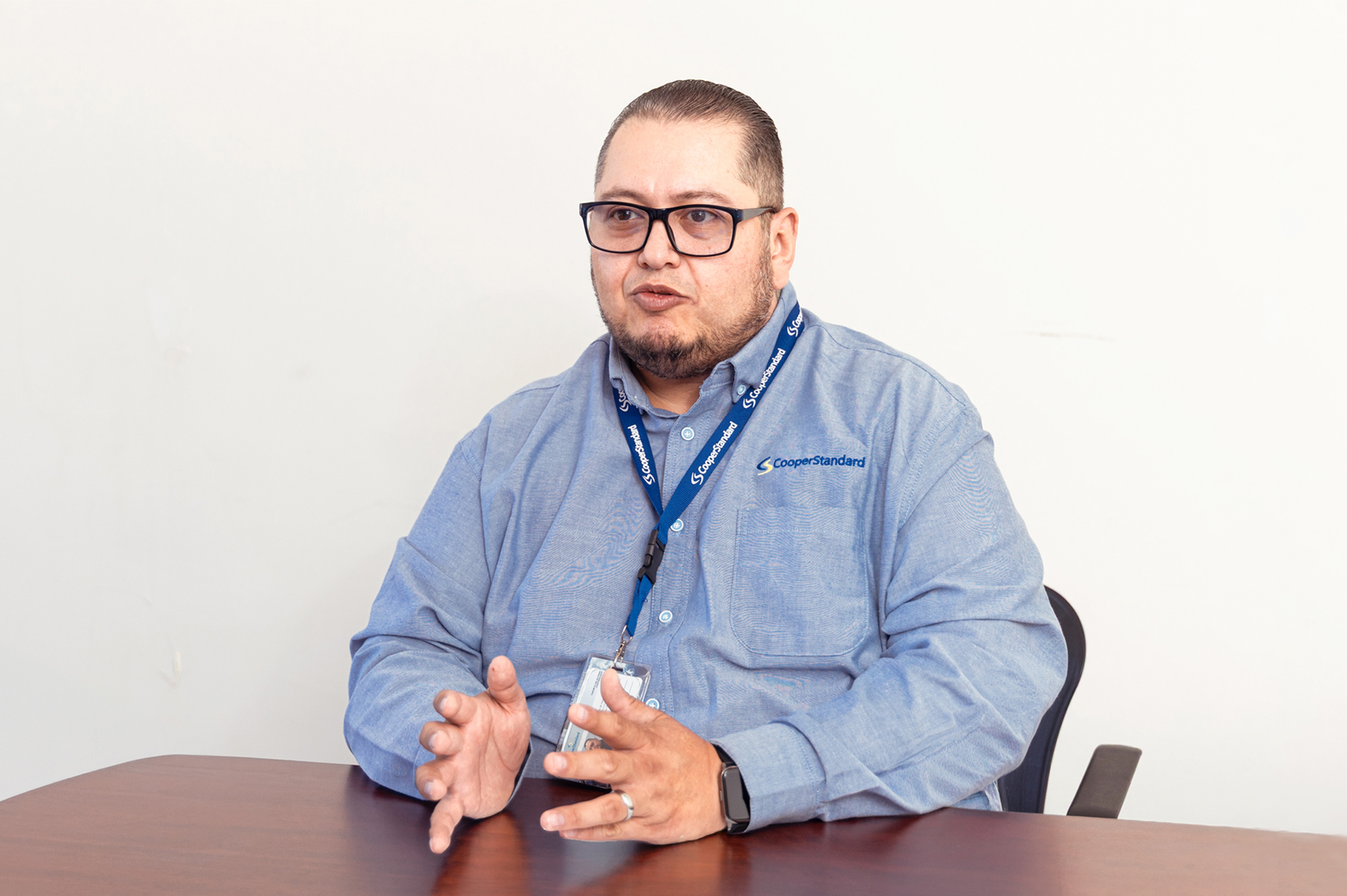
Support has accompanied this expansion. Martín is based in Torreón, spends a good part of his time in Saltillo, and travels to other sites, and has found the same response wherever he is, even on a recent trip to Europe. “I don’t need to be thinking about whether I am supported by someone. I know there will always be someone from KEYENCE helping us.” In applications that the team could not solve alone, that support has gone even further: for data acquisition via RFID on tooling, KEYENCE developed a way to translate a communication language from one manufacturer’s format to another, connecting antennas that previously could not be read.
“I explained the application to them and they supported me, to the extent that we translated a communication language from one brand to another, and thanks to that, right now I have those antennas connected to pull the information, which not even the machine manufacturer had done before.”
Frequently Asked Questions (FAQ)
QWhat problem did Cooper Standard solve with KEYENCE’s KV Series PLC?
A
The Saltillo plant mostly operates old, stand-alone machines that were never designed for data acquisition, and today customers demand traceability for every part. A KV Series controller was configured as a master PLC that collects information from all those machines and sends it via SQL to a server, so that the plant can query when a part was manufactured, at what time, by which operator, and with what process values.
QHow does KEYENCE’s KV Series connect with legacy PLCs from other manufacturers?
A
The plant linked very old legacy PLCs, new PLCs, and controllers of every brand in the plant, using the KV Series Ethernet communication unit. Whatever the communication protocol, the link was achieved, and KEYENCE’s master controller then performs the acquisition of all that information and sends it to the database.
QWhy did Cooper Standard choose KEYENCE’s KV Series over other controllers?
A
The team evaluated technical proposals from several brands. Some had very high prices and others were very capable but with an initial cost that the plant itself would have had to absorb. KEYENCE was chosen for its capability, price, and the advantages it offered, and what tipped the decision was the technical support and training provided with the equipment.
QDid KEYENCE’s KV Series meet Cooper Standard’s PLC security requirements?
A
Yes. Since the information goes to a company server, the control department had to involve the IT department, and the controller had to comply with security certificates, user and password control, and defined rules on who can view the information. The KV Series met the plant’s requirements, so the team was able to use it without any problems.
QWhat can be viewed with the web server function of KEYENCE’s KV Series?
A
By typing the controller’s IP address into a browser, the screens developed by the team itself open—one screen for a process, another for efficiency, and so on—without a per-screen license. The plant manager and the support engineer can monitor the same line at the same time and read and write information on the machines. The screens can also be accessed from mobile phones.
QHow many machines at the Saltillo plant run on KEYENCE’s KV Series, and what is next?
A
At the Saltillo plant, the estimate is about 30 machines, plus 4 in which the existing controller was replaced with a KV, giving around 34. The units purchased in December are pending installation, and there are new projects planned with the KV Series as well, including a scale application with label printing.