Non-Contact Measurement of Resonance Frequency: Evaluating Piezoelectric Elements and MEMS Resonators With Zero Mass Loading
Measure the resonance frequency of piezoelectric elements and MEMS resonators without contact and without applying a mass load. The LK-G5000 Series captures high-frequency amplitude with high-speed sampling and identifies the natural frequency using FFT.
Inquiries regarding non-contact measurement of resonance frequency
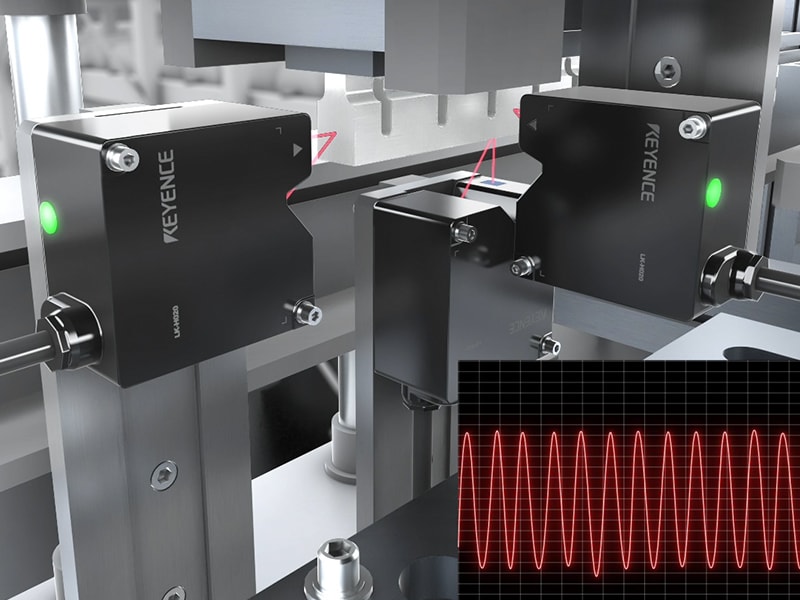
Three Challenges Encountered in Resonance Frequency Measurement of Piezoelectric Ceramics, Quartz Crystals, and MEMS Resonators
For small, lightweight electronic components, the measurement method itself affects the accuracy of resonance frequency identification.
Contact Methods Shift the Resonance Point Due to Mass Loading
In contact methods where an accelerometer or probe is attached, the mass of the sensor itself is added to the target, causing the natural frequency of lightweight piezoelectric elements and MEMS resonators to shift from its true value. Even a mass load of just a few milligrams shifts the resonance peak to a lower frequency, which can lead to incorrect design value verification during development or incorrect pass/fail judgments in mass production. Without a non-contact measurement method that does not apply a load, the resonance frequency of micro and lightweight components cannot be evaluated correctly.
Laser Doppler Vibrometers Are Difficult to Introduce and Adjust
Although laser Doppler vibrometers are an option for non-contact vibration measurement, adjusting the optical system, taking measures against speckle, and aligning each measurement point require specialized knowledge and time, making setup on-site and deployment to mass production lines difficult in practice. Because they tend to measure one point at a time, they are also unsuitable for synchronized evaluation of multiple points. If the burden of introduction and adjustment is heavy, resonance evaluation becomes dependent on specific personnel.
Insufficient Sampling Misses High-Frequency Amplitudes
To measure a target vibrating at a high frequency, the sampling frequency (sampling rate) must be at least 10 times the vibration frequency. If sampling is slow, the peak value is calculated to be smaller than the actual amplitude, leading to incorrect identification of the resonance point and mode separation. To correctly capture the resonance peak with FFT, high-speed sampling that can densely acquire high-frequency amplitude in a time series is essential, and if this is lacking, the reproducibility of the evaluation itself is compromised.
Four Steps to Identify Resonance Frequency Without Contact
The natural frequency is identified by exciting vibration, acquiring displacement at high speed, and identifying the resonance peak using FFT.
- 1 Excite vibration – STEP①. Piezoelectric elements and MEMS resonators are subjected to swept excitation or impulse excitation to excite mechanical vibration. Because it is a non-contact measurement, the influence on excitation conditions can be minimized.
- 2 High-speed sampling of displacement – STEP②. Displacement (amplitude) due to vibration is acquired in a time series with sampling at up to 392 kHz. The true vibration is captured with zero mass loading.
- 3 Identify resonance peak with FFT – STEP③. The acquired displacement waveform is subjected to frequency analysis (FFT), and the natural frequency is identified from the resonance peak where the amplitude is at its maximum.
- 4 Synchronized measurement of multiple points – STEP④. Multiple points are acquired simultaneously with synchronized sampling of up to 12 heads, which can be deployed for vibration mode separation and resonance inspection on mass production lines.
Comparison of Resonance Frequency Measurement Methods
Depending on the measurement method, there are significant differences in the presence of mass loading, ease of introduction, and multi-point synchronization.
| Comparison items | LK-G5000 Series (Laser triangulation / Non-contact displacement) |
Laser Doppler vibrometer | Contact accelerometer | Eddy-current displacement sensor |
|---|---|---|---|---|
Measurement principle |
LK-G5000 Series (Laser triangulation / Non-contact displacement)
Acquire displacement (amplitude) in a time series
|
Laser Doppler vibrometer
Velocity (Doppler effect)
|
Contact accelerometer
Acceleration (contact)
|
Eddy-current displacement sensor
Displacement (proximity/eddy current)
|
Non-contact / Presence of mass load |
LK-G5000 Series (Laser triangulation / Non-contact displacement)
◎ Non-contact, zero mass loading
|
Laser Doppler vibrometer
○ Non-contact
|
Contact accelerometer
× Contact, resonance point shift due to mass load
|
Eddy-current displacement sensor
△ Non-contact but proximity required
|
Time-series acquisition of high-frequency amplitude |
LK-G5000 Series (Laser triangulation / Non-contact displacement)
◎ Acquisition at up to 392 kHz
|
Laser Doppler vibrometer
○ Supports high-frequency measurement
|
Contact accelerometer
△ Integration processing required
|
Eddy-current displacement sensor
△ Depends on the model
|
Ease of installation and adjustment |
LK-G5000 Series (Laser triangulation / Non-contact displacement)
◎ Easily installed as a displacement sensor
|
Laser Doppler vibrometer
× Optical adjustment and speckle countermeasures required
|
Contact accelerometer
△ Effort required for wiring and attachment
|
Eddy-current displacement sensor
△ Target material restrictions
|
Multi-point synchronized measurement |
LK-G5000 Series (Laser triangulation / Non-contact displacement)
◎ Up to 12-head synchronization
|
Laser Doppler vibrometer
× Measurements tend to be limited to one point at a time
|
Contact accelerometer
△ Multi-channel wiring is required
|
Eddy-current displacement sensor
△ Depends on the model
|
Adaptability to surface conditions and materials |
LK-G5000 Series (Laser triangulation / Non-contact displacement)
◎ Automatic light intensity control with ABLE II
|
Laser Doppler vibrometer
△ Dependent on speckle and surface conditions
|
Contact accelerometer
◯ Works with any material
|
Eddy-current displacement sensor
× Conductors only
|
Reasons to Choose the LK-G5000 Series
The LK-G5000 Series is a non-contact laser triangulation displacement sensor that acquires high-frequency amplitude in a time series at 392 kHz without applying a mass load, allowing resonance peaks to be identified using FFT. Without relying on laser Doppler vibrometers, which are difficult to adjust, or contact-type sensors, whose resonance points shift due to mass loading, it easily and stably identifies the resonance frequencies of piezoelectric elements and MEMS resonators.
LK-G5000 Series Supporting Non-Contact Measurement of Resonance Frequencies
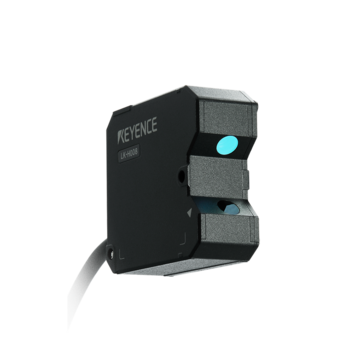
A triangulation-type laser displacement sensor. It acquires amplitude in a time series through high-speed sampling and identifies natural frequencies using FFT.
Supporting Non-Contact Measurement of Resonance Frequencies of Piezoelectric Elements and MEMS Resonators — LK-G5000 Series
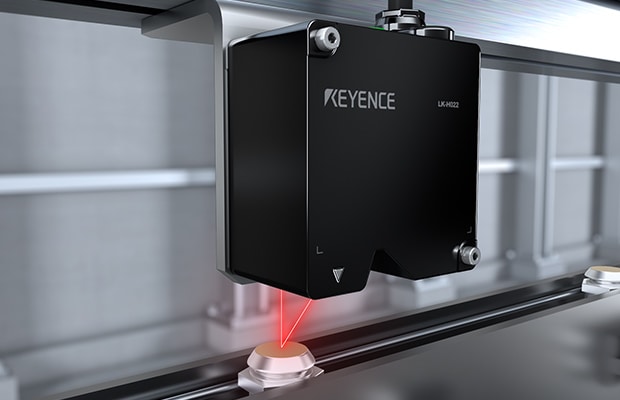
Ultra High-Speed/High-Accuracy Laser Displacement Sensor
The LK-G5000 Series is a laser displacement sensor that uses a reliable and proven triangulation method to measure displacement (amplitude) without touching the target. With ultra-high-speed sampling of up to 392 kHz, it acquires amplitude in a time series without missing data, even for targets vibrating at high speeds. By performing FFT analysis on the acquired displacement waveform, the natural frequency can be identified in a non-contact manner from the resonance peaks of piezoelectric elements and MEMS resonators. Because no mass load is applied, even lightweight and minute electronic components can be evaluated without disturbing their natural vibration. The ABLE II automatic light intensity control function tracks the surface condition of the target, ensuring stable measurement even on glossy or minute workpieces. By connecting a head expansion unit to the main controller, it supports synchronized sampling of up to 12 heads, allowing for expansion into multi-point vibration mode evaluation and resonance inspection on mass production lines.
Get Detailed Materials on the LK-G5000 Series
You can download a free catalog summarizing compatible head specifications, system configuration, and measurement examples.
Inquiries regarding non-contact measurement of resonance frequencies
Examples of Use in Resonance and Vibration Measurement of Electronic Components
They are used in non-contact measurement using high-speed sampling for piezoelectric elements, ultrasonic horns, vibration motors, and other devices.
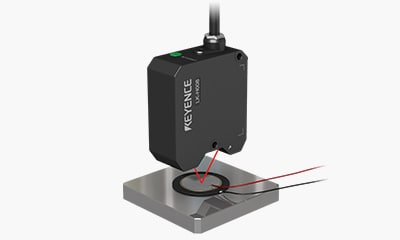
Resonance and Natural Vibration Measurement of Piezoelectric Elements
With high-speed sampling of up to 392 kHz, even minute vibrations that could not be measured conventionally are captured, and the amplitude of piezoelectric elements is acquired in a time series without contact. Resonance peaks are identified through FFT analysis.
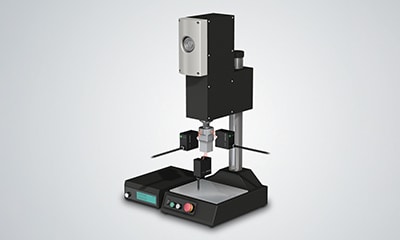
Resonance Amplitude Measurement of Ultrasonic Horns
The amplitude of an ultrasonic horn driven by resonance is measured without contact using a compact head. It is easy to install, stably captures even minute vibrations with high-speed sampling of 392 kHz, and is used for managing setting conditions.
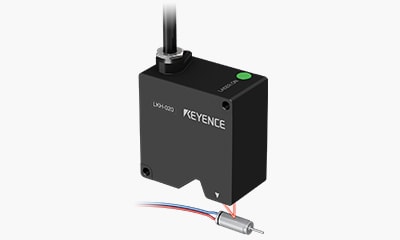
Resonance Frequency Measurement of Vibration Motors
Minute vibrations of small vibration motors are measured without contact. High-speed sampling captures even fine vibrations, allowing evaluation of resonance frequency and amplitude without applying a mass load.
Frequently Asked Questions About Non-Contact Measurement of Resonance Frequency (LK-G5000 Series)
Q Can the resonance frequency of piezoelectric elements and MEMS resonators be measured without contact?
A
Yes, they can. By acquiring displacement (amplitude) due to vibration in a time series with high-speed sampling using the LK-G5000 Series and performing FFT analysis, the natural frequency can be identified without contact from the resonance peak. Since no mass load is applied, the original values of even lightweight parts can be evaluated.
Q What is the difference from a laser Doppler vibrometer?
A
Laser Doppler vibrometers require difficult optical adjustment and speckle countermeasures, and tend to measure one point at a time. The LK-G5000 Series differs in that it is easy to introduce and adjust as a displacement sensor, supports synchronized measurement of up to 12 heads, and makes it easy to set up resonance evaluation on site.
Q How high a vibration frequency can be measured?
A
To measure an object vibrating at high speed, a sampling frequency of at least 10 times the vibration frequency is required. The LK-G5000 Series supports ultra-high-speed sampling of up to 392 kHz, allowing high-frequency amplitudes to be acquired without underestimating peak values.
Q What are the advantages compared to contact-type accelerometers?
A
With contact types, the mass of the sensor is added to the target, causing the resonance point of lightweight resonators to shift from their original values. Since the LK-G5000 Series is non-contact and has zero mass loading, even minute and lightweight electronic components can be evaluated in their original vibration state.
Q Can multiple measurement points be measured simultaneously?
A
Yes, they can. By connecting a head expansion unit to the main controller, synchronized sampling of up to 12 heads is possible. Multiple points can be acquired simultaneously to separate vibration modes, or this can be deployed for resonance inspection on mass production lines.
Q Can impedance and equivalent circuits also be measured?
A
This product is a displacement sensor that measures mechanical deformation (displacement/amplitude). It does not support measurement of electrical impedance or equivalent circuits, as these fall within the domain of network analyzers and similar instruments. Please use it for applications observing the mechanical behavior of resonance without contact.
Q Please feel free to contact us regarding challenges in measuring the resonance frequency of piezoelectric elements and MEMS resonators.
A
Compatible heads, system configuration, and measurement methods can be confirmed in the catalog or via the inquiry form.