Measure Vibration Without Contact: Capture Amplitude and Runout With a Laser Displacement Sensor
Capture the vibration of equipment and parts through non-contact measurement with the LK-G5000 Series laser displacement sensor. Even for targets where sensors cannot be attached, amplitude and runout can be measured for inspection on the production line.
Three Issues That Occur When Measuring Vibration With Contact Sensors
There are limits to contact measurement methods such as accelerometers, creating a contradiction where the very targets you want to measure cannot have sensors attached or cannot be measured.
Some Targets Cannot Have Sensors Attached, or Cannot Be Measured If They Are Attached
For high-temperature/red-hot targets, high-speed rotating bodies, and minute/lightweight parts, it is difficult to attach accelerometers, and even if they are attached, wiring and installation may not be practical. This creates a contradiction where contact sensors are harder to use on the very targets you want to measure, leading to a lack of vibration management. Unmanaged vibration manifests as abnormal noise or dimensional variation in subsequent processes, leading to a decline in final product quality or missed defects during inspection.
Mass Loading Changes the Vibration Itself
Attaching an accelerometer to a minute or lightweight object causes the mass of the sensor to change the target’s vibration (amplitude and frequency), making it impossible to measure the actual behavior. For targets such as ultrasonic welder horns and piezo elements, non-contact measurement with nothing attached to the target is required. Managing with values that differ from reality leads to welding defects or operation failures in subsequent processes, preventing inspection from determining the true quality.
High-Speed Vibration Is Underestimated Due to Insufficient Sampling
Unless measured at a sampling frequency at least 10 times the vibration frequency, the calculated peak value (amplitude) will be smaller than actual. In manufacturing inspection, if the measuring instrument cannot track high-speed vibration, missed amplitudes will directly lead to the outflow of defective products. Products judged as passing based on underestimated amplitudes may be damaged or exhibit insufficient performance in subsequent processes or final products.
Approach and Key Points for Non-Contact Vibration Measurement
From target selection to pass/fail judgment, a non-contact laser displacement sensor reliably captures amplitude and runout.
- 1 Target Selection – Step 1. Measure targets where accelerometers cannot be attached or where mass loading is undesirable (high-temperature, rotating bodies, minute, or lightweight objects) using a non-contact laser displacement sensor.
- 2 High-Speed Sampling Measurement – Step 2. Acquire displacement waveforms at up to 392 kHz. Sampling at 10 times or more the vibration frequency captures amplitude peaks without missing them.
- 3 Amplitude and Runout Evaluation – Step 3. Evaluate amplitude and runout from the acquired displacement waveform and use it for pass/fail judgment in manufacturing (also useful for evaluating frequency and natural frequency).
- 4 Pass/Fail Judgment and Recording – Step 4. Record amplitude and runout for all units. Because it is non-contact, stable inline measurement is performed without stopping, preventing the outflow of defective products.
Comparison of Vibration Measurement Methods
Depending on the measurement method, there are significant differences in non-contact capability, mass loading, direct measurement of amplitude, and tracking of high-speed vibration.
| Comparison Items | LK-G5000 Series (Laser displacement, non-contact) |
Contact accelerometer | Laser Doppler vibrometer (LDV) | Contact displacement sensor (dial gauge, etc.) |
|---|---|---|---|---|
Non-contact operation / Mounting required |
LK-G5000 Series (Laser displacement/Non-contact)
○ Non-contact/No attachment to target
|
Contact accelerometer
× Attachment to target/wiring required
|
Laser Doppler Vibrometer (LDV)
○ Non-contact
|
Contact displacement sensor (dial gauge, etc.)
× Contact required
|
Mass load on minute/lightweight targets |
LK-G5000 Series (Laser displacement/Non-contact)
○ Minimal mass loading
|
Contact accelerometer
× Vibration changes due to mass load
|
Laser Doppler Vibrometer (LDV)
○ No load
|
Contact displacement sensor (dial gauge, etc.)
× Affected by contact pressure
|
Direct measurement of amplitude (displacement) |
LK-G5000 Series (Laser displacement/Non-contact)
○ Directly measures displacement = amplitude
|
Contact accelerometer
△ Converted from acceleration
|
Laser Doppler Vibrometer (LDV)
△ Measures velocity
|
Contact displacement sensor (dial gauge, etc.)
△ Mainly static displacement
|
Tracking high-speed vibration (sampling) |
LK-G5000 Series (Laser displacement/Non-contact)
○ Up to 392 kHz
|
Contact-type accelerometer
○ Supports high-speed vibration
|
Laser Doppler Vibrometer (LDV)
○ Supports high-speed vibration
|
Contact displacement sensor (dial gauge, etc.)
× High-speed vibration not supported
|
Application to high temperatures, rotating objects, and narrow spaces |
LK-G5000 Series (laser displacement, non-contact)
○ Up to 1 m installation distance; supports high temperatures and rotating objects
|
Contact-type accelerometer
× Difficult to attach
|
Laser Doppler Vibrometer (LDV)
△ Depends on optical system and cost
|
Contact displacement sensor (dial gauge, etc.)
× Difficult to apply
|
Role (area of expertise) |
LK-G5000 Series (laser displacement, non-contact)
◎ Amplitude and runout (manufacturing quality, 100% inspection)
|
Contact-type accelerometer
Equipment diagnosis and acceleration
|
Laser Doppler Vibrometer (LDV)
Velocity and research measurements
|
Contact displacement sensor (dial gauge, etc.)
Static displacement
|
Why Choose the LK-G5000 Series
The LK-G5000 Series directly captures amplitude and runout through non-contact laser displacement measurement, and with sampling at up to 392 kHz, it ensures no peaks of high-speed vibration are missed. Because it does not need to be attached to the target, it reduces mass loading on minute or lightweight objects, as well as installation constraints on high-temperature or rotating objects. Its suitability for inline use on production lines is also a major strength.
LK-G5000 Series for Non-Contact Vibration Measurement
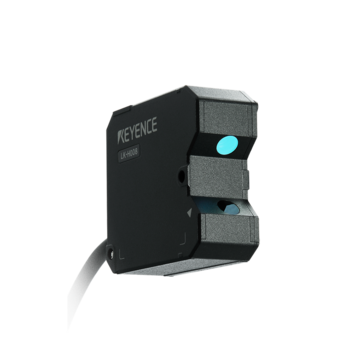
A triangulation laser displacement sensor. It captures displacement waveforms with sampling at up to 392 kHz, measuring amplitude and runout without contact.
Support for Non-Contact Vibration Measurement — LK-G5000 Series
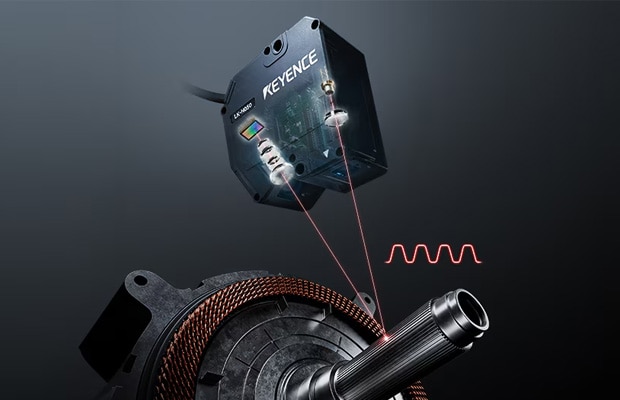
Ultra High-Speed/High-Accuracy Laser Displacement Sensor
This sensor uses triangulation to measure displacement to the target surface without contact. With ultra-high-speed sampling at up to 392 kHz, it reliably captures the displacement waveforms of targets vibrating or rotating at high speeds, stably measuring amplitude and runout. It features an automatic light intensity control function that supports various colors, materials, and surface conditions, and can handle high-temperature or red-hot targets at an installation distance of up to 1 m. With a flex-resistant cable, it can be mounted on moving parts such as robots. Because it is non-contact, the sensor does not need to be attached to the target, which is a key feature that prevents interference with the vibration of minute or lightweight objects. It detects even minute targets with an ultra-small spot of φ20 µm, and can measure multiple points simultaneously with synchronized sampling of up to 12 heads.
Get Detailed Information on the LK-G5000 Series
You can download a free catalog containing specifications, system configurations, and application examples.
Applications of Non-Contact Vibration Measurement
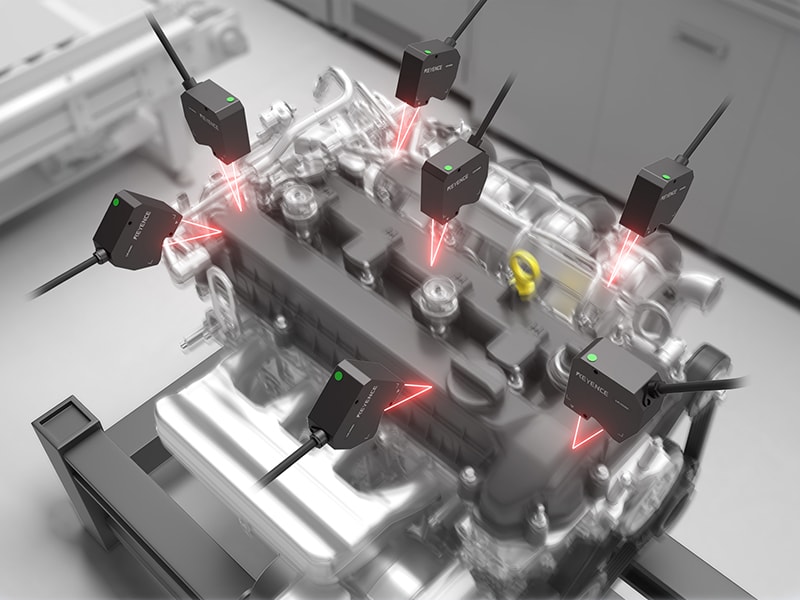
It is used for vibration measurement of targets where contact-type sensors are difficult to use, such as ultrasonic welders, piezo elements, transfer arms, and engines.
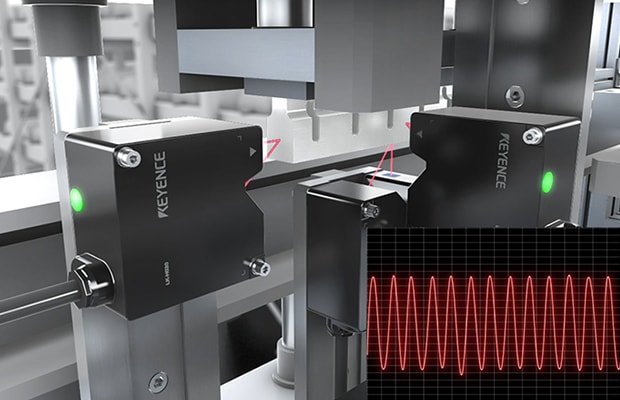
Vibration Measurement of Ultrasonic Welder Horns
Measures horn amplitude without contact. It captures the amplitude of high-speed vibration without applying a mass load and determines whether weld quality is acceptable.
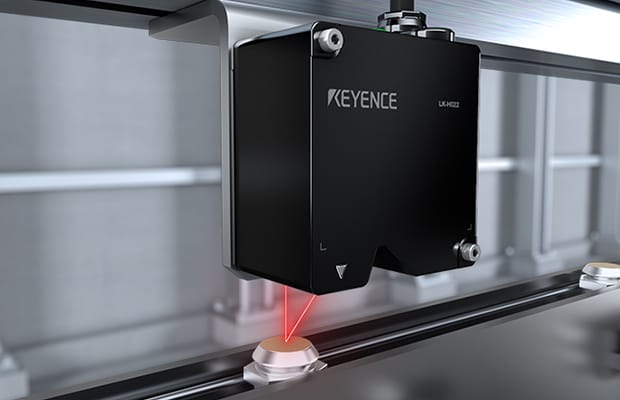
Vibration Measurement of Piezo Elements
Measures the vibration of minute and lightweight elements without contact. It avoids the mass load caused by mounting a sensor and captures the true amplitude.
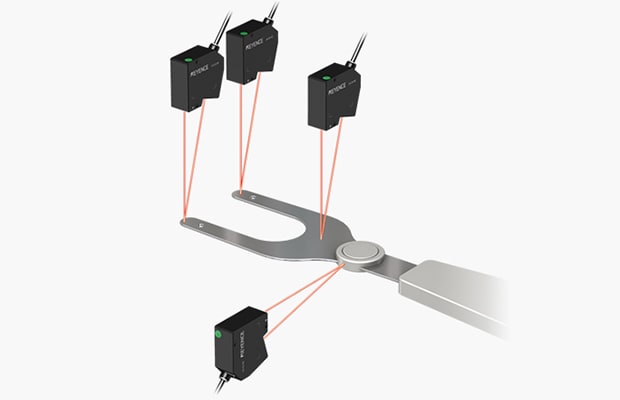
Vibration Measurement of Transfer Robot Arms
Measures the vibration and runout of moving parts without contact to check positioning and operation quality. It can also be installed on moving parts using a flex-resistant cable.
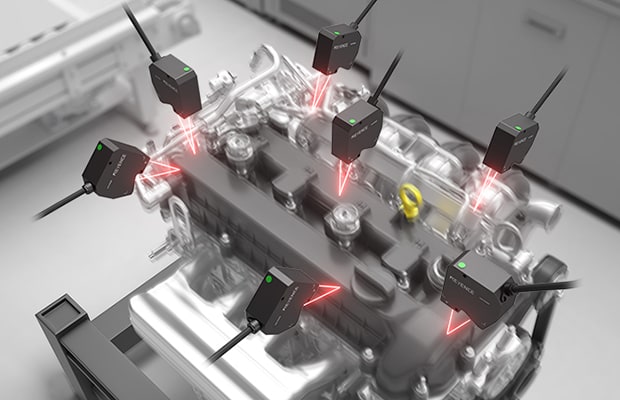
Vibration Measurement of Engines
Captures high-speed vibrating targets with a maximum sampling rate of 392 kHz, measuring amplitude without missing peaks. This supports the evaluation of high-speed vibration.
Frequently Asked Questions About Non-Contact Vibration Measurement (LK-G5000 Series)
Q Can vibration be measured without contact?
A
Yes, it can. The LK-G5000 Series laser displacement sensor captures the displacement of the target surface without contact to measure amplitude and runout. There is no need to attach a sensor to the target.
Q How does it differ from a contact-type acceleration sensor?
A
While acceleration sensors are attached to the target to measure acceleration, the LK-G5000 Series directly measures displacement (amplitude) without contact. It does not apply a mass load and is suitable for high-temperature, rotating, or minute targets where sensors cannot be attached.
Q Can it measure targets that vibrate at high speeds?
A
Yes, it can. With a maximum sampling rate of 392 kHz, measuring at 10 times or more the vibration frequency captures the amplitude peaks without missing them.
Q Can it also measure the vibration of ultrasonic welder horns and piezo elements?
A
Yes, it can. Non-contact laser displacement measurement is ideal for targets that are minute, lightweight, and sensitive to mass loads. Since nothing is attached to the target, the original amplitude can be captured as is.
Q Can it also be used to check natural frequencies?
A
Displacement waveforms acquired through high-speed sampling can be used to evaluate frequency (natural frequency) in addition to amplitude. This can be used in conjunction with pass/fail judgment in manufacturing.
Q Can every unit be measured on the production line?
A
Yes, it can. Because it is non-contact, measurement can be performed without stopping, and amplitude and runout can be recorded inline for every unit as part of manufacturing pass/fail inspection.