What Is an Industrial Barcode Scanner?
An industrial barcode scanner is a device purpose-built to read and decode barcodes in environments where standard retail scanners fail outright, dust, vibration, heat, moisture, and continuous high-cycle use disqualify consumer-grade hardware from the start. These scanners capture barcode patterns and convert them into digital data that enterprise systems process; the distinction from checkout-counter models isn't cosmetic, it's structural.
Industrial barcode scanning operates across environments that each impose distinct demands:
- Warehouses and distribution centers for inventory tracking and shipping verification
- Manufacturing floors for parts tracking and assembly quality control
- Cold storage facilities where temperature extremes stress both labels and electronics
- Shipping and receiving docks handling high-volume, continuous package processing
- Field service operations requiring portable, impact-resistant hardware
The key differentiators are IP-rated protection against liquid and particulate ingress, shock resistance defined by drop specifications, and sealed housing with internal shock absorption. Drop testing from multiple meters onto concrete is a standard durability benchmark, frame integrity and lens retention under impact are what that test actually proves.
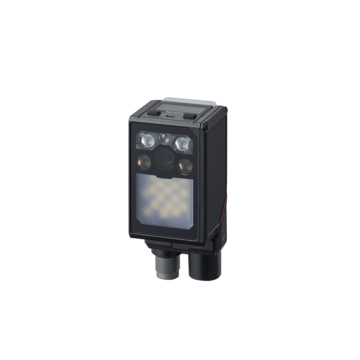
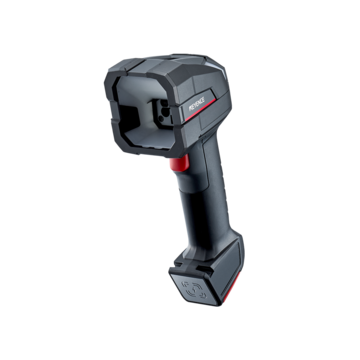
Code format support matters here too. Industrial scanners handle both 1D and 2D formats, including damaged or low-contrast barcodes that consumer scanners misread, a real operational advantage when label quality degrades in the field. Fixed-mount models integrate directly into conveyor lines for unmanned high-speed scanning; handheld wireless units cover mobile warehouse workflows. Connectivity spans USB, Ethernet, Bluetooth, and industrial protocols depending on integration requirements.
How Industrial Barcode Scanners Work: Core Components of Fixed-Mount Code Readers
Four primary subsystems drive every industrial code reader: a light source (LED illumination or laser) that illuminates the target code, a CMOS image sensor that captures the reflected light pattern, optical elements, the imaging lens and polarizing filters, that focus light with precision, and a decoder that converts captured images into usable data. Each component has a defined job in the read chain; a weakness at any stage causes no-reads, misreads, and line stoppages.
Light Source and Illumination Technology
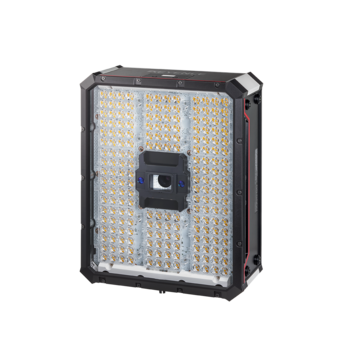
Modern fixed-mount barcode readers and 2D code readers rely on high-intensity LED illumination engineered for uniform brightness across the entire field of view. KEYENCE code readers, for example, use high-intensity red LED lighting paired with reflector designs such as CPC (Compound Parabolic Concentrator) illumination, which reduces loss in light intensity so even low-contrast codes and direct part marks (DPM) at the edges of a wide field of view are evenly lit. Advanced readers like the SR-X Series AI-powered code reader integrate built-in 3-way lighting, direct, polarized, and diffused and automatically select the optimal lighting condition for the target, whether that's pin-stamped marking on a cast metal surface, black resin, or hairline-finished metal.
Legacy laser barcode scanners steer a laser diode's point beam through rotating polygon mirrors to generate a scan line, which limits them to 1D barcodes. Camera-based (imager) code readers have largely replaced laser scanners in industrial automation because they read both 1D barcodes and 2D codes, Data Matrix (ECC200), QR codes, GS1 DataMatrix, PDF417, in any orientation, with omnidirectional reading and image-based error analysis.
Image Sensors and Signal Conversion
The image sensor is where reflected light becomes data. High-sensitivity CMOS image sensors dominate modern fixed-mount code reader design: millions of photodetectors convert reflected light into electrical signals, and higher pixel counts translate directly into wider fields of view and longer reading distances. KEYENCE's SR-2000 Series uses a 3.1 megapixel high-sensitivity, low-noise CMOS sensor for an ultra-wide field of view, roughly twice that of conventional models, while the SR-5000 Series logistics code reader scales to a 16.8 megapixel CMOS sensor to cover an entire conveyor side with a single unit, even on high-speed lines running 150 m/min or faster.
Sensor sensitivity determines performance on moving targets: a high-sensitivity CMOS can capture usable images at exposure times as short as 100 μs, which is what makes reading codes in motion, on conveyors, rotating parts, or robot-presented workpieces, possible without motion blur. HDR (High Dynamic Range) capture extends this further, preventing washed-out highlights and underexposed shadows when codes sit at different heights or on reflective surfaces.
Optical Elements: Lenses and Filters
The imaging lens gathers reflected light and focuses it onto the sensor plane; depth of field and focal quality directly determine read reliability. Purpose-built code reader lenses are designed for large depth of field so a single fixed-mount installation can read codes at varying distances, stacked cartons of different heights, parts on hangers swaying in transit, without tooling changes, code position controllers, or C-mount lens selection. Autofocus mechanisms eliminate manual focus adjustment entirely: one-click automatic calibration tunes focus, exposure, and image processing filters for anyone to deploy, no machine vision expertise required.
Polarizing filters are the other critical optical element in industrial environments. Automatic polarization control removes halation (glare) from reflective targets, machined metal, glossy labels, film-wrapped packages, so readers can be mounted straight-on to shiny parts instead of at awkward angles with external lighting rigs.
Decoder and Processing Architecture
The decoder analyzes captured images, locates the code, validates its structure against symbology rules, Code 128, Code 39, ITF, GS1-128, UPC/EAN, Data Matrix, QR, and converts the pattern into text output. This is where industrial code readers separate themselves from commodity scanners.
Multi-core parallel processing architectures run image capture, preprocessing filters, and decoding simultaneously across CPU, DSP, FPGA, and dedicated AI (NPU) cores, so no images are missed on high-speed lines. Advanced decoding algorithms handle the hard cases: heat-map search algorithms instantly locate codes anywhere in a high-resolution image; super-resolution and high-resolution algorithms recover low-resolution codes at long ranges; and AI filters, trained on databases of over 100,000 code images, reconstruct damaged, stained, scratched, low-contrast, and worn codes that conventional decoders cannot read. KEYENCE's barcode reading lineup integrates all four subsystems, illumination, CMOS sensor, optics, and decoder, with algorithms like SR-X Drive, delivering stable reads and striving for 100% read rates where component-level weaknesses in conventional designs produce re-scans and line stoppages.
How the Barcode Scanning Process Works: Step by Step
The read sequence begins when a trigger input activates, a photoelectric sensor, PLC signal, or encoder pulse detecting an object entering the reading position. The LED illumination floods the code with uniform, high-contrast light that separates dark bars or cells from light spaces.
Reflection contrast determines whether data capture succeeds. White spaces reflect substantially more light than black bars, which absorb most of the illumination. Engineers quantify this differential as Print Contrast Signal (PCS), the gap between maximum reflectance from light elements and minimum reflectance from dark elements. Low-contrast printing, dot-peen direct part marking, and laser-etched codes push PCS below comfortable thresholds, which is exactly where automatic tuning earns its keep: readers like the SR-2000 automatically optimize roughly 1.5 million parameter combinations, exposure time, gain, dynamic range correction, contrast zoom, and image processing filters, to make marginal codes readable.
The CMOS image sensor converts the reflected light pattern into electrical signals, which an analog-to-digital converter (ADC) transforms into digital image data. The decoder then locates the code within the image, identifies start/stop characters or finder patterns, measures bar and space widths (or cell geometry) against the symbology specification, and performs checksum calculations to validate data integrity, any mismatch triggers a re-decode rather than passing corrupt data downstream. Multi-image capture gives modern readers several chances to decode each passing object instead of one.
Once validated, the decoded data transmits to the host system, PLC, PC, or WMS, over industrial communication protocols including EtherNet/IP, PROFINET, TCP/IP, FTP, PLC Link, and RS-232C, with Power over Ethernet (PoE) simplifying wiring on newer models. Customizable data output formatting eliminates programming corrections on the host side.
Beyond Reading: Verification, Matching Level, and Traceability
Industrial code readers increasingly do more than read. Code verification functions grade print quality against international standards, ISO/IEC 15415, ISO/IEC 15416, ISO/IEC TR 29158 (AIM DPM), ISO/IEC 16022, SAE AS9132, and SEMI T10-0701, supporting print quality control both inline and offline. Matching level functions score every read on a 1–100 scale, so a code that still reads at 100% but is degrading gets flagged for predictive maintenance before it becomes a no-read. Web-based monitoring tools expose read rates, error images, and statistical information from any browser on the network, no custom software required, closing the loop on traceability from receiving to shipping.
Conclusion
Industrial barcode scanners transform reflected light into actionable traceability data through a precise sequence of illumination, image capture, and decoding. Rugged, IP65-rated fixed-mount code readers deliver reliable performance in harsh manufacturing and logistics environments where consumer-grade scanners fail, provided they integrate high-sensitivity CMOS sensors, uniform LED illumination, large depth-of-field optics, and multi-core decoding architecture.
KEYENCE's code reader lineup, from the ultra-compact, AI-powered SR-X Series to the SR-2000 Series 1D/2D code reader and the SR-5000 Series logistics code reader, combines these core technologies with autofocus, automatic tuning, and AI-driven decoding algorithms for stable reads across the most challenging conditions. Operations and engineering teams that understand this scanning process make better equipment choices that improve read rates, traceability, and overall equipment effectiveness.
FAQs
Q What is the step-by-step process of how a barcode scanner reads a code?
A
The reader first illuminates the barcode with LED lighting, then its CMOS image sensor captures the reflection pattern, white spaces reflect more light than dark bars or cells. An analog-to-digital converter turns that optical pattern into digital image data, and the decoder locates the code, validates it against symbology rules (Code 128, Data Matrix, QR, and so on), runs checksum verification, and outputs the data to your PLC, PC, or warehouse management system over EtherNet/IP, PROFINET, or TCP/IP.
Q What are the most common issues that prevent barcode scanners from reading codes properly?
A
The leading challenge factors are low contrast between dark and light elements (low PCS), printing defects like bleeding or thin/thick printing, physical damage such as scratches, stains, smudging, and wear, distortion on curved or angled surfaces, and glare (halation) from reflective materials. Motion blur on high-speed lines and low resolution at long reading distances compound these. Modern industrial code readers counter them with automatic tuning, HDR, polarizing filters, geometric correction, and AI filters that reconstruct damaged codes.
Q How do barcode scanners function in warehouse operations?
A
In warehouses and distribution centers, every location, item, and container carries a barcode label linked to the warehouse management system (WMS). Fixed-mount logistics code readers mounted over conveyors, like wide-field-of-view, long-depth-of-field units that cover an entire conveyor side with a single reader, scan cartons of varying heights and label positions at line speeds of 150 m/min or faster, updating inventory and sortation data in real time. Handheld code readers cover receiving, picking, and cycle-count tasks.
Q Do barcode scanners read the black bars or the white spaces?
A
Both. The reader measures the contrast between them: white spaces reflect significantly more light back to the image sensor, while black bars absorb most of the illumination. This reflectance differential, the Print Contrast Signal, creates the pattern the decoder converts into data. That's also why low-contrast codes and direct part marks benefit from polarized or diffused lighting and contrast-enhancing image filters.
Q Why are industrial barcode scanners different from regular retail scanners?
A
Industrial code readers are engineered for harsh conditions, dust, moisture, vibration, and temperature extremes, with rugged IP65-rated housings and 24 VDC industrial power. Beyond durability, they add capabilities retail scanners lack: reading damaged, low-contrast, and DPM codes with AI-driven decoding algorithms, multi-code reading across an ultra-wide field of view, encoder-synchronized reading on moving conveyors, code quality verification to ISO/IEC standards, and native industrial network connectivity (EtherNet/IP, PROFINET, PLC Link) for full production traceability.