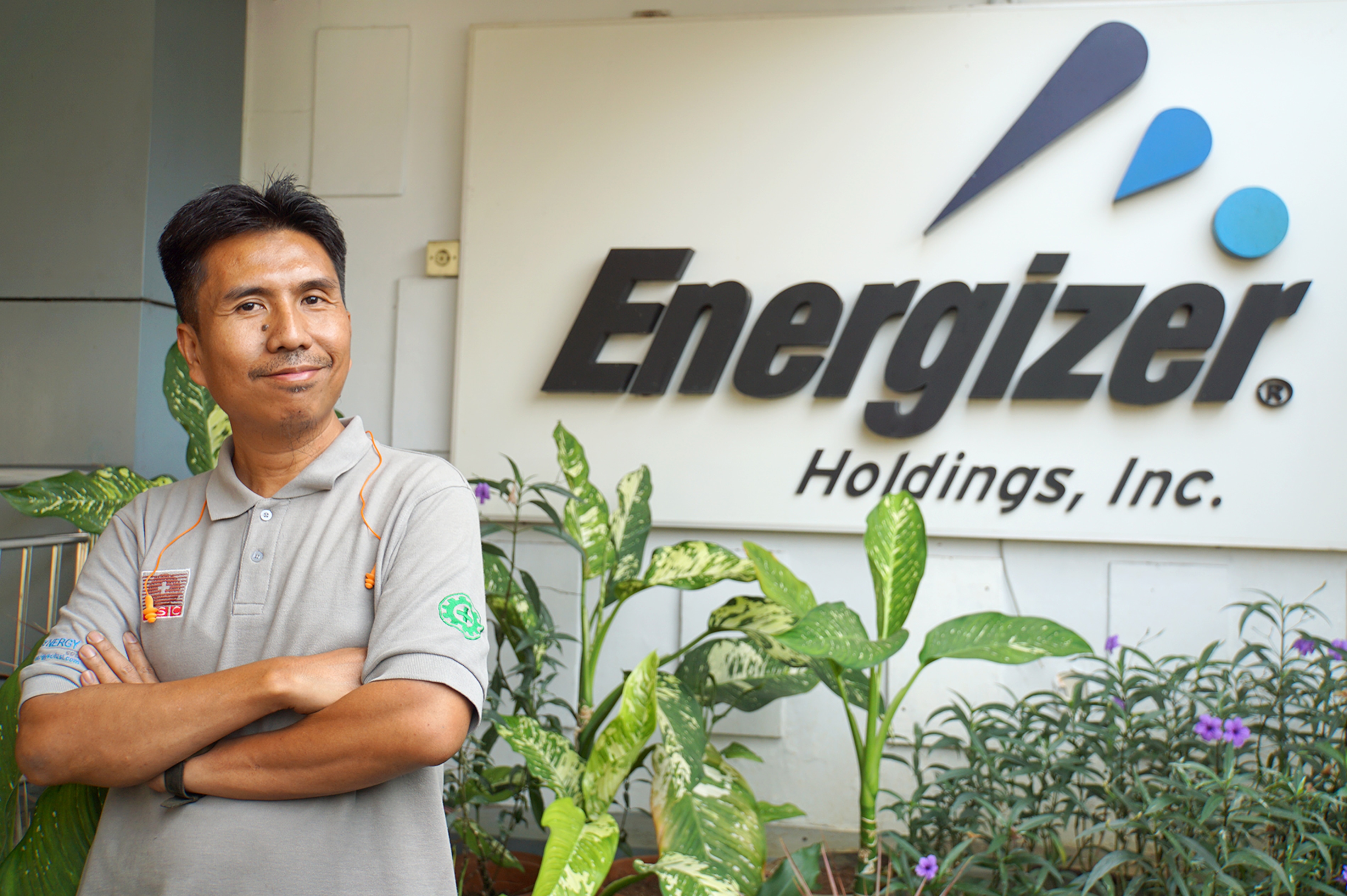
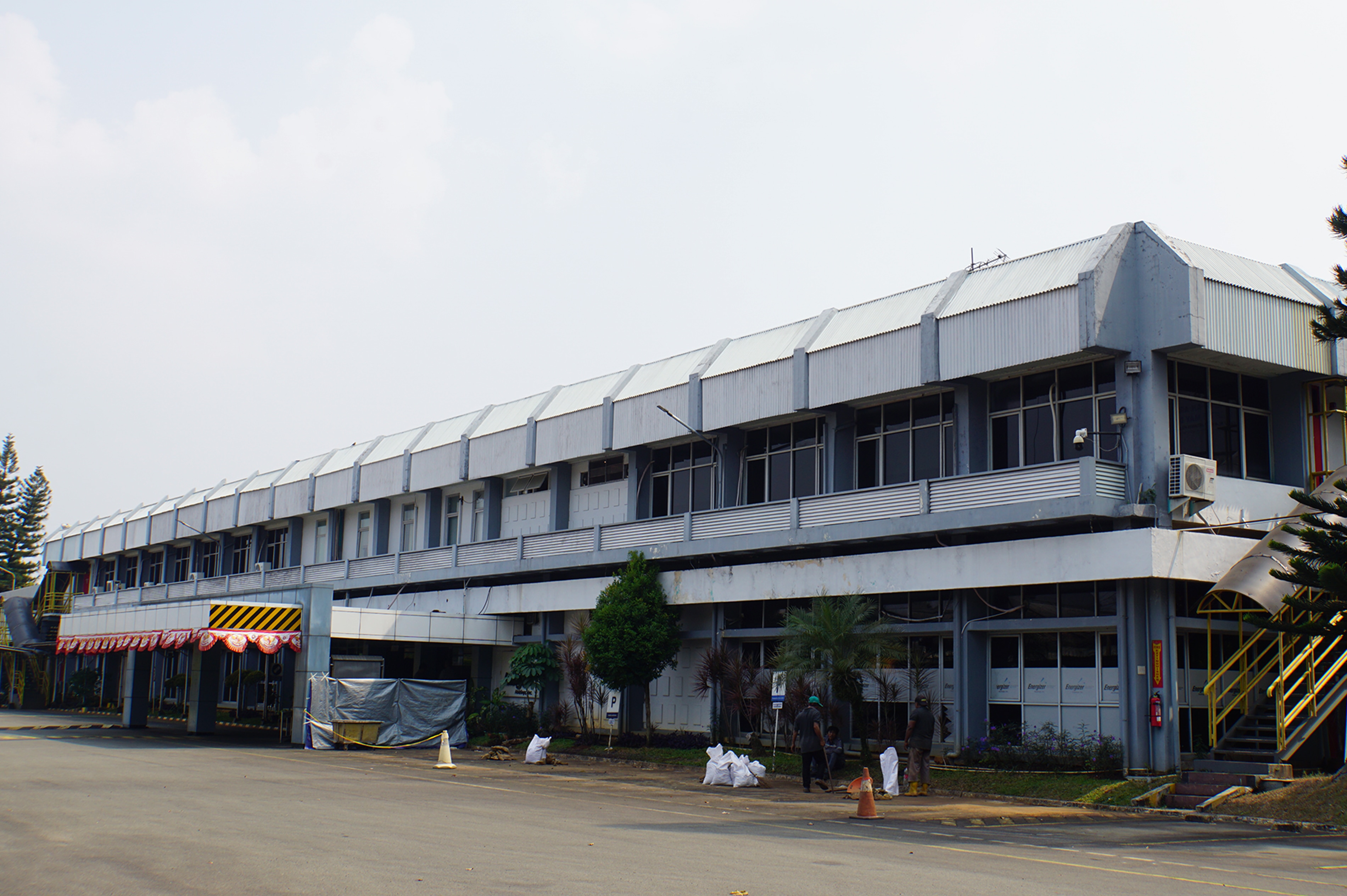
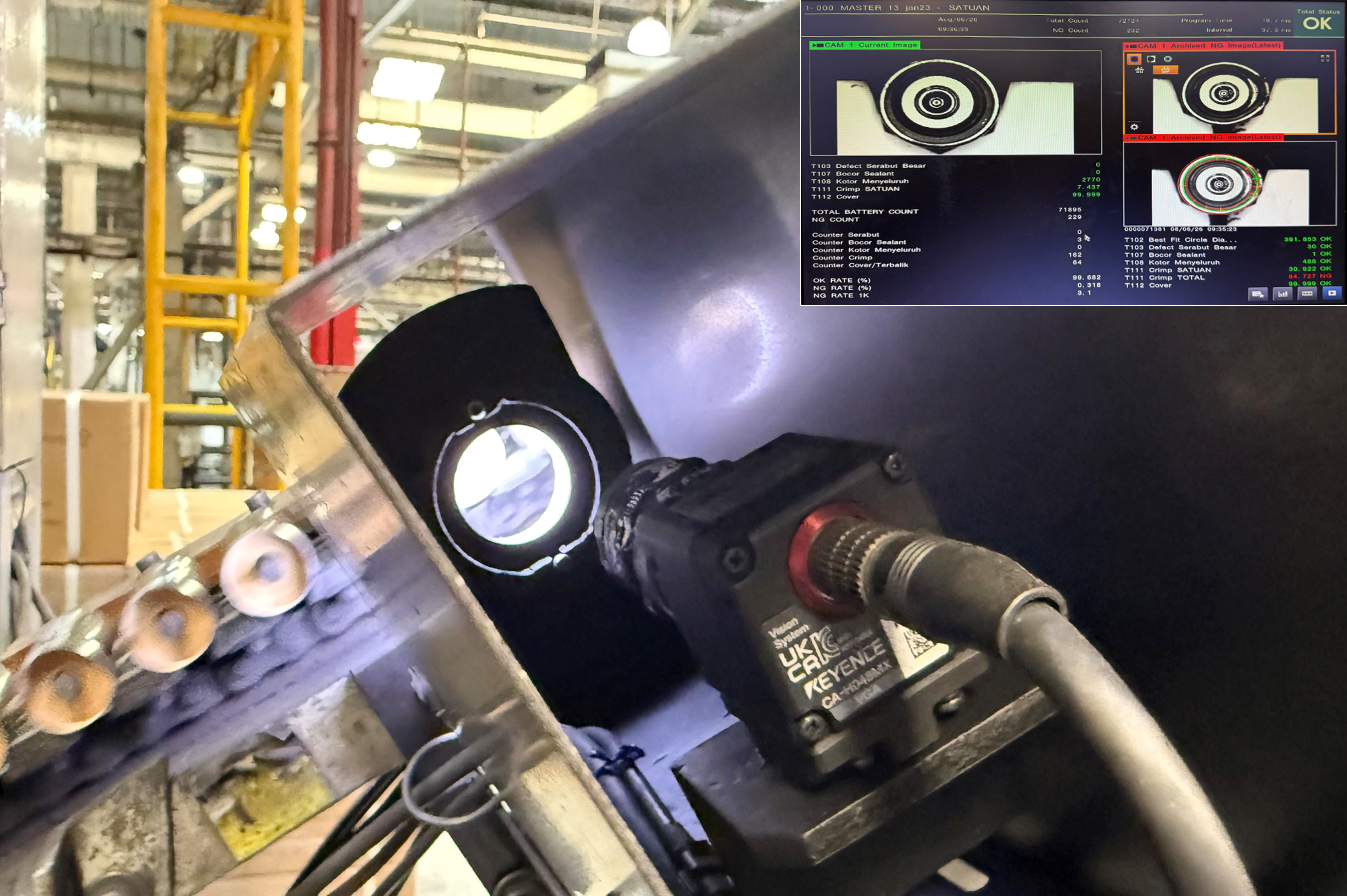
At its Cimanggis plant—a site that has been producing batteries since 1970—PT Energizer Indonesia manufactures AAA, AA, and D zinc-carbon dry cell batteries, with most of its output destined for export markets. On a production line processing 600 pieces every minute, dents on the battery can edges typically went undetected until a week-long aging test, by which time the cans had already been assembled into finished batteries. By installing the KEYENCE VS Series vision system inline during the swaging process, the plant can now detect defects while the components are still just cans—and, unexpectedly, discover types of defects that had never been inspected before.
Summary
- PT Energizer Indonesia manufactures zinc-carbon dry cell batteries (AAA, AA, D) at its Cimanggis plant, which has been operating since 1970, with most of its production destined for export markets.
- Before the KEYENCE VS Series, defects on the can edges were only found after a week-long aging test; by that time, the cells had already become finished batteries and had to be discarded, incurring hazardous waste disposal costs in addition to material losses.
- With the VS Series inline inspection, defects are detected while the components are still just cans, allowing the cans to be reused and repacked.
- At a speed of 600 pcs/min—36,000 units per hour—the previous method of taking three samples per hour could not represent the entire batch. Now every unit is inspected and recorded, and the line can automatically stop after a certain number of consecutive rejects.
- An unexpected additional benefit: the same camera also detects misplaced or folded internal components, allowing about 1 out of every 1,000 batteries to be saved—roughly 1,000 batteries per million produced.
- The engineering team reports they can now handle about 80% of setup and calibration independently, and that KEYENCE equipment meets the plant’s two-year payback target while remaining operational for five to ten years.
ChallengeWhat are the limitations of OK/NG camera sensors?
The Cimanggis plant is no stranger to automated inspection. Before the VS Series, the plant used camera sensors on the swaging line to inspect battery can edges for dents and deformations. The issue was not the sensor’s ability to detect, but the limited information it could provide.
Camera sensors only provide binary decisions. They can only tell the line whether a part is OK or NG, and nothing more. For diverse defect types such as dented can edges, it became difficult for the team to develop inspections as inspection standards became stricter. Their previous vision equipment came from another manufacturer overseas; the results were acceptable, but when problems occurred, parts and support had to be sourced from overseas, and resolution took time.
The biggest cost impact, however, appeared at the end of the process. Dented cans that slipped through were not found on the production line at all — they were only discovered a week later, after aging tests, when the cans had already become complete batteries with jackets attached.
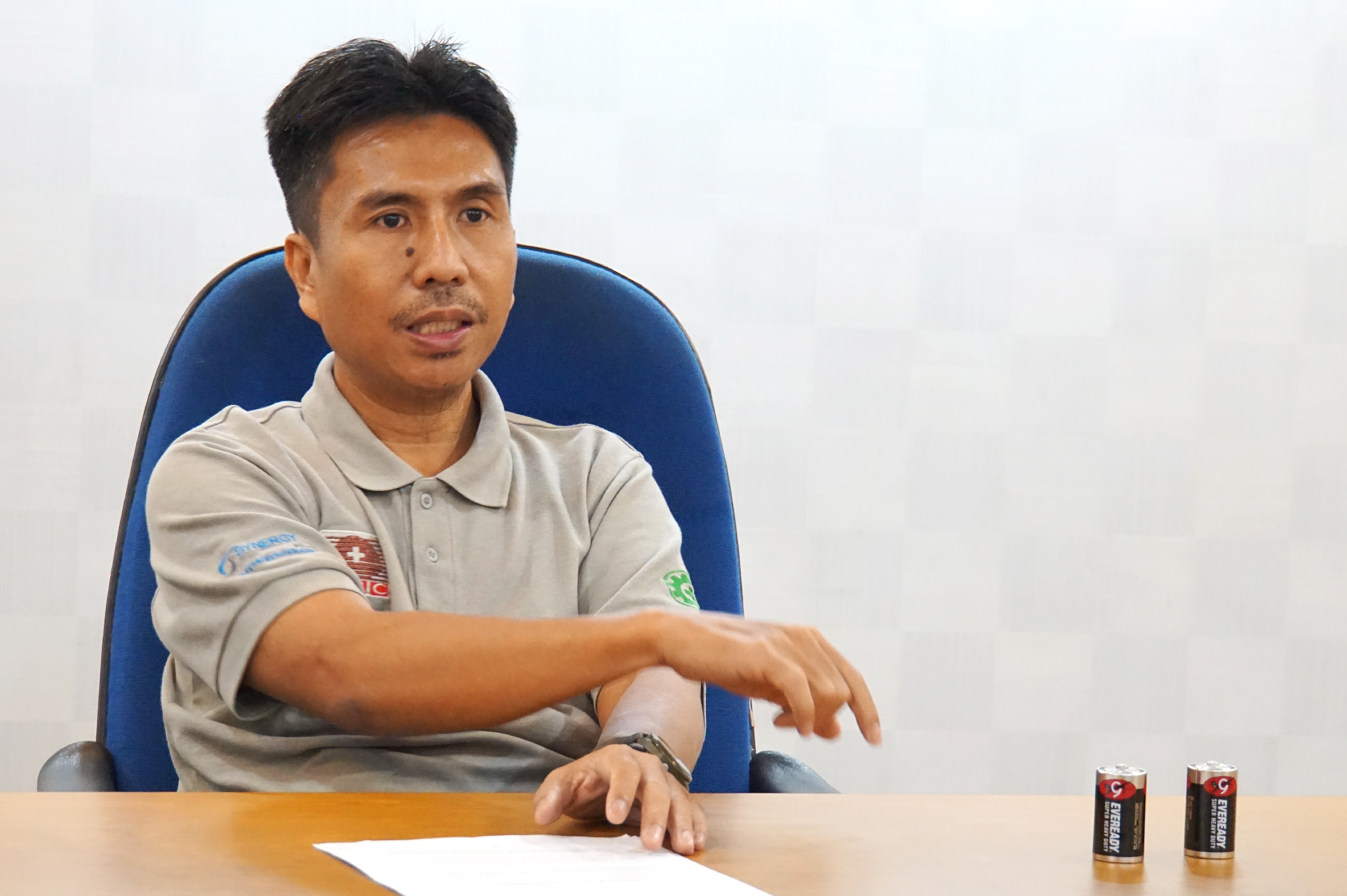
“Previously, we had to wait for aging for a week, so it was only detected when it had become a finished product. So the battery was complete, with a jacket already on. Now, with this, we only check the can itself, we can take the can, and then repack it. If it has already become a battery, then it becomes scrap. And for those batteries, we also have to pay to dispose of the scrap.”
SelectionWhy KEYENCE, and why the VS Series?
When asked what his considerations were when choosing a vision system supplier, Abdul Basit, Electrical & Facility Engineer of the plant, placed support as the first priority, price second, and features third. What ultimately decided it, though, was not the spec sheet but whether his own team could operate the system without needing to contact anyone.
“Some cameras might be fully featured, but sometimes my team struggles with the settings. With this, we try to learn once or twice, and after that, we can do it. So for this KEYENCE camera, we already know 80% of its features, we know the settings. So we don’t have to ask the vendor for every little thing.”
The team’s ability to perform calibrations independently also helps reduce costs when issues arise. When the team can adjust inspections themselves, product changes or process deviations do not always require assistance from a technician team. They still consult with KEYENCE for things that are truly beyond their experience, but routine work is handled internally.
The second deciding factor was how purchases were evaluated. Instead of choosing from a spec sheet, the plant first discussed the application with KEYENCE: samples were tested, and units were installed on the actual production line before an order was made. A purchase order was only issued after the production team approved it.
“So before we ordered the product, we were probably 90% confident that we could do this. The production team was okay, approved it, and only then did we open a PO. So that was quite helpful for us.”
Because the application was already proven on the customer’s own samples, installation generally went smoothly: guidance was already available, the unit just had to be installed, and production was usually back up and running in one to two days. Post-sales support was also rated as meeting the team’s expectations: they could contact the sales team and, when needed, technical experts directly, with remote assistance when visits could not be made immediately.
ResultsWhat changed on the production line after installation?
The most visible change was the number of products that could be inspected. The line runs at 600 pieces per minute — 36,000 units an hour. With the previous method, an operator only took a few samples every hour.
“Ideally, we perform sampling inspection of 7 pcs per 1,000 products. But our production is 600 pcs per minute, so in 1 hour that’s 36,000 pcs, and if we only take 3 pcs from that, it’s not enough to guarantee the production lot.”
With the VS Series inspecting every unit, the quality of each product is checked and the results are recorded, rather than relying on a few samples. The system can also be set to automatically stop the machine when it detects a predetermined number of consecutive NG products, instead of relying on the operator to notice and intervene.
This has a significant impact on the inspection process. Manual visual inspection on this line meant one person was stationed at the conveyor, rotated every four hours across three shifts. Even with training, judgments remained variable: those that were consistent in the first hour had drifted by the next. Different people also applied different thresholds under different pressures. Automated inspection eliminates those variables, and the three positions previously assigned to this check across three shifts can be redeployed elsewhere in the plant.
Defective products that slip through the inspection process can have a direct impact on customers. A battery that is supposed to last two years might only last a few weeks in the customer’s hands if there is a problem with the can, and with the Energizer name on store shelves worldwide, the plant recognized that this would not only incur warranty costs but could also damage its brand reputation. Before cameras were implemented across the entire swaging line, a batch that had been stored for a long time led to leakage complaints from overseas customers. Since then, according to the team, leaks have become rare.
There were also benefits no one had anticipated. The camera was installed to look at the edge of the can; it turned out the camera could see more than that.
“We only focused on the can lip, but we also detected misplaced or folded components. And that saves us almost one pc per thousand. So if it’s one million, that’s a thousand batteries saved. And that wasn’t our parameter before. So in the future, that might become our parameter.”
The system also captures conditions such as off-center electrodes — not the plant’s primary concern, but now visible when they weren’t before. As Basit said, the inspection that was originally set for only one parameter turned out to be much more detailed.
Although stricter inspection increases the number of NG products detected during assembly, this is still considered positive because problems can be found earlier. Consequently, the number of NG products at the end of the process that must be discarded is also reduced.
OutlookNext steps: marking, code traceability, and new parameters
The project focus at this plant has now shifted from the edges of the cans to the printing on them. Date and batch codes are currently applied using ink, which has several drawbacks, such as operators forgetting to refill the ink, faint printing, or code errors that are not immediately detected.
“We use ink, and we often face issues with that ink. Operators forget to refill the ink, and then it gets faint. Early detection is not fast, because several times it happened that we only found out after several pallets. Then there are also wrong codes. If we use a laser, for example, and then we can record it, that might be better maintained for us.”
The team is currently in discussions with KEYENCE regarding laser marking and code reading, as well as expanding the use of the vision system to detect smear-type defects that are currently inspected with measurement sensors. Camera trials for that application are currently underway.
When asked if he would still choose KEYENCE at other locations, Basit pointed to another location within his group: the company’s second plant in Indonesia already uses KEYENCE, and when affiliated plants overseas ask for recommendations, his team directs them to the equipment they use themselves.
Frequently Asked Questions (FAQ)
QWhat problems did PT Energizer Indonesia solve with the KEYENCE VS Series vision system?
A
Dents and deformations on the edges of battery cans previously only appeared after a week-long aging test, at which point the batteries were already finished products and had to be scrapped. With the VS Series inline inspection, defects are found while the components are still cans, allowing the cans to be recovered and repacked instead of being scrapped.
QWhy did the plant switch from camera sensors to the KEYENCE VS Series vision system?
A
The camera sensors previously used were limited to OK/NG outputs. The team wanted more inspection details on the can edges, and they wanted to be able to configure and adjust the system themselves. The VS Series gave them both, and the engineering team now reports handling about 80% of the setup and adjustments internally.
QWhy was hourly sampling not enough on a 600-pieces-per-minute line?
A
At a speed of 600 pieces per minute, the production line produces 36,000 units per hour, so operators taking three samples per hour cannot represent the entire batch. The VS Series inspects every unit inline and records the results, and the line can be set to automatically stop after a predetermined number of consecutive rejects.
QWhat unexpected benefits did the VS Series bring to the battery production line?
A
The camera was installed to inspect the can edges, but it also detects misplaced or folded internal components, which was never previously an inspection parameter. The team estimates this saves about one piece per thousand, or about one thousand batteries per million produced, and plans to make it an official inspection parameter.
QHow does PT Energizer Indonesia assess the investment feasibility of KEYENCE equipment?
A
Management sets a two-year payback period target for every camera or machine purchase, calculated upfront from the scrap expected to be eliminated by the equipment. The engineering team reports that the ordered KEYENCE equipment has met those calculations, and the units typically remain in operation for five to ten years.
QWhat does PT Energizer Indonesia appreciate most about working with KEYENCE?
A
The support and the ability to try before buying. The team can discuss applications with KEYENCE, test samples, and evaluate units on the actual production line before issuing a purchase order, so that when the order is placed, they are already confident the application will succeed. Installation then typically takes only one to two days before production is running again.