BIEMMEPI SISTEMI S.R.L. (hereinafter BIEMMEPI), an Italian manufacturer of CNC machines, including machines for the eyewear industry, has integrated the KEYENCE MD-U Series UV laser marker directly into its QUBE LENSES 5-axis lens machine. Sunglass lenses are now marked in-machine while they are still clean and in a known position: operators no longer need to pick up, clean, and re-center each lens at a separate marking station. Alessandro Pagani, owner of BIEMMEPI, explains why KEYENCE made this solution possible and how the machine operates unattended.
This case at a glance
- Marking moves inside the machine. BIEMMEPI integrated the KEYENCE MD-U Series into its 5-axis QUBE LENSES, eliminating the separate marking station, the need for handling, and the additional operator.
- No re-centering. The lens is marked on the same support used for milling: its position is already known, and marking occurs while it is still clean.
- Software correction, not mechanical. The variable Z-coordinate, marking on 3D surfaces, and autofocus across the entire work area allow the laser to remain stationary and the marking to be corrected via software.
- Designed for unattended operation. Z-tracking detects obstructions such as falling chips, and BIEMMEPI’s software repeats the marking: the machine works for 8 to 10 hours, and the operator only needs to load and unload the lenses.
- High productivity in a small footprint. Two processing stations work on two fixtures in a time interval of about 1 minute, doubling the parts produced within the same footprint.
- Now a standard product. The QUBE LENSES with laser is standardized and in production, offering BIEMMEPI a technologically advanced machine to stand out.
Who is BIEMMEPI SISTEMI?
BIEMMEPI is a historic family-run company, founded in 1981 by Alessandro Pagani's father and grandfather. Today, the company is led by Alessandro and his brother: Alessandro mainly deals with software development and the commercial side, while his brother handles mechanical and electronic design and support.
BIEMMEPI builds CNC machines, mainly for the eyewear sector and other fashion sectors. BIEMMEPI evaluates the devices to be integrated based on the needs and technical capabilities of its end-user customers. Instead of directly measuring the marking cycle time, it has customers send test samples, creates the technical application, and compares the results with them. In eyewear, aesthetics matter as much as speed.
“Not everyone has aesthetic needs. We, on the other hand, need to obtain a finish that is pleasing to the eye. Consequently, differentiations in terms of cycle time become necessary to obtain one finish rather than another.”
ChallengeWhy was marking lenses off-machine a problem?
The QUBE LENSES (QUBE because the axes form a cube, LENSES for the lenses; there is also a variant for frames) was already a very advanced product, with automatic loading and unloading, five axes, and tool change. BIEMMEPI wanted to introduce an extra step that is normally performed off-machine: laser marking.
Marking off-machine requires a series of precautions. The processed lens must be picked up, cleaned, positioned on a pedestal or on a support made by the customer specifically for that lens, and then the correct marking position must be found again.
“Working off-machine, you have to correctly reposition the already processed lens. Therefore, an extra person, an extra step, a different organization, and above all a specific station for marking are required.”
In the QUBE LENSES, the raw lens is positioned on a resin support and processed there: the automatic loader and the machine already know exactly where the lens is. Marking at that point means the lens is marked while it is still clean, and no one has to physically pick it up, put it on another support, and perform centering, which is a non-trivial operation.
SelectionWhy choose the KEYENCE MD-U Series for in-machine marking?
Before choosing KEYENCE, BIEMMEPI tried laser markers from other manufacturers. The deciding factor was the combination of software and hardware potential that allowed the laser to be integrated inside the machine.
“The variable Z coordinate, which is non-trivial, all the potential of the software for working on 3D surfaces and 3D solids, and other features such as autofocus over the entire work area allowed us to integrate the laser directly into the machine. Otherwise, it would have been much more complicated and would have required, on a mechanical level, a different setup of the machine.”
Instead of changing the tooling, BIEMMEPI simply keeps the laser stationary. The machine opens the door, the KEYENCE software applies all the necessary corrections, and the final marking comes out correctly regardless of where the lens is positioned.
ResultsHow does in-machine marking work on the QUBE LENSES?
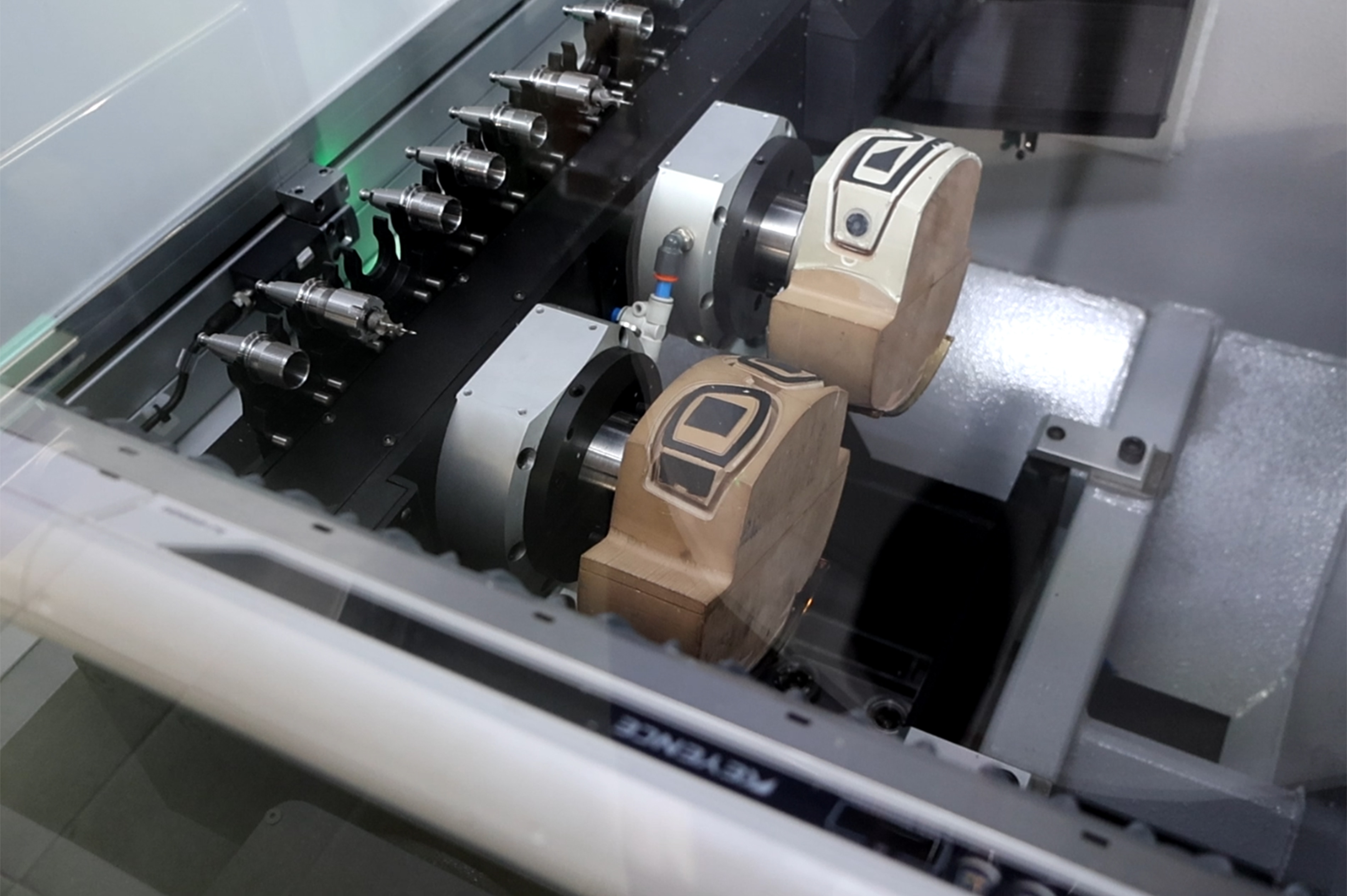
The machine has three stations: loading, milling and marking, unloading. An automatic loader with three CNC axes picks up each lens or fixture based on coordinates such as size and shape, so when the lens model changes, it adapts automatically. Instead of vision systems, the machine uses presence sensors and vacuum switches, and the supports already used for milling also serve for marking.
The five axes are essential for marking quality. The rotary axes tilt the lens at a defined angle, so that the surface remains perpendicular to the laser and stays within the marking cone even on a complex 5-axis fixture. In the software, surfaces are used to correct the marking. This is another reason why the laser was placed in the machine and not left outside.
The laser is located below the milling area, behind a door with an air blow for cleaning. Despite this protection, chips can still fall, which is why BIEMMEPI uses KEYENCE’s Z-tracking in a particular way.
“We use Z-tracking to check if there is an obstruction between the laser and the lens. We developed our own software to repeat the marking a certain number of times, trying to clean the laser lens over and over again, until a correct result is obtained or it is reported that the laser failed to mark correctly. For a fully automatic machine, this is a very important feature.”
The goal is complete autonomy: the machine is loaded with parts and works for 8 to 10 hours, while the operator only has to load and unload the lenses. The marked lenses are placed on polystyrene supports and, when the queue is full, taken to assembly or cleaning. The anti-UV protective glass allows the marking to be observed safely, which is particularly useful during the prototyping phase.
The machine is also highly productive. For a fairly complicated lens, it processes two fixtures in a time interval of about 1 minute. With two processing stations operating simultaneously, BIEMMEPI halves the cycle time: an important advantage for Italian customers, who often have little space available.
“The same footprint as another machine, but here I make twice as many parts.”
For customers who previously did not have marking or had it done externally, the main advantage is that a dedicated person for marking is no longer needed. Quantitative comparisons with previous processes will be collected by customers in the future.
OutlookWhat are the next steps for BIEMMEPI?
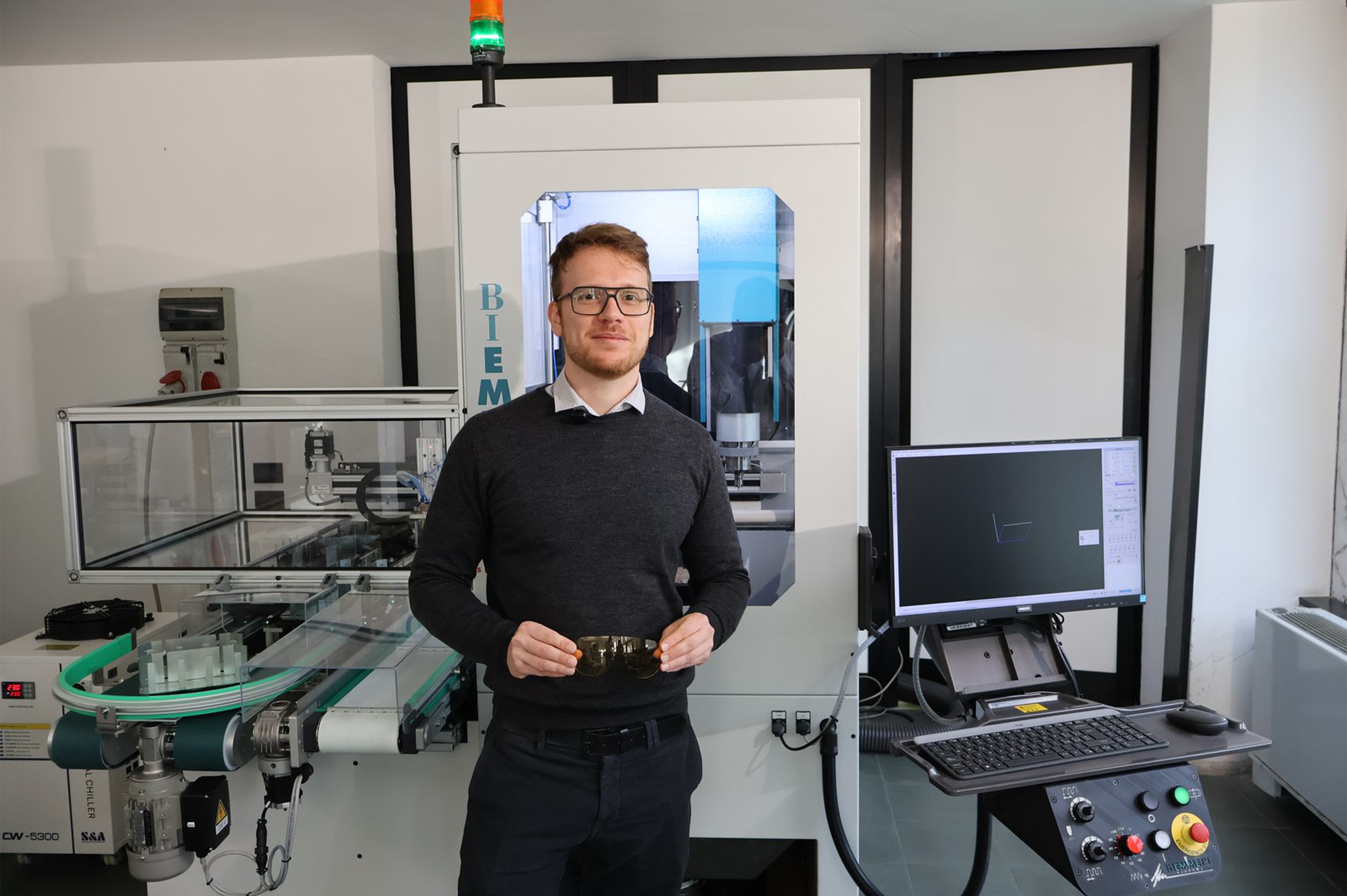
The QUBE LENSES with laser is now fully standardized and in production. BIEMMEPI considers it a fairly unique product, with few comparable solutions on the market, which allows it to stand out especially in highly competitive markets such as Asia.
Alessandro has already recommended KEYENCE to other companies, including nearby ones.
“As a company, we look closely at the technical aspect. Your marker has so much potential compared to other markers: autofocus, Z-surface scanning, and the camera positioned both coaxially and non-coaxially, which is very useful, especially during the prototyping phase.”
Frequently Asked Questions (FAQ)
Q Why did BIEMMEPI SISTEMI integrate the KEYENCE MD-U Series into its lens machine instead of marking lenses at a separate station?
A
With off-machine marking, an operator had to pick up the processed lens, clean it, position it on a support made by the customer for that lens, and find the correct marking position again. Marking inside the machine eliminates this handling, the extra person, and the dedicated marking station, because the machine already knows exactly where the lens is.
Q Which functions of the KEYENCE MD-U Series made in-machine marking possible?
A
The key functions were the variable Z-coordinate, the software for marking on 3D surfaces and 3D solids, and the autofocus over the entire work area. Thanks to these functions, the laser remains stationary and the marking is corrected via software, so a different mechanical setup of the machine was not necessary.
Q How does BIEMMEPI SISTEMI use the Z-tracking of the KEYENCE MD-U Series?
A
The laser is positioned below the milling area, so chips can fall despite the door and air blow. Z-tracking is used to check if there is an obstruction between the laser and the lens. BIEMMEPI has developed its own software that repeats the marking a set number of times, cleaning the laser window each time, until the result is correct or a marking failure is reported.
Q How does the 5-axis QUBE LENSES machine keep the lenses within the marking area of the KEYENCE MD-U Series?
A
The rotary axes tilt the lens at a defined angle so that the surface remains perpendicular to the laser. This way, the lens always remains within the marking cone of the laser, which would not be possible from a fixed position on a curved and complex fixture.
Q What cycle time does the QUBE LENSES achieve with the KEYENCE MD-U Series?
A
For a fairly complicated lens, the machine processes two fixtures in a time interval of about 1 minute. It has two processing stations operating simultaneously, so the cycle time is halved and twice as many parts are produced with the same footprint.
Q Why does BIEMMEPI SISTEMI recommend the KEYENCE MD-U Series laser marker?
A
As a company highly focused on the technical aspect, BIEMMEPI appreciates the potential of the marker: autofocus, Z-surface scanning, and the camera that can be positioned both coaxially and non-coaxially, which is particularly useful during the prototyping phase. Alessandro Pagani has already recommended KEYENCE to other companies.