- Home
- Solutions
- Case Studies
- KEYENCE BT Series Handheld Computers Drive Accuracy and Efficiency at Major 3PL Provider
KEYENCE BT Series Handheld Computers Drive Accuracy and Efficiency at Major 3PL Provider
Rapid growth and increasing customer expectations are placing ever greater demands on third-party logistics (3PL) providers to deliver speed, accuracy, and full traceability. At U.S.-based Commonwealth Warehouse Inc., the transition from paper-based processes to digital data capture using KEYENCE BT Series handheld computers is driving dramatic improvements in accuracy, throughput, and QA process management.
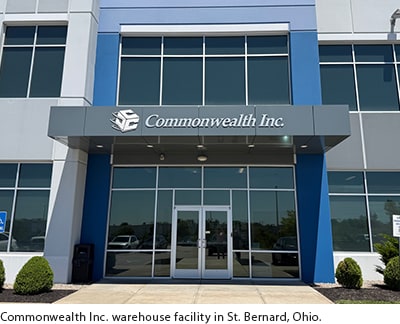
With its headquarters in St. Bernard, Ohio, Commonwealth Warehouse operates a total of seven facilities in Ohio and Kentucky, primarily around the Cincinnati area.
“We provide 3PL support through flexible warehousing space, multimodal transportation, and fulfillment,” explains Tom Hull, the company’s QA Manager.
From paper to precision
As the business scales, so too does the need for more robust quality control and traceability. Previously reliant on manual, paper-based systems, Commonwealth Warehouse faced inherent limitations.“Prior to adopting KEYENCE handheld computers, we relied on paper pick tickets and paper receipts,” says Hull. “The potential for human error was clear, and it would inevitably cause issues from time-to-time. We require full traceability on any license plate - pallet, container, box - moving through our system. It’s essential to have complete confidence in item and lot number accuracy, especially in the event of a client recall, where an immediate response is paramount.”
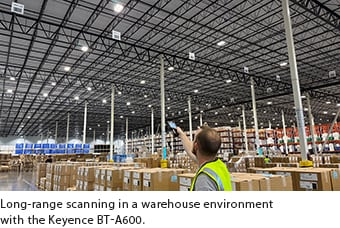
To address these challenges, Commonwealth Warehouse implemented a fleet of KEYENCE BT Series handheld computers, primarily the BT-A700 model, alongside a smaller number of BT-A600 devices for a specialized application.
Seamless integration, immediate impact
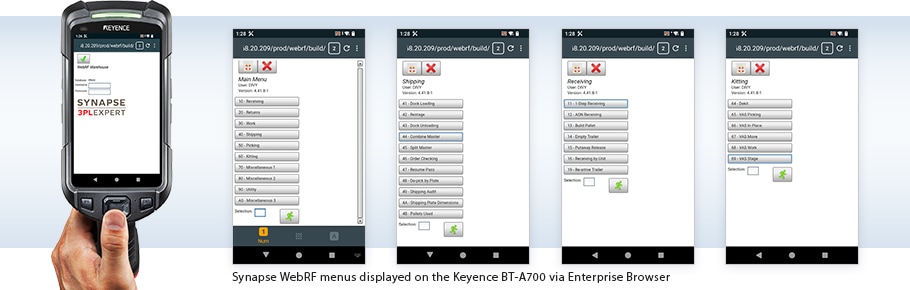
A key factor in the success of the project was seamless integration between the KEYENCE devices and the company’s new warehouse management system (WMS): Synapse WebRF by Made4Net.“It was virtually plug and play; so simple and smooth,” reveals Hull. “Setting up one BT Series handheld computer took about five minutes before we cloned the configuration across the rest. If we received a batch of devices in the morning, they would be delivered to work locations and operational by lunchtime.”
“We kept hearing from existing users of our chosen WMS that the KEYENCE BT Series was what we needed, and that’s proven absolutely correct,” he adds.
Driving accuracy and eliminating errors
The transition to digital scanning has delivered immediate and measurable benefits, particularly in reducing costly mis-shipments.
“I estimate we’ve saved thousands of dollars just by eliminating mis-shipments caused by human error,” says Hull. “Accuracy is the biggest improvement.”
The BT-A700 handheld computers, which make up most of the company’s deployment, offer a wide reading range, from just a few centimeters up to 10 meters, enabling operators to scan items quickly and reliably. Their ergonomic design and robust wireless connectivity further enhance productivity in busy warehouse environments.
Meanwhile, the BT-A600 models play a critical role in a specialized customer project at Commonwealth Warehouse that requires validation between two labels on outbound shipments.
“The BT-A600 is vital for that application,” explains Hull. “We need to confirm that specific fields on two labels match before shipping. The accuracy and speed of the BT-A600 scanners make it possible.”
By leveraging the BT Application Design Tool in combination with AI powered OCR (optical character recognition), the device can capture barcodes, read printed text, compare required data points between both labels, and record each verification. Together, these capabilities deliver precise and dependable label validation beyond the limits of traditional barcode scanning technology.
Transforming receiving operations
One of the most significant operational improvements is in the receiving process, where digital data capture has dramatically reduced dock-to-stock times.
“If the product is properly labeled, we can scan it as we unload the truck and it becomes available in the system immediately,” says Hull. “Previously, we had to write everything down, label it, put it away, and then manually enter the data. Dock-to-stock could take 90 to 120 minutes, sometimes longer for bulky items. Now we can process a full truckload in as little as 15 minutes in some cases.”
Enhancing QA and visibility
Beyond speed and accuracy, the KEYENCE BT Series devices are strengthening Commonwealth Warehouse’s QA management processes.
“Auditing used to be a long process,” he remarks. “Auditors would pick pallets, write down information, and then return to the office for verification against the system. Now they just scan the pallet, and the system tells them exactly what should be there. The auditors compare it physically and the job is done.”
The ability to scan items anywhere in the workflow, including on trucks or in staging areas, ensures real-time visibility across operations, providing “a huge advantage”.
Flexible, future-ready technology
Another important benefit is the flexibility offered by the KEYENCE development environment, facilitated by the BT Application Design Tool.
“We’ve been able to develop custom applications to support specific customer requirements,” says Hull. “If the scope of a project changes, we can adapt quickly. That’s been huge for us and provides opportunities for future projects as well.”
The ability to manage multiple data formats, including barcodes, QR codes, and OCR (Optical Character Recognition), further supports the diverse needs of Commonwealth Warehouse’s customer base.
Strong partnership and ongoing support
Hull is equally positive about the company’s experience of working with KEYENCE.
“Fantastic - one of the best suppliers I work with today,” he says. “KEYENCE have been very supportive and responsive, from initial selection through to on-site support and aftersales service.”
He concludes: “It’s clear to see that we’re not shy about investing in quality. If there’s a way to improve accuracy and customer satisfaction, we’ll do it. Our investment in KEYENCE handheld computers exemplifies that ethos.”
APPLICABLE PRODUCT CATALOG

Related Products
-

- Handheld Computer
BT-A600 series -
The Android™ handheld computer BT-A600 Series allows you to take advantage of high-speed reading performance with a quad camera that flexibly handles both near and far codes, and an 8-core CPU with AI core. KEYENCE’s AI filters also allow for instant reading even for challenging codes. It is equipped with a large 4.3-inch screen, alpha-numeric keyboard, and also has attachment options such as a gun grip and ring trigger. These options provide improved usability in any application. This product’s diverse set of features includes best-in-class durability, a battery that enables a full day of operation, and a device management tool that backs up data from startup to operation and maintenance.
- Handheld Computer
-

- Handheld Computer
BT-A700 series -
Our new, full-range model of handheld computers, the BT-A700 Series, is capable of reading codes from a minimum distance of 1 in (2.5 cm). to a maximum distance of 10 m (30 ft). Its impressive reading range and speed enable users to read codes instantaneously in one hand not only while standing but also while seated in a forklift. This leads to impressive productivity improvements. The combination of the first-in-class full-range camera and ultra-high-speed decoding allows instantaneous reading of barcodes even from an angle. The ease of on-site use has also been greatly enhanced. The compact body with a largest-in-class 5-inch screen offers excellent grip to allow stable one-handed operation. Rugged design with a tempered glass screen withstands drops from heights of 2.4 m (8 ft). The device can also be used continuously for up to 32 hours.
- Handheld Computer
- PLEASE
CONTACT US