How Optical Transceiver Laser Marking Supports Quality in AI Data Center TOSA Production
Optical transceiver manufacturers supplying AI data centers need reliable component identification throughout production, inspection, and long-term use. Adhesive labels can become difficult to read or may detach when exposed to manufacturing processes, handling, heat, or harsh operating environments. When identification is compromised, traceability and quality control become more difficult to maintain.
TOSA (Transmitter Optical Sub-Assembly) is a key component within optical transceivers, responsible for converting electrical signals into optical signals for fiber-optic communication. As AI data center infrastructure continues to require higher bandwidth and faster data transfer, manufacturers face increasing demands for reliable quality assurance and product traceability.
Laser marking addresses these requirements by enabling permanent serial numbers, barcodes, and data matrix codes that remain readable throughout the component lifecycle. This article explores how laser marking supports TOSA manufacturing quality and traceability in optical transceiver production.
Key Takeaways
- Laser marking provides permanent traceability that remains readable throughout manufacturing and product use, even in demanding production environments.
- TOSA components play a critical role in optical communication systems used in modern AI data centers.
- Integration with manufacturing and quality systems can support faster issue identification, product tracking, and quality control processes.
- Data matrix codes can store production and traceability information in a compact footprint, helping manufacturers improve visibility across the production lifecycle.
- Non-contact laser marking preserves component integrity without adding bulk, helping maintain product quality and performance.
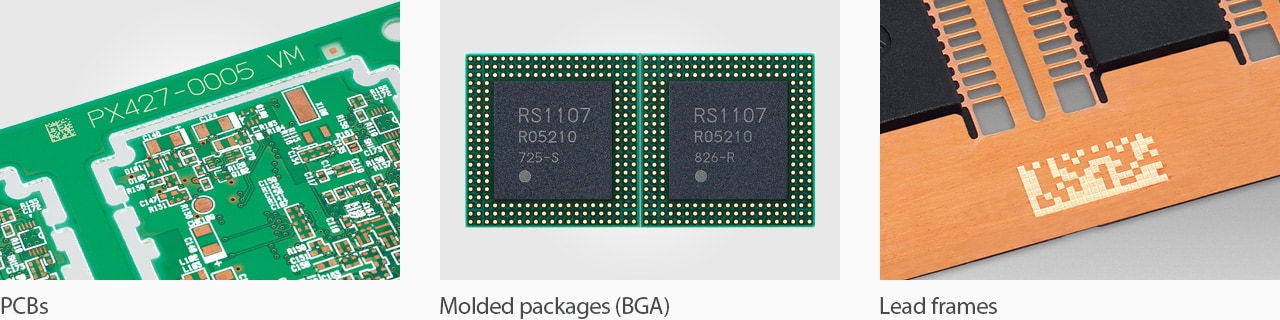
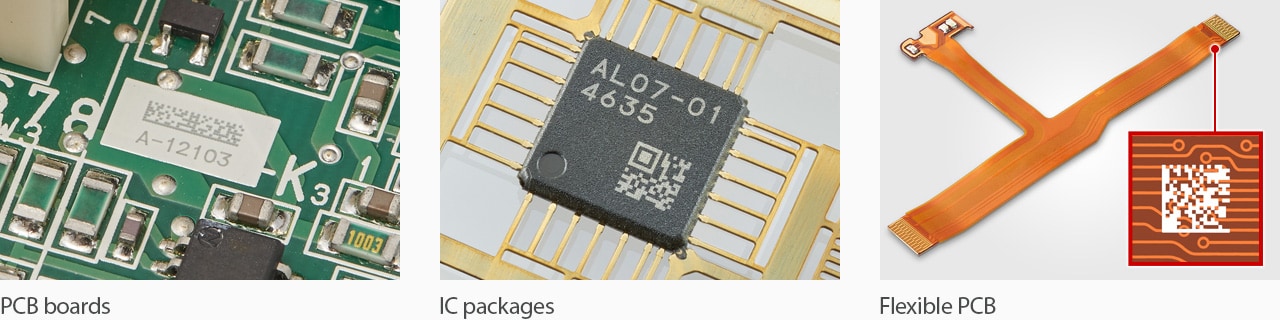
Laser Marked Electronics Examples
What Is TOSA and Why It Matters in AI Data Centers
TOSA is the core component responsible for electrical-to-optical signal conversion in fiber optic communications. Each assembly integrates a laser diode as the primary light source, monitoring photodiodes that maintain consistent output power, and optical isolators that prevent reflected light from disrupting laser operation. Applications that require precise temperature regulation also incorporate thermoelectric coolers to keep the laser diode within optimal operating conditions.
Laser diode selection helps determine the performance and communication distance a TOSA can support. Different laser technologies are used depending on application requirements, with some optimized for shorter-range communication and others designed for longer-distance, higher-performance networks. As optical communication technology continues to evolve, manufacturers are placing greater emphasis on quality, reliability, and traceability throughout the production process.
How TOSA and ROSA Work Together in Optical Transceivers
TOSA handles signal transmission, while ROSA (Receiver Optical Sub-Assembly) receives incoming optical signals and converts them back into electrical signals. ROSA commonly incorporates photodiodes and signal amplification circuitry to support reliable data transmission. Together with driver electronics, control circuitry, and housing components, TOSA and ROSA form the core optical interface within modern transceivers.
The Role of TOSA in Modern AI Data Centers
As AI workloads continue to expand, data center networks require greater bandwidth, lower latency, and higher efficiency. Optical transceivers play a critical role in enabling these high-speed communications, with TOSA serving as the transmission component responsible for generating optical signals.
As data center architectures evolve, manufacturers must maintain strict quality and traceability standards across increasingly compact and sophisticated optical components. Reliable identification and production tracking help ensure product quality throughout manufacturing, deployment, and long-term operation.
Why TOSA Quality Directly Impacts Data Center Performance
TOSA performance directly affects signal integrity, optical output, and transmission reliability. As data centers demand faster communication speeds and greater bandwidth, manufacturers must maintain consistent quality and traceability throughout production to support reliable performance.
Why Laser Marking is Essential for TOSA Manufacturing Quality
Laser marking supports quality, traceability, and reliability throughout optical transceiver manufacturing by helping manufacturers:
- Create permanent identification - Laser marks are applied directly to the component surface, creating durable identifiers that resist wear, chemicals, and environmental exposure throughout the product lifecycle.
- Mark challenging materials – Engineering plastics and other materials commonly used in optical components can be permanently marked with clear, high-contrast identifiers without labels or consumables.
- Eliminate label-related issues – Unlike adhesive labels, laser marks cannot peel, detach, or degrade due to heat, handling, chemicals, or environmental exposure.
- Preserve component integrity – Because laser marking is a non-contact process, it minimizes mechanical stress and contamination concerns while helping maintain the integrity of sensitive optical components.
- Improve traceability – Serial numbers, batch codes, and data matrix codes can be linked to production records, supporting product tracking throughout manufacturing and supply chain operations.
- Support quality and compliance initiatives – Laser-marked identifiers can be integrated with manufacturing systems to support documentation, audit requirements, and quality assurance processes.
Laser Marked Electronics Examples
Key Laser Marking Applications in TOSA Production
Common laser marking applications in optical transceiver manufacturing include:
- Optical chips and laser diodes – Serial numbers, identifiers, and 2D codes can be applied directly to components to support inventory management and manufacturing traceability.
- TOSA housings – Data matrix codes and serialized identifiers can link each unit to production records, inspection data, and other traceability information throughout the manufacturing process.
- Batch and lot identification – Batch codes can be used to track manufacturing dates, production locations, lot numbers, and production lines, supporting quality investigations and product tracking.
- Assembly alignment marks – Orientation and polarity indicators help automated assembly equipment correctly position fiber optic components during production.
- Compliance and quality documentation – Machine-readable marks support traceability programs, quality documentation, and industry-specific compliance requirements throughout the product lifecycle.
Contact us to learn how KEYENCE laser marking systems support traceability and quality control in optical transceiver manufacturing.
How Optical Transceiver Laser Marking Improves Quality Control
Laser marking supports quality control throughout optical transceiver manufacturing by helping manufacturers:
- Verify mark quality in real time – Vision systems can inspect codes immediately after marking to identify unreadable or low-quality marks before components move to the next production stage.
- Integrate with MES platforms – Laser-marked identifiers can be linked to manufacturing databases, helping automate data collection and support end-to-end production tracking.
- Improve traceability and product visibility – Serialized markings can be associated with production records, inspection data, and manufacturing history throughout the product lifecycle.
- Support product authentication initiatives – Permanent, machine-readable identifiers can help organizations maintain visibility across manufacturing and supply chain operations.
- Streamline troubleshooting and quality investigations – When issues arise, marked components can be traced back to relevant production records, supporting faster root-cause analysis and product tracking.
Together, these capabilities help manufacturers improve production visibility, maintain traceability, and support quality assurance throughout optical transceiver manufacturing.
Conclusion
Optical transceiver laser marking provides a permanent identification method for TOSA components used in AI data center applications. By enabling durable serial numbers, data matrix codes, and traceability information directly on component surfaces, manufacturers can support quality control, production visibility, and long-term traceability.
When integrated with manufacturing and inspection systems, laser marking helps simplify product tracking throughout production while supporting quality assurance initiatives. As optical communication technologies continue to evolve, permanent component identification will remain an important part of maintaining traceability across increasingly sophisticated optical assemblies.
Frequently Asked Questions
Q What role do lasers play in optical transceivers for data centers?
A
Lasers serve as the light source in optical transceivers, converting electrical signals into optical signals for data transmission over fiber networks. The laser diode is a core component of TOSA (Transmitter Optical Sub-Assembly), with different types like VCSEL, DFB, and EML lasers selected based on transmission distance requirements and performance needs.
Q Why is laser marking preferred over adhesive labels in TOSA manufacturing?
A
Laser marking creates permanent identification directly on the component surface. Unlike labels, laser marks are not susceptible to peeling, fading, or detachment, making them well suited for traceability applications in manufacturing environments.
Q How does photonics technology benefit AI data center operations?
A
Photonics provides high-speed, energy-efficient interconnects that significantly enhance data center performance. This technology enables faster AI training and inference, supports real-time processing capabilities, and addresses bandwidth demands associated with increasingly data-intensive AI workloads.
Q What information can be encoded in data matrix codes on TOSA components?
A
Data matrix codes can store information such as serial numbers, batch identifiers, manufacturing data, and traceability records. Their compact size makes them particularly useful for small optical and electronic components where available marking space is limited.
Q How does laser marking improve quality control in optical transceiver production?
A
Laser marking supports quality control by enabling permanent component identification and traceability throughout manufacturing. When combined with inspection systems and manufacturing databases, organizations can more effectively track components, access production records, and investigate quality-related issues.