LIBS vs. EDS: What's the Difference?
LIBS and EDS are elemental analysis techniques used to identify and characterize the composition of materials, but they differ significantly in how measurements are performed. This article will compare laser-induced breakdown spectroscopy and energy-dispersive X-ray spectroscopy across operating principles, sample preparation, speed, detection capabilities, accuracy, and common applications to help readers determine which technique is appropriate for their analysis needs.
Key Takeaways
- LIBS, laser-induced breakdown spectroscopy, uses a focused laser pulse to create a plasma and identify elements based on their characteristic light emissions.
- EDS (energy-dispersive x-ray spectroscopy) uses X-rays generated through electron-beam interaction with a sample to determine its elemental composition.
- LIBS can provide rapid elemental analysis with minimal sample preparation, making it useful for a variety of materials and applications.
- EDS is commonly paired with electron microscopy to analyze elemental composition and correlate results with microscopic features.
- Choosing between LIBS and EDS depends on factors including the sample, elements of interest, spatial resolution, detection requirements, and analysis workflow.
Anyone comparing elemental analysis techniques eventually runs into the same question: LIBS or EDS? Both identify what a material is made of, but they capture the information in different ways, and the right pick usually comes down to the sample itself rather than a spec sheet. Here's how each technique works, where they diverge, and what tends to tip the decision.
What Is Laser-Induced Breakdown Spectroscopy (LIBS)?
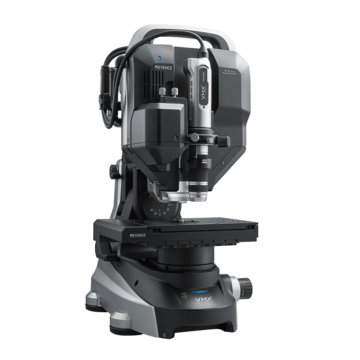
Laser-induced breakdown spectroscopy fires a short, intense laser pulse at a sample's surface, vaporizing a tiny amount of material and generating plasma, a hot cloud of ionized atoms. As the plasma cools, those atoms release light at wavelengths specific to each element, and a spectrometer matches those wavelengths against a library of known signatures. Because the process happens almost instantly with little setup, LIBS is often the go-to option when speed matters more than fine microscopic detail. KEYENCE's EA-300 Series uses laser-induced spectroscopy to identify materials quickly as there is no need for sample preparation or a vacuum.
What Is Energy-Dispersive X-Ray Spectroscopy (EDS)?
Energy-dispersive X-ray spectroscopy takes a different route. A focused electron beam, usually from a scanning electron microscope, strikes the sample and knocks electrons out of their inner atomic shells. As outer electrons drop down to fill those gaps, they release X-rays with energy levels unique to each element, and a detector sorts those X-rays into a spectrum showing what's present and roughly how much. Since EDS runs alongside an electron microscope, it's often used when researchers already need high-magnification imaging tied directly to elemental data.
How do LIBS and EDS work?
How LIBS Works
A pulsed laser, typically in the nanosecond range, targets a small spot on the sample with enough energy to strip electrons from atoms and briefly turn a microscopic volume into plasma. As that plasma glows and cools, a spectrometer collects the emitted light, and software cross-references the wavelengths against known atomic emission lines to identify which elements are present.
Some systems also estimate concentration from the intensity of specific peaks. This entire process, from laser pulse to elemental readout, is what makes laser induced breakdown spectroscopy such a practical option for fast, on-the-spot testing.
What to see how LIBS works? Contact KEYENCE to schedule a demo of the EA Series.
How EDS Works
EDS depends on an electron microscope's beam column rather than a laser. Electrons collide with atoms near the surface, dislodging inner-shell electrons and leaving the atom excited. When a higher-shell electron drops down to stabilize it, the released energy comes out as an X-ray photon tied to a specific element.
A solid-state detector sorts these photons by energy into a spectrum of peaks. Because the beam can be focused to a fine point, EDS can map elemental distribution at a resolution few other techniques match. This electron-beam-driven process is what gives energy dispersive X-ray spectroscopy its fine spatial resolution compared to other elemental techniques.
LIBS vs. EDS: Key Differences
The core difference between LIBS and EDS comes down to what triggers the signal: a laser pulse and plasma emission for LIBS, an electron beam and X-ray emission for EDS. That distinction shapes nearly everything else. LIBS works on bulk samples with little regard for surface prep, while EDS typically needs a vacuum chamber and often a conductive coating on non-conductive materials.
LIBS causes minor ablation at the test site, while EDS is generally non-destructive at the microscopic scale. Spatial resolution also splits the two: EDS can pinpoint composition down to sub-micron features, useful for inclusions or grain boundaries, while LIBS samples a larger spot and suits bulk composition better than fine mapping.
Comparing Sample Preparation and Analysis Speed
Sample prep is where LIBS pulls ahead. Many systems, like the EA-300 Series, analyze a sample as-is, with no coating or vacuum step, and results return within seconds, which makes LIBS practical for quick contaminant and coating/corrosion checks. EDS usually means loading a sample into a vacuum chamber and, for non-conductive materials, applying a thin coating first.
The analysis itself may take only a few minutes with EDS, but setup adds time that LIBS skips entirely. Labs already running samples through an electron microscope or a digital microscope for imaging feel that extra step less, since the sample is already being prepped anyway.
Accuracy, Detection Limits, and Elemental Capabilities
LIBS handles a wide range of elements, including light ones like lithium and beryllium, and can reach parts-per-million detection limits depending on the sample matrix. EDS is generally strong from boron upward, though very light elements are harder to quantify accurately. EDS often edges out LIBS in repeatability and quantitative precision, since electron-beam interaction is more consistent shot to shot than laser-induced plasma.
That consistency is one reason energy-dispersive X-ray spectroscopy is often the preferred choice when quantitative precision matters more than speed. LIBS results can vary with surface condition or moisture, so operators sometimes need matrix-specific calibration curves.
Applications for LIBS and EDS
LIBS shows up often in industries like battery, plating, Food/Pharma, electronics, and automotive. That combination of speed and portability is a big reason laser-induced breakdown spectroscopy has become popular in those industries.KEYENCE's EA-300 Series combines LIBS and a digital microscope to create an all-in-one, easy-to-use system for imaging and elemental analysis.
EDS is a staple in materials science, semiconductor failure analysis, and forensic work, wherever composition needs to tie back to a specific visual feature. It's common to see EDS paired with a scanning electron microscope, since correlating a high-resolution image with an elemental spectrum from the same spot tells a fuller story than either tool alone.
How to Choose the Right Elemental Analysis Technique
Picking between these elemental analysis techniques starts with a few honest questions. Is spatial distribution or bulk composition more important? Can the sample tolerate minor ablation, or does it need to stay fully intact? Is speed the priority, or is precision worth extra prep time?
A lab running quick field checks on unknown metals will likely lean toward LIBS, while a team investigating a failure at the microscopic level will probably reach for EDS. Some organizations use both, treating LIBS as a fast first screen and EDS as the follow-up when a closer look is needed. Reach out to a KEYENCE materials analysis specialist if you're still weighing LIBS vs. EDS for a specific application.
Frequently Asked Questions
Q What is the difference between LIBS and EDS?
A
LIBS uses a laser pulse to vaporize a small amount of a sample and reads the light from the resulting plasma, while EDS uses an electron beam to generate X-rays that reveal composition. LIBS works on bulk samples with minimal prep, while EDS typically requires a vacuum chamber and offers finer spatial resolution.
Q Is LIBS more accurate than EDS?
A
Not necessarily. EDS often offers better quantitative precision and repeatability for detailed microscopic work, while LIBS delivers strong accuracy for bulk composition and rapid screening. The better choice depends on the sample and the level of detail needed. Need help figuring out what the best solution is? Contact KEYENCE's technical experts
Q What elements can LIBS detect?
A
LIBS can detect most elements on the periodic table, including light elements like lithium and beryllium, making it useful across metals and other materials.
Q What elements can EDS detect?
A
EDS typically detects elements from boron upward, performing well on metals and heavier elements, though very light elements can be harder to quantify precisely.