Machine Vision Glossary: Key Terms Every Manufacturer Should Know
This machine vision glossary defines the most common terms in plain English, from field of view and resolution to lighting, inspection tools, and deep learning. The terms are grouped by where they appear in a system.
Key Takeaways
- Machine vision terms are easier to learn when grouped by purpose: imaging and optics, lighting, inspection tools, AI, and system performance.
- Field of view, working distance, and resolution work together. Changing one affects the others, so they should be specified as a set.
- AI and deep learning handle variable or hard-to-define defects, while rule-based tools remain the better choice for clear, measurable features.
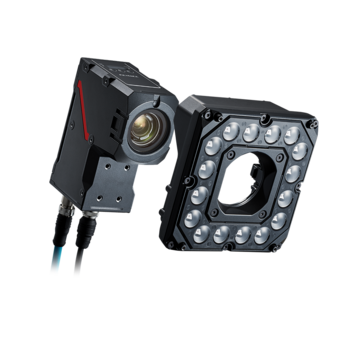
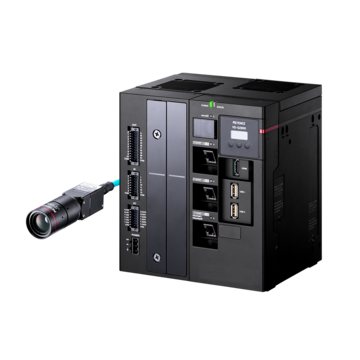
- The KEYENCE VS Series smart camera and VS-G Series controller combine optics, lighting, processing, and AI tools in one platform, which reduces the number of terms and components a team has to manage.
How to Use This Machine Vision Glossary
Machine vision brings its own vocabulary. Terms such as field of view, depth of field, thresholds, and deep learning appear in every quote, datasheet, and application discussion, and the meaning is not always obvious to someone new to the technology. Misunderstanding a single term can lead to a camera that is too far away, a lens that cannot hold focus, or an inspection that is more complex than it needs to be.
This glossary explains the most common machine vision terms in plain English. The terms are grouped by where they appear in a system, from the optics that capture an image to the AI tools that interpret it. Each entry stays short on purpose, so the page can serve as a quick reference during planning, training, or vendor conversations.
Imaging and Optics Terms
Field of View (FOV)
Field of view is the area the camera can see at a given distance, usually described as a width and height. A larger FOV covers more of the part, while a smaller FOV shows more detail. Choosing the FOV is typically the first step in planning an inspection.
Working Distance
Working distance is the space between the lens and the part being inspected. It affects FOV, focus, and how much room is available for lighting and fixtures. A longer working distance generally requires a different lens to keep the same FOV.
Resolution
Resolution describes how many pixels the sensor has, and therefore how much detail an image can hold. A defect typically needs to cover several pixels to be found reliably. Higher resolution helps with small defects or large fields of view, but the right amount depends on the smallest feature that must be detected.
Depth of Field
Depth of field is the range of distance in which the part stays acceptably sharp. Parts with height variation need a deeper depth of field, or they will appear blurred at some positions.
Optical Zoom
Optical zoom changes the FOV by moving lens elements, so the sensor keeps its full resolution. Digital zoom only crops the image, which loses detail. The KEYENCE VS Series uses ZoomTrax, an integrated optical zoom that adjusts the FOV through software without a lens change.
Lighting and Image Quality Terms
Lighting Method
Lighting method describes how light reaches the part, such as direct, diffuse, or backlit. The method determines whether a feature stands out or disappears, which is why lighting is often considered the most important part of a vision setup.
Exposure Time
Exposure time is how long the sensor collects light for each image. Short exposures freeze moving parts and reduce motion blur, while longer exposures brighten dark scenes.
Contrast
Contrast is the difference in brightness between a feature and its background. Strong contrast makes inspection tools more stable, and many inspection problems are really contrast problems.
Inspection Tool Terms
Region of Interest (ROI)
A region of interest is the portion of the image a tool analyzes. Limiting the ROI to the area that matters speeds up processing and avoids false results from irrelevant parts of the image.
Threshold
A threshold is the cutoff that separates pass from fail, or one brightness level from another. Thresholds set too tightly cause false rejects, while thresholds set too loosely allow defects through.
Pattern Matching
Pattern matching compares the image to a stored reference and reports how closely they match. It is commonly used to confirm presence, locate parts, or verify assembly.
Edge Detection
Edge detection finds the boundaries where brightness changes sharply. It supports measurement tasks such as width, gap, and position checks.
Blob Analysis
Blob analysis finds connected groups of similar pixels and reports their size, shape, and count. It is often used to find spots, voids, or missing features.
OCR and OCV
Optical character recognition (OCR) reads printed text, while optical character verification (OCV) confirms the text is correct and legible. Both are used for date codes, lot numbers, and labels.
Rule-Based Inspection
Rule-based inspection uses defined tools and settings, such as measurements and thresholds, to judge each part. It performs well when a defect can be described with clear numbers.
AI and Deep Learning Terms
Artificial Intelligence (AI)
In machine vision, AI refers to software that learns to make inspection decisions from examples rather than from fixed rules. It is especially useful for parts with natural variation, such as textured, molded, or organic surfaces.
Machine Learning
Machine learning is the broader category of methods that improve through data. Deep learning is one type of machine learning.
Deep Learning
Deep learning uses layered neural networks to find patterns in images. In inspection, it can classify defects or detect anomalies that are difficult to define with measurements alone.
Training Images
Training images are the example images used to teach an AI tool what good and bad parts look like. A varied, well-labeled set of examples usually matters more than a very large one.
Anomaly Detection
Anomaly detection learns what normal parts look like and flags anything different. It works well when defects are rare or unpredictable, because it needs few or no defect examples.
System and Performance Terms
Smart Camera
A smart camera combines the sensor, lens, lighting, and processor in a single unit. This reduces wiring and setup compared to a separate camera and PC, as seen in the VS Series smart camera.
Controller
A controller is the processing unit that runs inspection programs, often supporting multiple cameras. The VS-G Series controller adds tools such as an Image Database and Settings Verification.
Trigger
A trigger is the signal that tells the camera when to capture an image, usually from a sensor or PLC. Poor trigger timing is a common cause of unstable results.
False Reject and False Accept
A false reject is a good part marked as bad, and a false accept is a bad part marked as good. Both are measures of inspection reliability, and teams track them to judge system performance.
Cycle Time
Cycle time is how long one inspection takes from trigger to result. It must be shorter than the time between parts on the line.
Image Database
An image database stores pass and fail images for later review. It supports troubleshooting, training, and validating changes against real production images.
Putting the Terms to Work
These terms rarely appear alone. A project might begin with the smallest defect, which drives resolution, which drives FOV and working distance, which in turn shapes the lens and lighting. Understanding the chain makes it easier to ask better questions and to compare options fairly. More information on machine vision systems and industry applications is available for teams planning a new inspection.
Contact KEYENCE to discuss which machine vision terms and settings matter most for a specific inspection, and how the VS Series and VS-G Series can support it.
Frequently Asked Questions
Q What is field of view in machine vision?
A
Field of view is the area the camera sees at a set distance. It is determined by the lens, sensor size, and working distance, and it is usually the first value defined when planning an inspection.
Q What is the difference between AI and deep learning in machine vision?
A
AI is the general idea of software making decisions from learned examples. Deep learning is a specific method within AI that uses neural networks. Most AI-based inspection tools today use deep learning.
Q Does a higher resolution camera always give better results?
A
No. Resolution should match the smallest feature that must be detected and the size of the FOV. Extra resolution can slow processing without improving the result.
Q When should rule-based tools be used instead of AI?
A
Rule-based tools suit features that can be measured clearly, such as position, length, or presence. AI is better when defects vary in appearance or are hard to describe with numbers.
Q What is the difference between a false reject and a false accept?
A
A false reject fails a good part, which wastes product and time. A false accept passes a bad part, which risks quality escapes. Both should be monitored and kept as low as possible.
Q Why does lighting appear so often in machine vision discussions?
A
Lighting controls contrast, and contrast determines how reliably the tools can see a feature. A good lighting setup often solves problems that tool adjustments cannot.