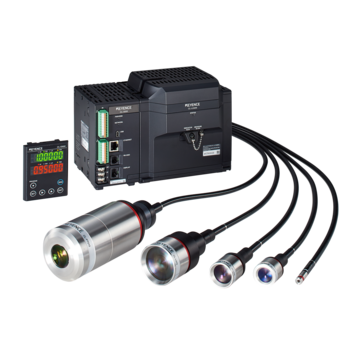
Non-Contact Measurement of Robot Repeatability: Verifying Stop Position and Trajectory Reproducibility at Multiple Points
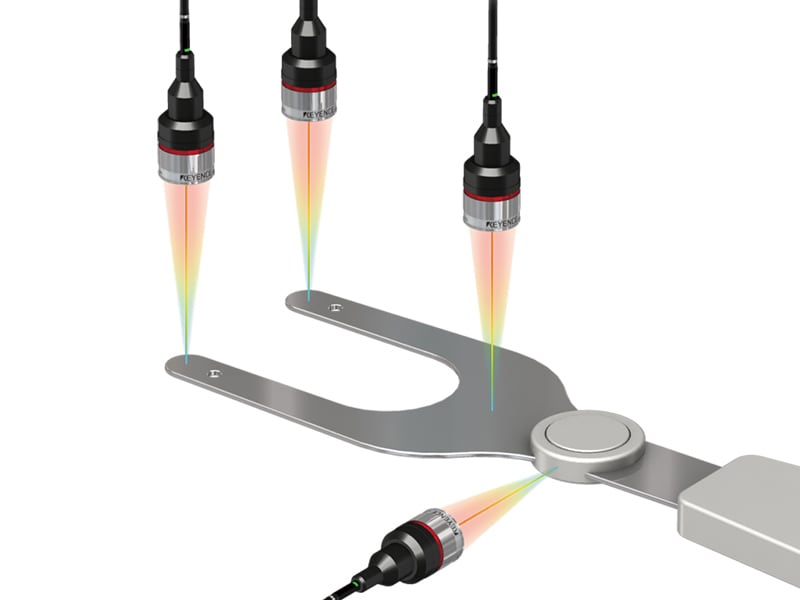
Verify stop position variation and residual vibration of robot hands and arms on actual machines during operation. The ultra-compact head of the CL-3000 Series multi-color confocal coaxial displacement sensor enables non-contact measurement even in tight spaces inside equipment.
Three Issues That Arise When Robot Repeatability Cannot Be Measured Correctly
The reproducibility of the stop position and trajectory of moving articulated robots presents different challenges compared to dimensional measurement of stationary targets.
Stop Position Variation Affects Process Capability
The repeatability of articulated robots directly affects the process capability of handling and assembly. If the return position to a fixed point varies due to aging after installation, temperature, or load conditions, gripping errors and misalignment will escape to subsequent processes as defects. Operating without being able to quantify the stop position variation of the actual machine makes it impossible to isolate the cause, leading to line stops and increased rework.
Internal Encoder Feedback Does Not Guarantee Actual Behavior
Although the robot’s position is managed by the encoder inside the controller, this is internal information on the command value and joint angle, and does not externally guarantee the actual stop position of the hand, including reduction gear backlash and arm deflection. Unless the hand behavior of the actual machine is verified by independent external measurement, discrepancies in which the actual robot is misaligned even if the internal values are fine will be overlooked.
Contact and Sample Measurements Cannot Capture Dynamic Trajectories or Vibrations
Contact dial gauges and offline sample measurements can be used to check a single stationary point, but they cannot capture dynamic behavior such as trajectory reproducibility during operation or residual vibration and overshoot during stopping. If measurement is based on the premise of stopping the movement, reproducibility under actual operating cycle time and acceleration/deceleration conditions cannot be evaluated, weakening the quality basis under mass production conditions.
What and How to Measure (Four Verification Approaches)
Quantify robot reproducibility non-contact from four perspectives: stop position, trajectory, vibration, and multiple points.
- 1 Return reproducibility to a fixed point – Perspective ①. Repeatedly perform the operation of returning to a fixed point with the same command, and record the displacement to the reference surface near the hand non-contact. Quantify the variation in the return position (repeatability).
- 2 Trajectory/path reproducibility – Perspective ②. Repeatedly operate along a fixed path, and continuously acquire displacement to the reference surface with high-speed sampling. Superimpose waveforms for each path to visualize deviations in reproducibility.
- 3 Vibration (dynamic behavior) – Perspective ③. Capture overshoot and settling immediately after stopping, as well as residual vibration of the arm, non-contact. Shaking that leads to defects in subsequent processes or machining defects can be checked in advance.
- 4 Simultaneous multi-point/multi-axis measurement – Perspective ④. Simultaneously measure displacement at multiple points or in multiple axis directions with up to six sensor heads. Eliminate the need to remeasure axis by axis, and evaluate reproducibility for each attitude collectively.
Comparison of Robot Accuracy Measurement Methods
Depending on the measurement method, there are significant differences in whether measurements can be taken during operation and whether actual behavior can be verified from the outside.
| Comparison items | CL-3000 Series (Multi-color confocal/coaxial, ultra-compact head) |
Contact dial gauge | Robot internal encoder (internal FB) | Conventional offline/sample measurement |
|---|---|---|---|---|
Non-contact / Influence on actual machine |
CL-3000 Series (Multi-color confocal/coaxial, ultra-compact head)
○ Non-contact, no influence
|
Contact dial gauge
× Contact/pressing required
|
Robot internal encoder (internal FB)
- (Not applicable)
|
Conventional offline/sample measurement
△ Jigs/setup required
|
Measurement during operation (dynamic) |
CL-3000 Series (Multi-color confocal/coaxial, ultra-compact head)
○ Measurement during operation
|
Contact dial gauge
× Requires target to be stationary
|
Robot internal encoder (internal FB)
○ Acquired during operation
|
Conventional offline/sample measurement
× Requires stopping/sampling
|
Quantifying return repeatability to a fixed point |
CL-3000 Series (Multi-color confocal/coaxial, ultra-compact head)
◎ Quantifying variation with waveforms
|
Contact dial gauge
△ Manual measurement point by point
|
Robot internal encoder (internal FB)
△ Indirect based on command values
|
Conventional offline/sample measurement
△ Fragmentary due to sampling
|
Understanding trajectory/path repeatability |
CL-3000 Series (Multi-color confocal/coaxial, ultra-compact head)
○ Visualization with continuous waveforms
|
Contact dial gauge
× Cannot measure paths
|
Robot internal encoder (internal FB)
△ Within the range of internal commands
|
Conventional offline/sample measurement
× Cannot measure paths
|
Capturing residual vibration when stopped |
CL-3000 Series (Multi-color confocal/coaxial, ultra-compact head)
◎ Measures behavior immediately after stopping
|
Contact dial gauge
× Cannot track
|
Robot internal encoder (internal FB)
× End-effector vibration is not covered
|
Conventional offline/sample measurement
× Not covered
|
Simultaneous measurement of multiple points/axes |
CL-3000 Series (Multi-color confocal/coaxial, ultra-compact head)
○ Simultaneous measurement with up to 6 heads
|
Contact dial gauge
× One point at a time
|
Robot internal encoder (internal FB)
△ Internal values for each axis
|
Conventional offline/sample measurement
× One point at a time
|
Installation in confined spaces or vacuum environments inside equipment |
CL-3000 Series (Multi-color confocal/coaxial, ultra-compact head)
○ Ultra-compact ø8 head / vacuum-compatible head available
|
Contact dial gauge
× Installation space required
|
Robot internal encoder (internal FB)
○ Not required as it is built-in
|
Conventional offline/sample measurement
× Assumes removal from the equipment
|
Measurement of tilted or stepped hands |
CL-3000 Series (Multi-color confocal/coaxial, ultra-compact head)
○ Less susceptible to influence due to coaxial measurement
|
Contact dial gauge
△ Error depending on how it is applied
|
Robot internal encoder (internal FB)
× Not applicable
|
Conventional offline/sample measurement
△ Dependent on setup
|
Externally verify the behavior of the actual robot hand |
CL-3000 Series (Multi-color confocal/coaxial, ultra-compact head)
◎ Independent external measurement
|
Contact dial gauge
△ Static points only
|
Robot internal encoder (internal FB)
× Internal information only
|
Conventional offline/sample measurement
△ Fragmentary verification
|
Role (Area of expertise) |
CL-3000 Series (Multi-color confocal/coaxial, ultra-compact head)
Dynamic stop position, trajectory, and vibration repeatability
|
Contact dial gauge
Dimensional confirmation of static points
|
Robot internal encoder (internal FB)
Position control and monitoring
|
Conventional offline/sample measurement
Inter-process sample inspection
|
Why Choose the CL-3000 Series
The CL-3000 Series uses the multi-color confocal method for coaxial measurement, stably detecting the position even of robot hands with tilts or steps. The φ8 ultra-compact head can be installed in narrow spaces inside equipment, and heads for vacuum environments are also available. The variation in stop position and residual vibration can be externally verified without touching the actual machine, allowing quantification of dynamic repeatability, which is difficult with contact types or internal encoders.
CL-3000 Series Supports Robot Repeatability Measurement
A confocal displacement sensor using the multi-color confocal method. From ultra-compact heads to long-range models with a reference distance of 150 mm, heads suitable for various applications can be installed inside the equipment to evaluate the stop position and residual vibration of the hand in a non-contact manner.
Supports Non-Contact Verification of Robot Hand Stop Position and Residual Vibration — CL-3000 Series
Confocal Displacement Sensor
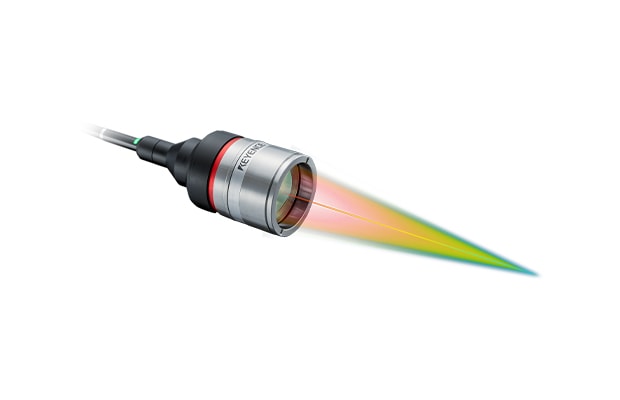
This is a coaxial laser displacement sensor that uses the multi-color confocal method. Because the transmitter and receiver are coaxial, it can stably capture reflected light even on tilted or stepped robot hands, measuring changes in stop position and height without contact. The φ8 ultra-compact head, with a volume 1/50th of conventional models, can be installed in limited spaces inside equipment. In addition, a long-range model with a reference distance of 150 mm is also available in the lineup, allowing up to 6 sensor heads to be connected for simultaneous measurement of multiple points. Heads for vacuum environments are also available, enabling measurement of the hand position of vacuum transfer robots. If you want to continuously acquire even faster vibration waveforms, you can also use the LK-G5000 Series laser displacement sensors (high-speed sampling of up to 392 kHz), which use the triangulation method.
Get Detailed Materials on the CL-3000 Series
You can download a free catalog summarizing sensor head specifications, system configurations, and application examples.
Application Examples of Robot Stop Position and Residual Vibration Measurement
It is used in applications to measure the actual behavior of robots without contact, such as the hand position of transfer robots and residual vibration when stopped. In narrow equipment or vacuum environments, the coaxial and compact heads of the CL-3000 Series are used selectively.
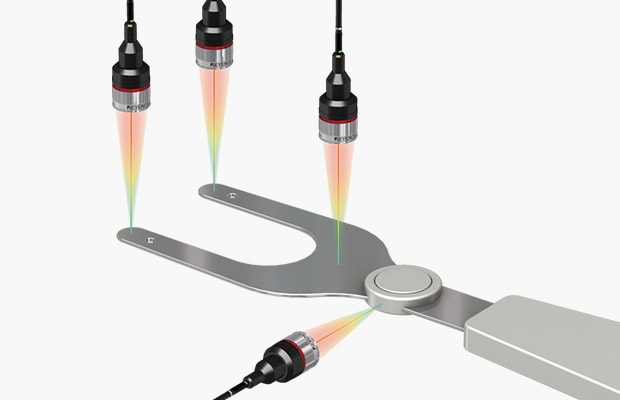
Robot Hand Position and Residual Vibration Measurement
Multiple sensor heads are aimed at the hand of a transfer robot to measure the height, position, and residual vibration when stopped without contact. Capturing changes in the hand’s position over time helps reduce defects in subsequent processes and machining failures.
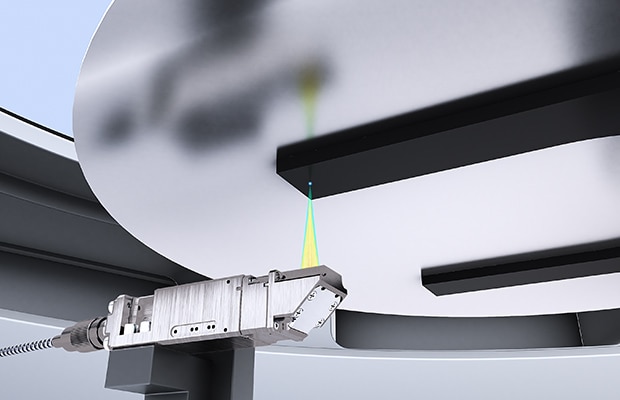
Height Measurement of Vacuum Transfer Robot Hands
The height and position changes of robot arms and hands operating in a vacuum environment are measured using an ultra-high vacuum compatible head. Because the sensor head is ultra-compact, it can be installed in limited spaces inside equipment.
Frequently Asked Questions About Robot Repeatability Measurement (CL-3000 Series)
Q Can robot repeatability be measured without contact?
A
Yes, it can. By installing the CL-3000 Series near the robot hand and recording the displacement by repeating the operation of returning to a fixed point, the variation in the return position (repeatability) can be quantified without contact and without touching the actual machine. The φ8 ultra-compact head can also be installed inside equipment.
Q What is the difference between internal encoder feedback and external measurement?
A
Internal encoders provide internal information on command values and joint angles, and do not guarantee the actual behavior of the hand, including reduction gear backlash and arm deflection. The CL-3000 Series can verify the actual displacement of the hand through independent external measurement, allowing you to check the deviation between the internal values and the actual robot.
Q Can you measure not only the stop position but also the reproducibility of the trajectory or path?
A
Yes, it can. By repeatedly operating along a certain path and continuously acquiring displacement to the reference surface with high-speed sampling, you can overlay the waveforms for each path to visualize deviations in trajectory and path reproducibility.
Q Can I switch from a contact-type dial gauge?
A
Yes, you can. The CL-3000 Series can measure without contact and without stopping operation, and there is no error caused by pressing. It can also handle residual vibration immediately after stopping, which is difficult with contact types, and measurement inside narrow equipment.
Q Can multiple points on an articulated robot be measured simultaneously?
A
Yes, they can. The CL-3000 Series can connect up to 6 sensor heads for simultaneous measurement, allowing you to acquire displacements at multiple points and in multiple axial directions all at once. This eliminates the hassle of re-measuring axis by axis, and allows you to evaluate reproducibility for each posture.
Q Can absolute positioning accuracy (coordinate traceability) also be measured?
A
This method is suitable for evaluating return reproducibility to a fixed point and relative displacement/vibration. Applications that require traceability of absolute spatial coordinates (such as laser trackers) are out of scope, so please consult us regarding a measurement plan tailored to your objectives.