Industrial Laser Marking Systems / Laser Markers
How Does a CO2 Laser Work in Marking Applications?
Key Takeaways
- CO2 laser marking is well-suited for non-metal materials such as wood, paper, cardboard, glass, rubber, and many plastics.
- It is commonly used for engraving, coding, and marking applications that require clear, permanent results on organic or coated surfaces.
- Compared with fiber lasers, CO2 systems are generally the better choice for non-metals, while fiber lasers are typically preferred for metals.
- CO2 laser marking machines are widely used in packaging, consumer goods, and general manufacturing because of their versatility across materials.
When looking for a reliable way to label products, many businesses turn to CO2 laser marking for its speed and versatility. This technology excels where other methods fail, especially when working with organic surfaces. In this guide, you will learn the mechanics behind these systems, the major differences when comparing a laser CO2 vs fiber, and how to select a CO2 laser machine that fits your specific industrial needs.
What is a CO2 Laser?
CO2 laser engravers get their name because they use CO2 gas as their laser medium. It works by generating plasma from CO2 gas inside of a tube, amplifying that light between a reflective mirror and output coupler, and then outputting it as a laser beam. The output laser beam has a wavelength of 10600 nm, and due to this long wavelength, they are extremely heat dependent. They are great for material removal and for marking organic materials like cardboard, plastic, glass, and wood.
CO2 laser markers feature a wavelength that's 10× longer than that of conventional fiber systems. They're great at marking plastics, paper, resins, wood, rubber, and transparent materials (like glass and PET).
How CO2 Laser Marking Works
The core of CO2 laser marking lies in how the material absorbs the specific 10.6-micrometer wavelength. When the beam hits the surface, the material undergoes a thermal reaction. For organic items like wood or paper, the laser essentially burns the surface to create a dark mark. When using a CO2 laser machine on glass, the heat creates controlled micro-fractures that result in a clean, frosted appearance. This process is very efficient because the energy is absorbed directly at the surface rather than passing through it.
Precision is maintained through a series of high-speed mirrors that direct the beam across the target area. Because CO2 laser marking is a non-contact method, there is no physical stress on the part. This makes it a top choice for fragile items like thin films or delicate glass marking. By adjusting the power and speed settings, operators can switch from light surface coding to deep engraving in seconds.
CO2 vs Fiber Laser: Key Differences
The debate of CO2 vs fiber laser usually comes down to the material being processed. Fiber lasers operate at a much shorter wavelength, which is absorbed readily by metals but often passes straight through clear plastics or glass. Conversely, CO2 laser marking is the gold standard for organics. If you try to use a fiber laser on wood, it often fails to create a mark, whereas a CO2 laser machine creates a high-contrast finish effortlessly.
Maintenance and footprint also vary when comparing a laser CO2 vs fiber. Fiber systems are often more compact, but they are limited in their material range. CO2 laser marking machines are more versatile for general packaging because they can handle everything from rubber marking to cardboard boxes. Selecting between the two requires a clear understanding of your substrate to ensure the beam reacts correctly with the surface.
The Benefits of CO2 Laser Marking Machines
CO2 laser marking machines are renowned for their versatility and precision across many applications. Suitable for numerous applications, their ability to mark a wide range of materials, including plastics, glass, and paper, is helpful.
Beyond standard coding, a CO2 laser machine is vital for the medical industry to label plastic marking components that must withstand sterilization. In the fashion world, these lasers are used to etch patterns into leather or denim. The ability to handle high-volume runs makes CO2 laser marking a staple in any facility that deals with consumer-packaged goods. From marking expiration dates on juice cartons to etching logos on wood-marking crafts, the application range is extremely broad.
Another benefit of a CO2 laser marker is its permanence. High-energy CO2 laser beams produce long-lasting, readable markings that are immune to fading, abrasion, and corrosion. These durable markings are crucial for applications where adherence to stringent traceability and identification standards is necessary.
Also, CO2 laser marking is a non-contact process, which means there’s minimal wear on the machine and the materials being marked. This feature decreases both material waste and maintenance costs. If these benefits weren't enough, the rapid performance of CO2 laser etching machines also increases output and improves manufacturing operations' efficiency.
Applications of KEYENCE CO2 Laser Marking Machines
CO2 laser marking devices from KEYENCE have produced notable benefits for a number of industries. Healthcare, consumer goods, automotive, and electronics, for example, have all seen the benefits of using these machines. For traceability, parts in the automotive industry are marked with barcodes and serial numbers. CO2 laser marking is used in electronics to precisely mark circuit boards and other components so that they can survive in challenging conditions.
Permanently marking medical equipment and packaging is another use case. Medical devices and packaging must comply with regulatory requirements, and a CO2 laser etching machine can assist. Consumer goods manufacturers use a CO2 marking machine for branding and customizing products, enhancing their market appeal.
Instrumental in the packaging industry, CO2 laser machines provide high-quality marks on cardboard and plastic packaging materials that convey important product information. Manufacturers enjoy their ability to mark quickly and accurately, which works well in high-speed production environments.
CO2 laser markers rely on heat to mark parts, making them perfect for cutting applications. In fact, CO2 lasers are commonly used for cutting holds, gate cutting, and sticker half-cutting applications.
Compared to mechanical cutting tools, CO2 laser markers are fully automatable, flexible, and almost entirely maintenance-free.
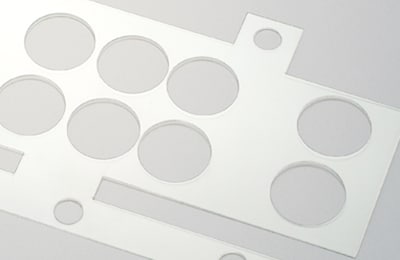
Film processing
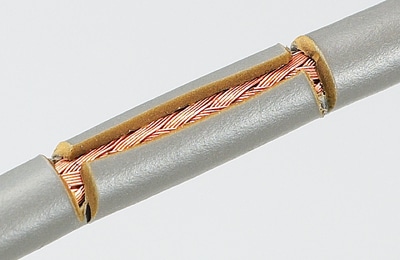
Wire sheathing cutting
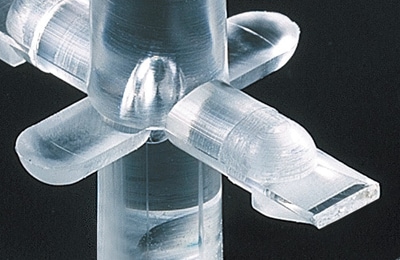
Gate cutting
CO2 Laser Feature: Synthetic Rubber Marking
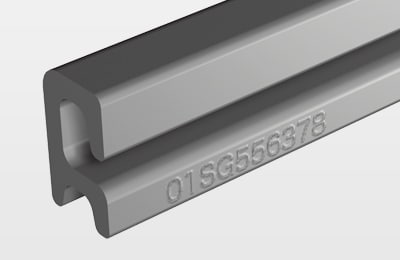
Synthetic rubber has high heat and chemical resistance properties, meaning some marking methods are not strong enough to mark it. However, CO2 laser marking has very high heat absorption, allowing it to etch marks onto synthetic rubber.
CO2 laser marking synthetic rubber applications:
- Wiper blades
- Rubber gloves
- Car tires
- Belts
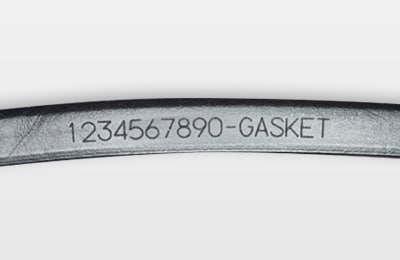
Rubber gasket - Head lamp
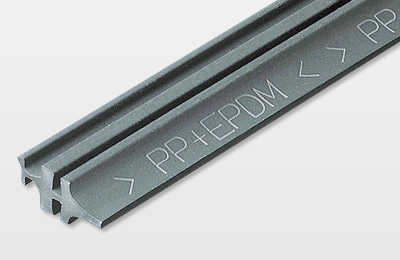
Wiper blade
Door molding
CO2 Laser Feature: Marking on Glass
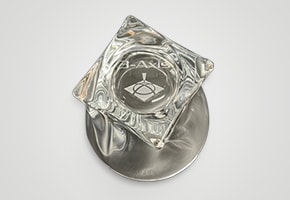
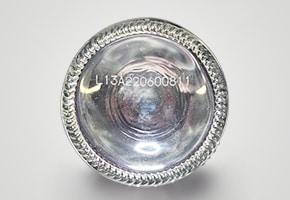
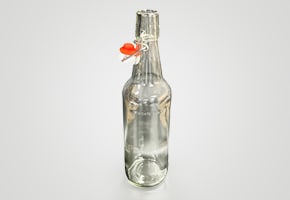
Glass has high heat resistance and is commonly transparent. Standard Fiber wavelength systems are unable to interact with glass due to these properties; however, incorporating a CO2 laser makes the marking process seamless. CO2 lasers engrave white marks into glass by gently generating tiny cracks (micro-fractures) using low power. The micro-fractures make up the mark or design.
CO2 laser marking glass applications:
- Windowpane
- Bottle
- Jar
- Drinkware
CO2 Laser Feature: Marking on Cardboard and Wood
Using a CO2 laser for cardboard and wood marking ensures permanent marks that never smudge. The CO2 laser burns designs, logos, barcodes, or characters onto the wood or cardboard surface. CO2 laser marking is used for either white marking or dark marking.
CO2 laser marking cardboard and wood applications:
- Drink carton
- Decorative wood sign
- Shipping box
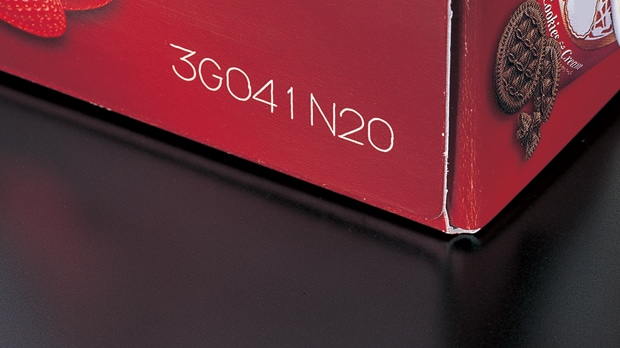
Cartons
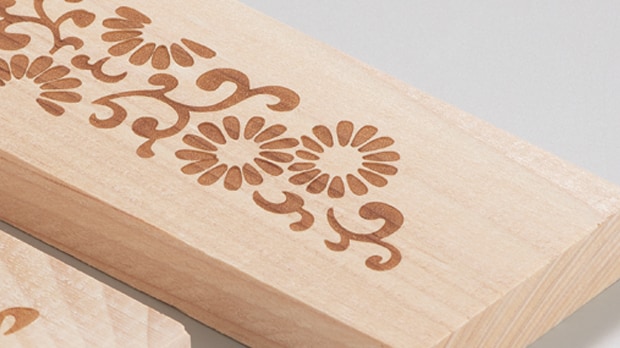
Design marking
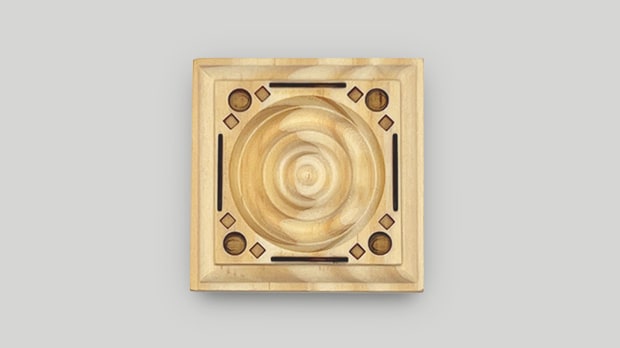
Wood label replacement
Product Introduction
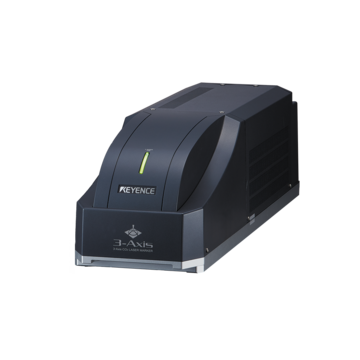
World's first 3-axis control 3-Axis CO2 Laser Marker ML-Z Series
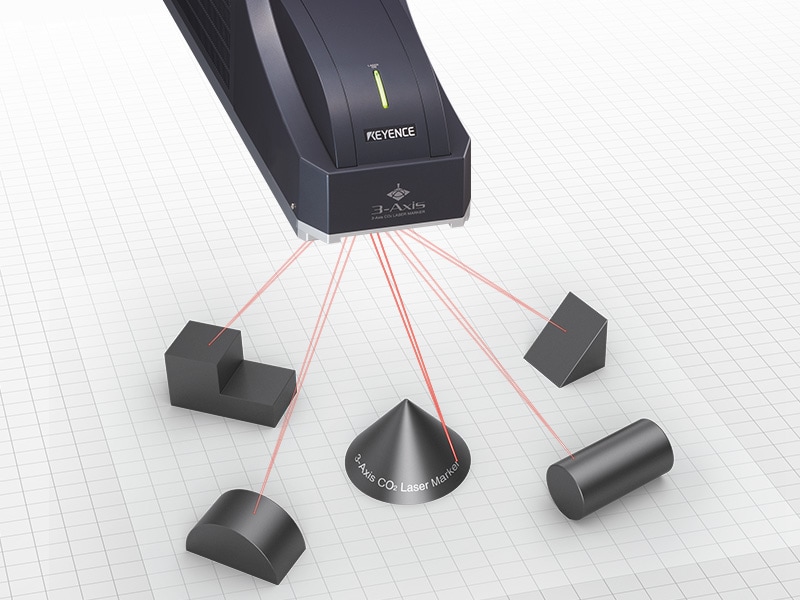
KEYENCE's unique 3-axis control incorporated into the ML-Z CO2 laser marking machine ensures distortion-free marking over the entirety of its field of view. It allows the focal distance to be adjusted over a 42 mm (1.65″) range. This enables precise marking on 3D part shapes and reduces tooling costs. The ML-Z CO2 laser uses the 3-axis control to mark uniformly across step, inclined, cylinder, and circular cone targets. It can even use CAD data of non-standard shapes to map its focal path and retain focus.
300 mm (11.81″) wide area
The wide-area models in the ML-Z Series CO2 laser have a marking area of 300 × 300 mm (11.81″ × 11.81″), which greatly simplifies installation costs and reduces processing time.
Variable Beam Spot and Defocusing
The ML-Z CO2 laser marking machine uses focal point and beam spot adjustment to mark various character types. The variation allows marking thin, thick, shallow, or deep characters in the same motion and allows for variability of power density to achieve perfect marks over a wide range of materials.
Conventional Laser Marker
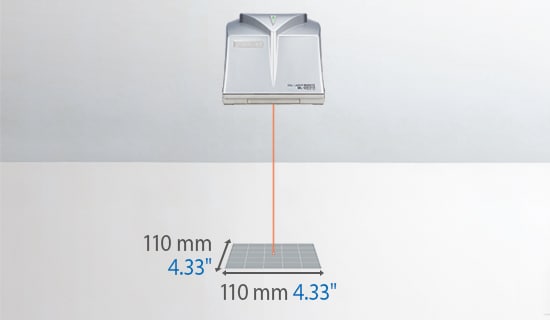
With conventional models, marking is limited to a fixed area.
3-Axis Control ML-Z Series
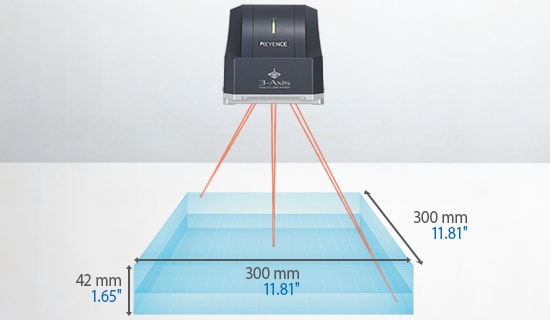
With the ML-Z Series, high-quality marking is possible over a wider area using 3-Axis control.
Improving Quality with Short-Wavelength and Thin Laser Types
9.3 μm vs. 10.6 μm wavelength
ML-Z Series laser markers feature two distinct wavelengths: 9.3 μm and 10.6 μm. The slightly shortened wavelength has a higher absorptivity in transparent materials like resin and glass. As a result, the shorter wavelength model allows for precision marking, shallower engraving, and less surface swelling.
Thin laser type
ML-Z Series laser markers also feature different spot sizes. Smaller spot diameters enable fine-print marking and greater power density, which in turn allows for more efficient processing, like cutting and drilling.
9.3 μm 0.37 Mil Short Wavelength Model
Conventional
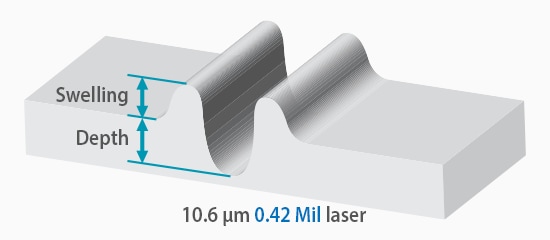
10.6 μm 0.42 Mil laser
Deep engraving with extensive damage.
ML-Z
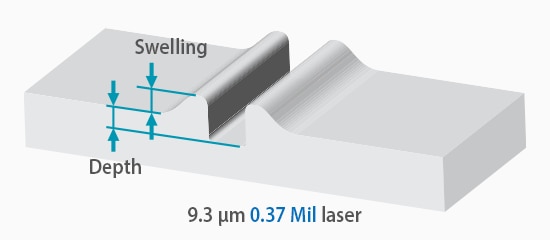
9.3 μm 0.37 Mil laser
Sharp, shallow engraving with minimal damage.
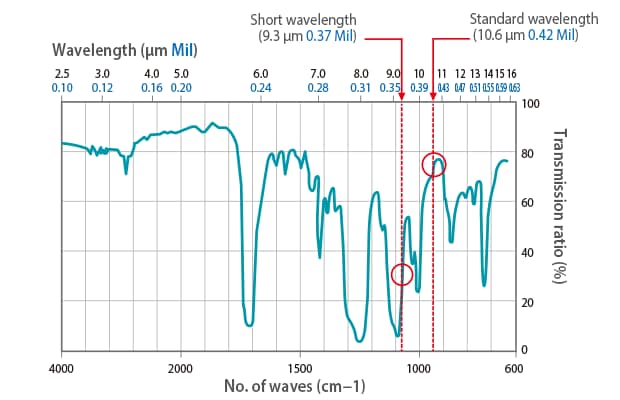
Relationship between wavelength and transmission ratio (PET)
The wavelength of the ML-Z Series’ laser is available at 10.6 μm 0.42 Mil as well as a shortened 9.3 μm 0.37 Mil to better suit the heat absorption characteristics of various resins. With a higher absorption rate in resin, this shorter wavelength allows for more precise marking with shallower engraving and less surface swelling.
Thin Beam Model
Compared with standard models, the laser spot diameter is smaller, enabling even finer marking. The smaller spot diameter allows for greater power density, which in turn allows for more efficient processing, such as cutting and drilling.
Comparison of Laser Spot Diameter and Power Density
| Standard mode | Thin beam mode | |
|---|---|---|
|
Spot diameter
|
Standard mode
140 μm 5.51 Mil
|
Thin beam mode
80 μm 3.15 Mil
|
|
Power density
|
Standard mode
2.0 kW/mm2
|
Thin beam mode
6.0 kW/mm2
|
* These are representative values
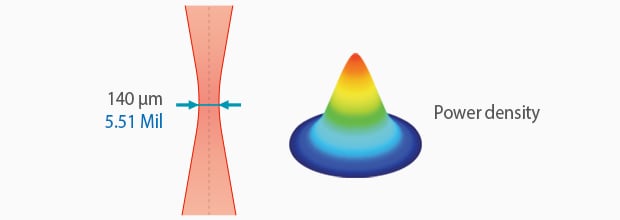
Standard model
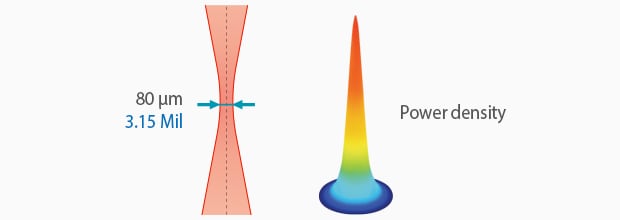
Thin beam model
Thin laser beam models provide greater power density with a narrower spot diameter.
Boost Your Production Efficiency with KEYENCE CO2 Laser Markers
Implementing CO2 laser marking in your production line can significantly boost operational efficiency. These machines streamline the manufacturing process with their fast marking speeds by reducing the time needed for product identification and branding.
When KEYENCE laser markers are integrated with automated systems, the operation is seamless, minimizing manual intervention and the risk of human error. This increases throughput and marking consistency, both of which are essential for upholding production quality standards.
CO2 laser etching machines are also flexible, so they can easily adapt to different marking tasks without requiring extensive setup changes. Due to this adaptability, manufacturers can respond quickly to changing production needs without sacrificing quality or speed.
Introducing CO2 Laser Marking to Your Manufacturing Process
Do you process ceramics, glass, rubber, or cardboard? Are you looking for an efficient and precise marking process that standard fiber lasers struggle with? Test KEYENCE's CO2 laser marking machine for your cutting and marking needs.
Our expert team offers you a free demo, trial equipment, and after-sales support if you buy. Contact KEYENCE today to start processing with the ML-Z CO2 laser marker.