
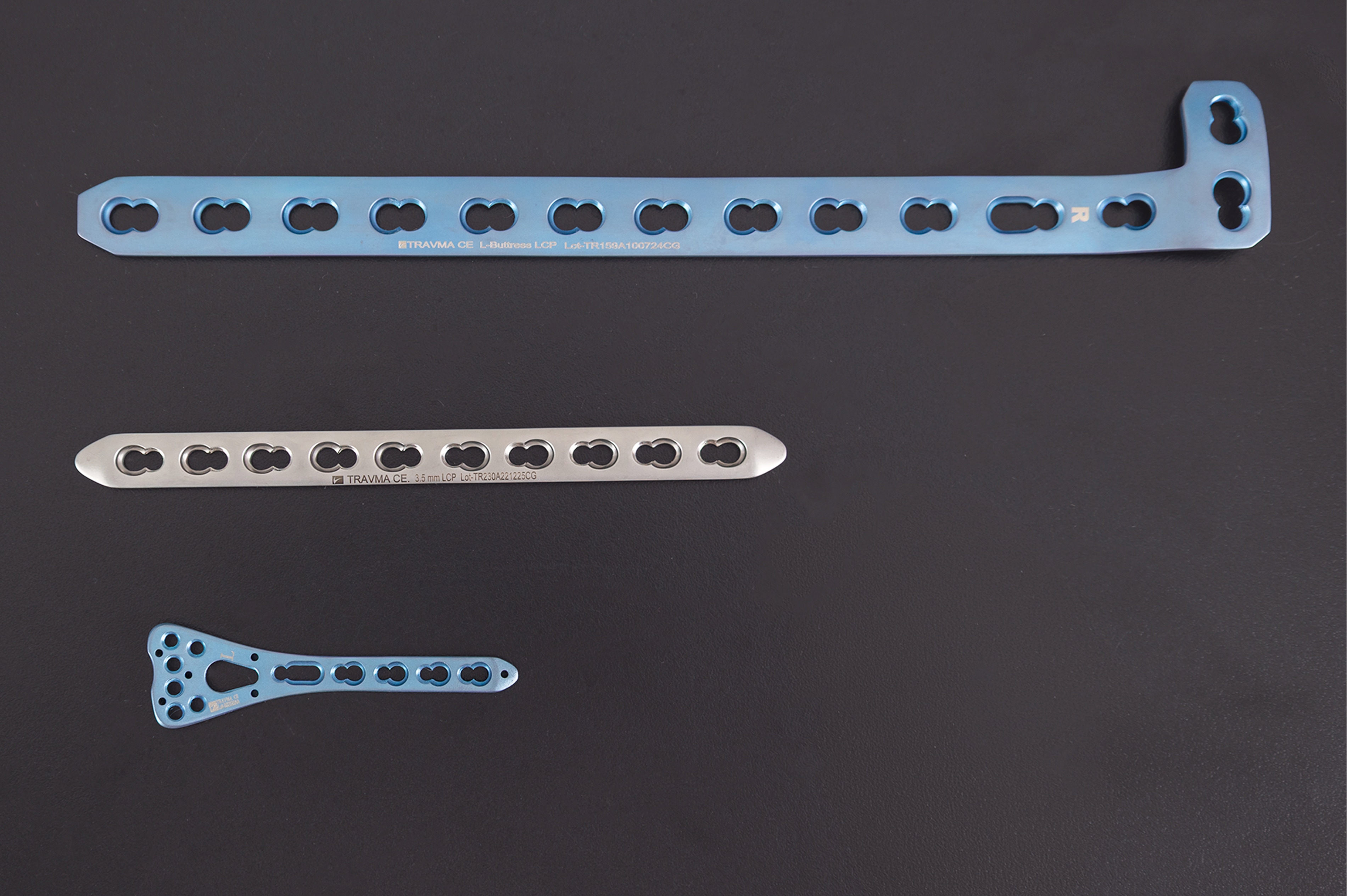
Travma, a Mexican distributor of trauma and orthopedic implants, marks lot numbers, logos, and customer-specific descriptions directly onto the metal implants and instruments it distributes. After years of dealing with downtime and defective engravings on legacy laser markers, Travma switched to the KEYENCE MD-X Series, moving from error-prone, multi-pass marking to single-pass engraving that has reduced waste and enabled same-day delivery of special orders.

Key Points
- Travma distributes trauma and orthopedic implants and laser marks lot numbers, logos, and customer-specific descriptions directly onto metal parts that cannot be coded with ink.
- Legacy laser markers often stopped mid-marking or failed to power on, ruining implants, instrument sets, and set lids that, once marked, could not be re-engraved.
- Two KEYENCE MD-X setups now cover both needs: a standard area model for small implant parts and a wide-area model for larger set lids and boxes.
- Batches of up to 10,000 screws that took two to three days with previous markers are now completed in a single day; batches of 200 to 300 drill bits are marked in no time.
- Logos that required three or four passes are now completed in one, reducing the lead time for special orders from one or two days to same-day delivery.
- Both units have been running for one to two years with almost no contact with support and no recurring failures.
About Travma
Travma is a Mexico-based company that distributes trauma and orthopedic implants. It does not manufacture products itself; it focuses exclusively on distribution, serving three types of customers: patients who buy directly, doctors who purchase materials, and its largest customer base, other distributors who buy in volume. Implants are the main product line, along with surgical instruments, motorized equipment, and fixators.
Two members of Travma’s operations team spoke about the switch to KEYENCE: César from the Receiving and Quality department, who oversees and measures all incoming material before it goes to the warehouse; and Roberto, warehouse manager, responsible for the overall operation of that department.
ChallengeDowntime-prone markers that turned good implants into scrap
Since most of the material Travma handles is metal, mainly steel or titanium, it cannot use ink for lot marking, which is why laser marking equipment was purchased for traceability from the very beginning. Before switching to KEYENCE, Travma operated three laser markers of uncertain origin. The machines were already old and caused frequent problems: they would stop mid-engraving, or sometimes would not turn on.
The real cost was that a poorly made engraving cannot be corrected. As soon as a customer’s logo or an instrument’s marking goes wrong, the part becomes useless.
“An engraving is very difficult to correct; if we engrave it wrong, we can no longer correct it. So, what was happening to us lately was that we were marking the customer’s logo and it would stop, leaving it half-engraved, or it would throw a spark or a laser beam when it shouldn’t, leaving the instrument or the lid poorly marked. So, that started to get us into trouble because those are losses. That is where the need to acquire new marking equipment came from.”
Some defective parts could still be saved by polishing them, especially implants with a smooth, low-relief design, but many could not because the previous markers left too deep a relief in the metal. That combination of downtime and too-deep engraving was gradually turning good implants into scrap.
SelectionWhy KEYENCE’s MD-X Series: See the mark before making it
The team was clear that damaging an implant is never acceptable, and the MD-X Series is built not to damage the material, with parameters adjusted so that the parts come off the line in the best possible condition. What finally tipped the decision was the equipment’s capabilities, especially its software.
“The programs we used with the other markers were very rudimentary. That is, they didn’t even allow us to see exactly where the engraving would land. It practically only showed us a marking area, but even when we marked, it would go out of control and sometimes deviate from the Cartesian plane. So, what the new marker allows us to do is precisely see where the engraving will be and how it will look in the end. So, even for orders, it was very important because the saleswomen were interested in seeing how it would look before we marked it. So, I think all those tools within the new marker helped us a lot in choosing.”
That visual and easy-to-read software is also the reason why Travma ended up with two different MD-X configurations. The standard area unit was the first one purchased and is used for implants and small to medium-sized parts: it handles almost everything on its own. The wide-area unit was added later because Travma also marks lids for instrument sets, and larger boxes that need much more marking space than the standard area allows. Previously, larger parts had to be placed diagonally just to fit in the standard work area; the wide-area MD-X completely eliminated that workaround.
ResultsMarking in a single pass and same-day delivery
From the Receiving and Quality side, the biggest change has been volume. Travma marks batches of up to 10,000 screws at a time, and sometimes has 10 to 15 batches of similar size in queue. With the previous markers, such a batch could take two to three days to finish; with the MD-X, the same volume is now marked in a single day. Batches of 200 to 300 drill bits, which now take advantage of the matrix marking function, are finished in no time.
From the warehouse side, the change has been fewer errors and less time per part. Marking a set lid or a customer’s logo used to involve multiple passes and a real risk of stopping mid-marking, a defect that meant wasted material and, sometimes, an uncomfortable conversation with a customer about a defective product.
“Previously, we had to make three, four, or even more passes over the same logo for it to look good and presentable. With this one, we don’t. With this one, it’s done in a single pass. So, that obviously helps us reduce lead times. And fortunately, we have had an increase in sales, and if we still had this issue, it would have delayed our operation. Now we arrive, place it, mark it, and move on to the next one.”
The number of people operating each machine has not changed—it is still a single operator per unit—but faster marking speeds up how quickly material reaches the warehouse to fill orders, shortening overall delivery times. The sales staff, who are Travma’s internal customers, have also noticed the difference: parts now look more presentable, and a special engraving that used to take one or two days can now be delivered the same day.

OutlookStable production and advice for other medical distributors
For now, Travma has no plans to expand the use of the MD-X to other product lines or locations: the two current configurations are enough to sustain production as it is. After-sales contact with KEYENCE has been minimal, simply because the machines have not needed it: the units have been running for one to two years without recurring failures, and the installation was handled entirely in-house. Travma’s own maintenance staff built the mounting bases, without needing an external contractor.
When asked what advice they would give to other companies in the medical sector considering laser marking, both interviewees pointed to the same thing: how accessible the equipment is to learn and use.
“The marker itself is quite efficient. That is something we can say: it is efficient. [...] It is also very user-friendly: the program is highly visual, so you don’t need much training to understand it. [...] I think its ability to adapt to any type of process is its best feature; it has helped us a lot. I would identify certain improvements for the program, such as shortcuts or small features, but even so, the program has been very practical to use.”
“Related to what the engineer [César] mentioned, it is very user-friendly for staff training. For example, when we hire staff, they can master the program within a week. That is very valuable to me because it reduces training time, compared with what I experienced with the first markers, where we had to sit with them for a large part of the day so they could understand because it was somewhat complicated. Here, though, the program is very, very easy to understand.”

Frequently Asked Questions (FAQ)
QWhy did Travma need to replace its previous laser markers with KEYENCE’s MD-X Series?
A
Travma’s previous laser markers were old, unbranded units of uncertain origin. They frequently stopped mid-engraving or failed to turn on, and a defective engraving on an implant or instrument could not be corrected once marked, turning good material into waste and generating real losses.
QWhat convinced Travma to choose KEYENCE’s MD-X Series over other laser marking equipment?
A
The MD-X Series software allows users to see exactly where the engraving will be and how it will look before marking. The previous software was rudimentary, only showing an approximate engraving area and sometimes deviating from the plane during engraving. The visual and easy-to-read software of the MD-X was described as a key reason for choosing KEYENCE.
QHow do KEYENCE’s MD-X standard area and wide-area units differ in Travma’s operation?
A
Travma uses two MD-X configurations: a standard area model for small and medium implants, and a wide-area model for larger set lids and boxes that need more marking space and previously had to be placed diagonally to fit in the smaller work area.
QWhat quantifiable improvements has Travma seen since introducing KEYENCE’s MD-X Series?
A
In receiving and quality, batches of up to 10,000 screws that previously took two to three days with the previous markers are now engraved in a single day, and batches of 200 to 300 drill bits are marked in a short time. In the warehouse, logos that previously required three or four passes are now completed in a single pass, and the lead time for special orders dropped from one or two days to same-day delivery.
QDid KEYENCE’s MD-X Series change how much material Travma discards during marking?
A
Yes. The previous markers engraved too deeply, so a poorly engraved implant often could not be saved even by polishing. The shallower marking of the MD-X keeps more parts within a salvageable range, and the single-pass marking itself, without stops, prevents mid-engraving failures that previously ruined parts.
QHow has the after-sales experience with KEYENCE’s MD-X Series machines been at Travma?
A
Travma’s two MD-X configurations have required almost no contact with support since installation, operating for one to two years without recurring failures. The internal maintenance staff built the mounting bases on their own, so an external contractor was not needed to integrate the machines into the existing workstations.