Flow Switch vs. Flow Meter: Why Knowing How Much Flow Matters More Than Just Detecting It
There's a question that doesn't get asked enough on plant floors across American manufacturing:
Is my flow switch actually telling me what I need to know?
For decades, flow switches have been a go-to solution for industrial liquid monitoring. They're simple, they're familiar, and they do exactly what they say — they detect whether liquid is flowing or not. But in today's manufacturing environment, where efficiency, sustainability, quality, and uptime are all being tracked and reported at a higher level than ever before, detecting flow is no longer enough.
The difference between a flow switch and a flow meter isn't just a matter of technology — it's a matter of what you can actually do with the information. And for plant engineers and facilities managers who rely on that information to make real decisions, the gap between the two is bigger than most people realize.
What a Flow Switch Actually Does
A flow switch is a binary device, providing only a discrete ‘go/no-go’ signal. It answers one question and one question only:
Is liquid flowing? Yes or no.
When flow drops below a set threshold, the switch triggers an alarm or shuts down a system. When flow resumes, it resets. That's the entire function.
For some basic applications, that may be sufficient. But consider everything a flow switch cannot tell you:
- How much liquid is flowing right now
- Whether flow has been gradually declining over the past two weeks
- How much total liquid has been consumed today, this week, or this month
- Whether flow is within the precise range required for your process
- Whether a partial blockage is slowly developing before it becomes a failure
- Whether your cooling system is delivering the exact flow rate your equipment needs
A flow switch provides an on/off signal, a single bit of data. Everything else is unknown. While useful for a basic check, it lacks the continuous process monitoring required for modern optimization.
What a Flow Meter Actually Does
A liquid flow meter measures the actual quantity and rate of liquid moving through a pipe — continuously, in real time, with data you can read, record, trend, and act on.
Instead of a binary signal, you get:
- Instantaneous flow rate — exactly how much liquid is moving right now
- Accumulated flow totals — how much liquid has passed through over a period of time
- Long-term trend data — historical records that reveal gradual changes before they become failures
- Threshold alarms with context — not just "flow stopped" but "flow dropped 15% below target"
- Data integration — real numbers feeding your SCADA system, IIoT platform, or data dashboard
That's not a minor upgrade from a flow switch. It's a fundamentally different level of visibility into your process.
Why the Difference Matters in Real Manufacturing Scenarios
Let's put this in practical terms. Here are situations where a flow switch leaves you blind — and a flow meter keeps you informed:
Cooling Water Monitoring
A flow switch tells you water is flowing to your equipment. A flow meter tells you it's flowing at exactly the rate needed to prevent overheating. In furnace cooling, melt shop water skids, or machine tool coolant systems, the difference between adequate flow and just enough to trip the switch can be the difference between a healthy machine and a catastrophic failure.
Water Usage and Sustainability Reporting
A flow switch tells you nothing about consumption. A water flow meter gives you the data you need to track usage, identify waste, hit reduction targets, and support ESG and Net Zero reporting, requirements that are increasingly non-negotiable for large manufacturers and their suppliers.
Dispensing and Filling Applications
In precision dispensing (adhesives, coatings, chemicals, lubricants), a flow switch can only confirm that something was dispensed. A flow meter confirms that the correct volume was dispensed, every single cycle. In quality-critical applications, that distinction is everything.
Predictive Maintenance
Gradual flow decline is one of the earliest indicators of a developing problem — a partial blockage, a pump wearing out, a filter loading up. A flow switch won't catch that until flow completely stops. A flow sensor with trend data catches it weeks earlier, when the fix is a scheduled maintenance call instead of an emergency shutdown.
The Installation Problem that Stopped Many Facilities from Upgrading
Here's a reason why so many plants are still running flow switches even when they know they need more data: traditional inline flow meters are a major installation project.
Installing a conventional inline or insertion flow meter means:
- Shutting down the production line — sometimes for hours or days
- Draining the system completely
- Cutting into the pipe
- Bringing in a specialist with plumbing expertise
- Risk of leaks, contamination, pressure loss, and voided equipment warranties
- Restarting and re-qualifying the system afterward
For many facilities, the disruption and risk have historically outweighed the benefit. So, they kept their flow switches and accepted the data gap.
That equation has changed.
The KEYENCE Clamp-On Flow Meter Family: Measurement Without the Disruption
KEYENCE engineered a complete family of clamp-on flow meters specifically designed to deliver true flow measurement, without any of the installation headaches that kept facilities from upgrading in the first place.
Every model in the KEYENCE clamp-on family shares the same core advantage: the sensor mounts to the outside of the pipe and never contacts the liquid inside. No pipe cutting. No draining. No production shutdown. No contamination risk. No pressure loss.
Installation requires nothing more than a screwdriver and a few minutes.
But within that family, each model is engineered for a specific range of applications, so you can match the right tool to your exact process requirements.
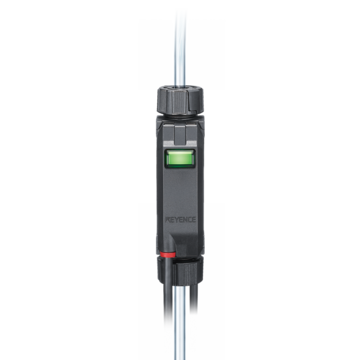
KEYENCE FD-X Series — Clamp-On Micro Flow Sensor
For precision dispensing, lubricating, spraying, filling and small-diameter tube applications
The FD-X is built for applications where every fraction of a milliliter counts. With a flow rate resolution of 0.1 mL/min and a shot amount resolution of 0.001 mL, this is not a general-purpose flow sensor, it's a precision measurement tool for the most demanding low flow applications.
Best suited for:
- Adhesive and sealant dispensing
- Flux and coating applications
- Chemical and lubricant micro-dosing
- Spray amount confirmation
- Intermittent shot/dispense monitoring
Compatible with: Metal pipes from ø0.11" to 0.55" and resin or rubber tubes/hoses from ø0.12" to 0.52" in diameter
What makes it different: The FD-X handles highly viscous liquids — grease, adhesives, thick chemicals — without the clogging, pressure loss, or measurement drift that plagues conventional mechanical flow sensors in these applications. Its non-contact design means the properties of the liquid, including viscosity, do not affect measurement accuracy.
Data can be exported directly to a PC via USB, and the FD-X can be connected to a network via IO-Link, EtherNet/IP, PROFINET, or Modbus/TCP — making it easy to integrate into existing automation and data collection systems.
Learn more about the FD-X Series
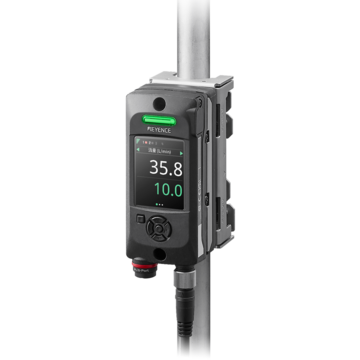
KEYENCE FD-H Series — Clamp-On Flow Sensor for Pipes, Tubes, and Hoses
For any rigid pipe applications, flexible hose applications, high-temperature environments, and multi-parameter monitoring
The FD-H expands the boundaries of what's possible with non-invasive flow measurement by adding support for something no standard clamp-on sensor handles well: flexible hoses, including high-pressure braided hoses. This is in addition to the wide range of rigid pipes (iron, copper, stainless steel, PVC, and rigid plastics) the FD-H is compatible with.
In many industrial facilities — hydraulic systems, coolant delivery lines, chemical transfer systems — the liquid runs through hoses, not rigid pipe. The FD-H was engineered to also address that reality.
Best suited for:
- General liquid flow applications
- Hydraulic and high-pressure hose systems
- Coolant and cutting fluid monitoring
- Chemical and oil flow monitoring
- High-temperature process lines
- Multi-parameter monitoring (flow + concentration + temperature)
Compatible with:
- Standard and high-temperature models: resin and metal pipes from 0.25" to 1.25"
- Hose-type models from ø0.51" to 2.48"
What makes it different: The FD-H handles conditions that challenge other sensors (bubbles in the liquid, extreme temperatures, and high viscosity) and delivers stable measurement regardless. High-temperature models support pipe surface temperatures up to 356°F (180°C), making it suitable for demanding thermal environments.
A detachable display allows for remote monitoring while showing current values, real-time graphs, and historical data. Universal connectivity is achieved through a choice of control outputs, analog outputs, and IO-Link (which opens the door to various protocols like EtherNet/IP, Modbus/TCP, PROFINET, & EtherCAT). The FD-H is also rated IP65 and IP67 for reliable performance in wet environments.
Uniquely, the FD-H can connect to concentration, temperature, and level sensors, enabling centralized management of multiple process parameters from a single platform, significantly improving possibilities for process quality control and cost reduction.
Learn more about the FD-H Series
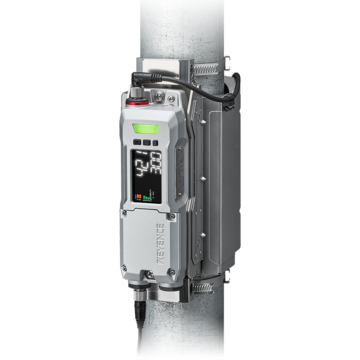
KEYENCE FD-R Series — Clamp-On Flow Meter for Large Industrial Pipes
For larger-diameter pipes across heavy industrial and process environments
The FD-R is designed for the full range of industrial pipe sizes and built to handle the toughest plant floor environments.
Best suited for:
- Larger pipe applications (> 1.5")
- Cooling water loop monitoring
- Process water and DI water systems
- Chemical and oil flow monitoring on large pipes
- Wastewater and effluent monitoring
- Cooling tower monitoring, chiller flow, die-cast machines, furnace/annealing machines
Compatible with: Stainless steel, iron, copper, PVC, and resin pipes up to ø8.66".
What makes it different: The FD-R combines broad pipe and liquid compatibility with the toughest environmental rating in the family — IP69K and NEMA 4X — making it suitable for outdoor installation and high-pressure washdown environments. It monitors both flow and temperature for liquids ranging from pure water to oils, chemicals, and high-pressure fluids, across a temperature range of -4°F to +248°F.
Real-time data and long-term trend recording are available directly on the device, and the combination of rugged metal construction and highly-visible indicator gives operators instant status confirmation no matter the environment.
Learn more about the FD-R Series
Choosing the Right Clamp-On Flow Meter for Your Application
| FD-X | FD-H | FD-R | |
|---|---|---|---|
|
Best For
|
FD-X
Low-flow, dispensing, precision dosing
|
FD-H
Pipes or hoses, high temp, multi-parameter
|
FD-R
Large pipes, heavy industrial
|
|
Pipe/Tube Size
|
FD-X
0.12" – 0.5"
|
FD-H
Pipe: 0.25" – 1.25"
Hose: 0.51" - 2.48" |
FD-R
Up to 8"
|
|
Pipe/Hose Types
|
FD-X
Metal, flex & rigid tubing
|
FD-H
Metal, plastic, flexible hoses
|
FD-R
Metal, plastic
|
|
Max Temperature
|
FD-X
Up to 212°F
|
FD-H
Up to 356°F
|
FD-R
Up to 248°F
|
|
Viscous Liquids
|
FD-X
Yes
|
FD-H
Yes
|
FD-R
Yes
|
|
Corrosive Liquids
|
FD-X
Yes
|
FD-H
Yes
|
FD-R
Yes
|
|
Data Export
|
FD-X
USB
|
FD-H
USB
|
FD-R
RS-232
|
|
Connectivity
|
FD-X
Discrete, Analog, IO-Link, Modbus, Ethernet/IP, PROFINET
|
FD-H
Discrete, Analog, IO-Link, Modbus, Ethernet/IP, PROFINET
|
FD-R
Discrete, Analog, IO-Link, Modbus, Ethernet/IP, PROFINET
|
|
IP Rating
|
FD-X
IP65, IP67, IP68G
|
FD-H
IP65, IP67
|
FD-R
IP69K, NEMA 4X
|
|
Pipe Cutting Required
|
FD-X
Never
|
FD-H
Never
|
FD-R
Never
|
The Real Cost of Staying with a Flow Switch
Here's the bottom line for plant engineers evaluating their current monitoring setup:
Every day you run a flow switch instead of a liquid flow meter, you are operating with incomplete information. You don't know if flow is trending down before it becomes a failure. You don't know your actual consumption. You can't prove your cooling is performing within spec. You can't support a water reduction initiative with real data.
And with the KEYENCE clamp-on flow meter family, there's no longer a significant installation barrier standing between you and that data. Any maintenance technician can install any model in the FD family — on any pipe, tube, or hose — in minutes, without touching the liquid, without cutting the pipe, and without interrupting production.
The question is no longer whether you can upgrade from a flow switch to a flow meter.
The question is how much longer you can afford not to.
Explore the Full KEYENCE Clamp-On Flow Meter Family
Whether you need micro-flow precision, general purpose, flexible hose compatibility, or large-pipe industrial measurement, KEYENCE has a non-invasive solution built for your application.
Visit the Flow Sensors / Flow Meters page to learn more.
Or contact a KEYENCE application specialist to find the right model for your process and request an on-site test/demonstration.