Industrial Laser Marking Systems / Laser Markers
Laser Marking in the Oil and Gas Industry
-
Tags:
- Laser Marking , Metal , Laser Engraving
Oil and gas operations rely on clear, durable identification. Engineers use marking to track heat numbers, lots, revisions, and service history. Laser marking for oil and gas offers permanent results with fast setup and low consumables.

What Is Laser Marking?
Laser marking uses a focused beam to alter or remove surface material, so information becomes visible. Common methods include annealing, etching, engraving, and coating removal. Data Matrix codes and human-readable text are the most frequent outputs, bug QR and linear barcodes are also used. Metals, plastics, and coated parts can be marked with the right wavelength and parameters.
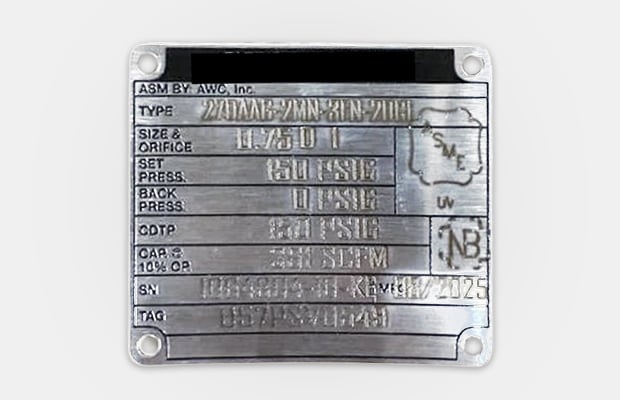
Conventional scribe on tag

Laser marked tag
Laser Marking Applications for the Oil and Gas Industry
Typical parts include valves, gaskets, tags, flanges, and fasteners or bolts. However, pipes, fittings, and instrumentation panels to link components to their material test reports are also common. For example, thousands of miles of infrastructure rely on pipeline identification marking to ensure clear identification and traceability. Content marked includes part numbers, heat or lot numbers, pressure class, and date codes. Data Matrix codes support compact traceability on small faces or bolt heads. Human-readable text helps field crews confirm information without a scanner. Valve and pump serial number marking is particularly common as well.
Surface condition matters for consistency and contrast. Rough forgings and bead-blasted zones benefit from deeper or slower passes. Post-machined faces allow faster, lighter marks with crisp edges. Coated parts can be marked by removing paint or anodize for high contrast. Inline verification helps confirm symbol quality before parts move downstream.
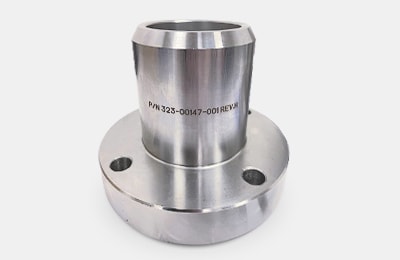
Flange

Flange collar

Gasket
Laser Marking for Stainless Steel
Stainless steel is standard for valves, flanges, and fasteners because it resists corrosion. Annealing creates a dark oxide layer with minimal surface change, which helps preserve corrosion resistance. Engraving produces deeper marks for high-wear areas or post-blast readability.
Brief standards often referenced include API 6A for component identification and ISO 16022 for Data Matrix symbols. ASME B31.3 supports documentation practices that link marks to records. ASTM A967 and A380 guide cleaning and passivation when required.

Tube assembly

Pipe fitting

ID ring
Laser Marking Solutions for Oil & Gas Industry
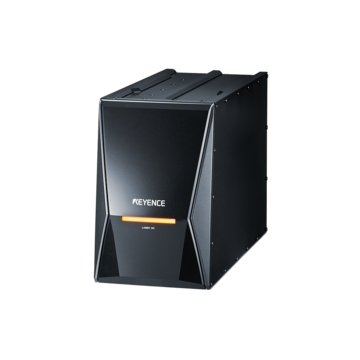
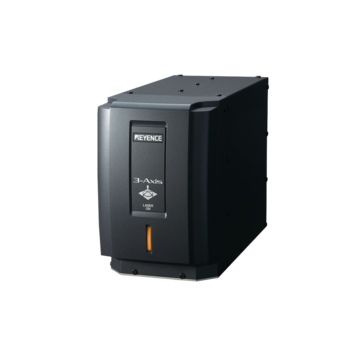
Fiber lasers handle most metals efficiently and support deep or high-contrast marks. The KEYENCE MD-X2 marks stainless and carbon steels with flexible depth and speed. For sensitive parts or plastics, the MD-U2 UV platform minimizes heat input while keeping characters sharp. The ML-Z CO2 excels at removing paint and anodized layers on tags and housings. 3-axis beam control helps maintain focus on curved flanges, stepped features, and uneven fixtures.
Compared with dot peen or hand stencil, lasers deliver higher data density and consistent readability. There are no inks or stencils to manage, which simplifies changeovers and mark quality is less dependent on operator technique. Cycle times are predictable for short runs and engineering changes. Deep engraving can replace stamp or peen on high-wear surfaces when specification allows.
Laser Marking for Hydraulics
Hydraulic manifolds, cylinders, and fittings need durable identification that survives assembly and service. Deep engraving on flats or bosses resists abrasion and cleaning. Compact Data Matrix codes fit near ports while human-readable text sits on accessible faces. The MD-X2 can vary depth to protect thin walls and sealing surfaces.
Advantages of Laser Markers for the Oil Industry
Permanence is one major advantage. Instead of applying surface coatings, laser energy modifies the material itself. It is nearly impossible to erase or conceal the resulting marks since they become an integral part of the component. A valve that is laser marked today will maintain its identification for the duration of its useful life.
In high-volume manufacturing, speed is equally important. Without slowing down production lines, oil and gas laser marking systems can process parts at an extremely fast rate. Laser marking for oil and gas eliminates the need for consumables, tool changes, and the need to wait for inks to dry, in contrast to dot peen or chemical etching.
When it comes to flexibility of marking technology, laser marking is fast and easy to use. It is possible to etch 2D data matrices on stainless steel flanges or engrave logos on aluminum casings using the same technique that imprints serial numbers on steel tubing. It takes minutes rather than hours to switch between occupations.
Precision surpasses what is achievable with mechanical techniques. Character heights that are less than 0.5 mm are completely readable, and dense information is crammed into small places using complex 2D codes.

2D code on pipe

Shape charges
Picking the Right Laser for Metals, Coatings, and Nameplates
Fiber lasers dominate bare metal marking applications. Their wavelength interacts strongly with steel, stainless steel, aluminum, and titanium. The marks appear as dark contrasts on light metals or can be adjusted to create light marks on dark surfaces. Fiber laser markers handle the vast majority of laser marking for oil and gas needs.
UV lasers are excellent for marking covered parts without causing harm to the substrates underneath. UV wavelengths leave clear marks on anodized aluminum, powder-coated housings, and painted equipment. Only the coating layer is removed by the laser, leaving sharp edges and stopping corrosion.
Occasionally, organic materials used in oil and gas applications are a good fit for CO2lasers. Composite materials and rubber seals react to CO2 more effectively than fiber wavelengths.
Production-Line vs Portable Marking Workflows
Mobile units integrated on stands prove valuable for field work on offshore platforms, maintenance facilities, and job sites where parts are too large or heavy to present to an enclosure or conveyor with a laser marker. These systems mark assembled pipelines, equipment, and valves directly without disassembly.
In production facilities, laser marking devices integrate directly into conveyor lines, automatically marking parts as they pause at marking stations before moving to the next stage, eliminating handling time and errors.
Mark Quality and Readability: Verification and Error Prevention
Industrial-grade designs are built for harsh environments, with sealed enclosures that protect optics from metal debris and oil mist. Automatic focus compensates for height changes, while error-proofing safeguards ensure incorrect data never reaches the laser.
Closed-loop systems detect errors in real time. Integrated cameras verify every mark and compare it to the intended data instantly without interrupting production. Vision technology keeps marks in the right place by finding features like holes or edges and adjusting automatically when parts vary.
Looking to improve equipment traceability? Schedule a laser marking for oil and gas demo to find the right solution for your needs.
Summary
Oil and gas laser marking systems support durable, traceable identification across many types of parts in the industry. Stainless steel, coated steels, and polymers are all viable with appropriate wavelengths and parameters. Brief standards to reference include API 6A, ASME B31.3, ISO 16022, and ASTM A967 or A380. KEYENCE MD-X2, MD-U2, and ML-Z cover metal, sensitive materials, and coating removal, while global direct sales, a comprehensive support system, and same day shipping help teams implement quickly and consistently.

FAQ
Is Passivation Required After Laser Marking Stainless Steel?
It depends on the mark type, the surface, and your specification. Annealed marks typically do not remove material, so passivation often is not required. Engraved marks expose metal and may require cleaning or passivation per ASTM A967 or A380.
Does Laser Marking Meet Oil and Gas Standards?
Laser marking can support identification and traceability in standards such as API 6A and ASME B31.3. Data Matrix symbols can be validated against ISO 16022 or equivalent grading methods.
How Deep Should Marks Be on Blasted or Coated Parts?
Depth depends on the blast profile, coating thickness, and inspection method. Coated parts may use coating removal for contrast or engraving below the surface when specified.