Digital Microscopes
Microscope Magnification: Everything You Need To Know
Key Takeaways
- Microscope magnification determines how large an object appears during inspection or analysis.
- Total magnification depends on both the objective lens and eyepiece magnification.
- Higher magnification does not always mean better image quality—resolution also matters.
- Different industrial applications require different magnification of microscope systems and imaging capabilities.
- Digital microscopes simplify magnification adjustments while improving measurement and documentation workflows.
Pick the wrong magnification and you'll either miss details you need to see or struggle with a field of view too narrow to be practical. It sounds simple, but magnification is where many inspection setups go wrong. This guide breaks down how magnification actually works, how to calculate it, and what to consider when choosing a system for your application.
What Is Microscope Magnification?
Microscope magnification is the ratio of how large something appears versus its true size. At 100×, a 1 mm scratch looks 100 mm wide. That kind of enlargement makes visible what the naked eye simply can't detect, whether that's a hairline crack, a surface pit, or a grain boundary in metal.
It's worth mentioning that bigger does not always mean better. When magnification is set too high without matching optical quality, the image becomes larger but loses clarity. What you see becomes a hazy, magnified representation of nothing useful. Magnification and resolution function together, not separately.
What is the magnification of microscopes that's right for your work? Start with the smallest feature you need to see clearly. That answer shapes everything else. Choosing the right magnification for your work depends on what you need to see, the optics of the camera/lens, and the limits of the brightness, resolution, and working distance. You should choose a magnification that allows you to see the feature you want and is within the optical resolution limit.
How Microscope Magnification Works
Every microscope, regardless of type, uses lenses to bend light and produce an enlarged image. Light either passes through the sample or bounces off it, then travels through a series of optical elements before reaching your eye or a camera sensor.
Traditional optical systems use objective lenses close to the sample and eyepiece lenses at the viewing end. The basic structure and principle of microscopes centers on these two lens groups working in sequence to build up the final image.
Digital systems swap the eyepiece for a camera and screen. The physics stays the same, but the output is a live digital image rather than a direct optical view. That shift also opens the door to digital zoom, image processing, and measurement tools layered on top of the optical magnification.
Objective Lens Magnification
The major lifting is done by the objective lens. It collects light and creates the first magnified image inside the microscope body while sitting immediately above the sample. 5×, 10×, 20×, 50×, and 100× are common powers.
More important than the magnification number on the side of the lens is the quality of the lens. Better coatings, more optical components, and higher tolerances are used in premium lenses. At higher magnifications, where less expensive lenses cause distortion or softness at the margins of the image, the difference is evident.
Switching magnification on a traditional microscope means rotating a different objective into position from the turret. Each objective also has its own working distance, the gap between the lens and the sample surface. Higher magnification usually means a shorter working distance, which limits the space you have from the lens to the sample.
Eyepiece Lens Magnification
The eyepiece takes the image produced by the objective lens and magnifies it again for your eye. Most eyepieces have a magnification range of 5× to 20×. Whatever objective is used, the eyepiece multiplies it once more.
Some eyepieces include reticles, small etched scales visible in the image. These allow quick size comparisons without software, but they require calibration and their scale shifts any time you change the objective.
Digital microscopes skip eyepieces altogether. The camera sits where the eyepiece would be, capturing the optical image directly. From there, screen size and digital zoom influence what you see, not a fixed glass lens.
Calculating Total Microscope Magnification
Total magnification is equal to the objective power multiplied by the eyepiece power. You can achieve 400× with a 40× objective and a 10× eyepiece.
The zoom ratio is added to that equation in stereo microscopes. 40× is the result of a 1× objective, 10× eyepiece, and 4× zoom position. Although it doesn't increase resolution, digital systems go one step further by enlarging the screen.
A microscope magnification chart lists common objective and eyepiece combinations with their resulting total magnification. It saves time when you're switching between setups and need to confirm you're at the right power for a specific inspection task.
How To Determine the Magnification of a Microscope
Unfamiliar equipment doesn't have to be a guessing game. The objective lens barrel is your first stop. Manufacturers mark the magnification directly on it, usually alongside the numerical aperture, something like "40/0.65."
The eyepiece is next. It will show a marking like "10×" or "WF10X" (widefield 10×). Multiply those two numbers and you have your optical magnification.
For a magnifying microscope with a zoom mechanism, find the zoom indicator, either a numbered dial or a digital display, and factor that into the calculation. Zoom setting times objective times eyepiece equals total magnification.
Digital microscopes sometimes show a magnification readout directly on screen, but check whether that figure includes digital zoom. If it does, the number may look higher than what the optics alone produce. For measurement work, knowing the true optical magnification matters.
Choosing the Right Magnification for Your Application
You have a wide field of view at low magnification, perhaps 20× to 100×. It is useful for determining whether an assembly is complete, identifying significant flaws, or gaining familiarity with a new component.
Most quality control and production inspection activities are covered by mid-range magnification, which ranges from 100× to 500×. In this range, dimensional characteristics, surface roughness, and tiny fissures all become apparent and quantifiable but your field of view is smaller.
You're in specialized terrain above 500×, such as academic research, semiconductor inspection, and metallurgical analysis. Focusing on uneven surfaces becomes more difficult as the depth of field significantly shrinks. Patience and preparedness are rewarded in these environments.
A consideration that many consumers ignore is working distance. High magnification objectives physically approach the sample, sometimes leaving only a few millimeters of space between the sample and lens. For mounted samples, that's acceptable, but if you need to move or probe something while seeing it, you risk crashing your lens into the sample.
Digital microscopes handle magnification changes differently from traditional systems. Continuous optical zoom replaces the fixed-power turret, so you can move smoothly from macro to micro observation without swapping lenses. Fewer mechanical changes also means less wear over time.
How Does Magnification Range Compare Across Leading Industrial Digital Microscope Brands?
The required magnification range will differ depending on the application. For example, research labs that look at samples that require more detail tend to use microscopes that have a magnification range from 500× and higher. Other labs may need a microscope with a wider range of magnification from 20× to 1000× for their applications.
Typically, entry-level digital systems have a maximum capacity of 200× and are used for basic surface inspection. When finer detail is required, that magnification range is insufficient. Most industrial applications are covered by mid-range platforms, which push to 1000×. High-end systems compete with optical research microscopes when they reach 5000× or above.
Some suspicion is necessary when dealing with raw magnification specs. Depending on lens quality, sensor resolution, and image processing, two systems with a 500× magnification rating can have rather different outcomes. Always find out what proportion of the claimed magnification is due to digital zoom vs optical.
As magnification increases, the field of view decreases. A normal field of view might cover 5 mm at 50×. At 500× that field of view changes to about 0.5 mm - as magnification increases, your field of view decreases. This relationship affects both scan speed and coverage area, which becomes problematic when recording several features throughout a part or on big samples.
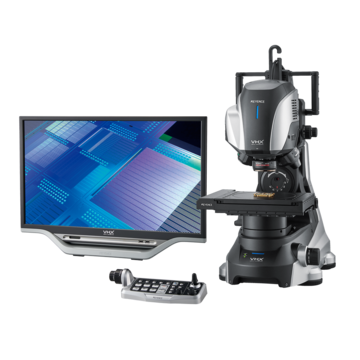
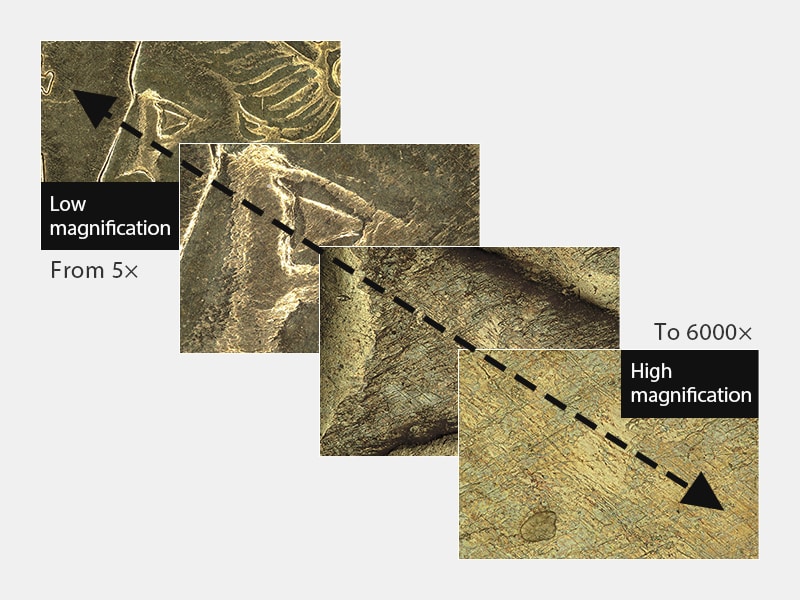
The VHX-X1 Series Digital Microscope shows what an all purpose industrial platform can do across a wide magnification range. The VHX microscope offers a wide range of magnification from 20× to 6000×, making it an extremely versatile tool for any type of inspection. The system adjusts lighting and focus automatically as you zoom, removing the manual juggling that slows down inspection with traditional setups.

Frequently Asked Questions
What Is the Magnification of the Microscope?
The magnification of the microscope varies widely based on type and application. Digital microscopes range from 20× to 6000× or more, compound microscopes from 40× to 1000×, and stereo microscopes from 7× to 45×. The sample size and the degree of detail you need to resolve determine the proper magnification.
How Do You Calculate Microscope Magnification?
How to determine the total magnification of the microscope involves multiplying the objective lens magnification by the eyepiece magnification. For example, a 40× objective with a 10× eyepiece yields 400× total magnification. Digital microscopes may add screen magnification or digital zoom on top of optical magnification.
What Is the Difference Between Magnification and Resolution?
Resolution controls how much detail is visible after expansion, whereas magnification increases the size of a picture. A picture can be magnified endlessly, but the amount of fine detail that the optics can see is limited by resolution. Large, hazy images are produced by high magnification combined with low resolution. Sharp, intricate structures can be seen with good resolution at the right magnification. The magnification of microscopes matters less than whether the system delivers sufficient resolution for your inspection needs.