Digital Microscopes
Digital vs Optical Microscopes: What’s the Difference?
Key Takeaways
- A digital microscope provides advanced imaging, measurement, and documentation capabilities for industrial inspection.
- Optical microscopes offer traditional direct-view observation with simple operation.
- The best digital microscope will improve workflow efficiency with live image sharing and automated measurements.
- Choosing between digital and traditional optical microscope platforms depends on application requirements, image quality needs, and inspection workflows.
- Industrial manufacturers increasingly use digital microscopy for quality control, research development, and failure analysis.
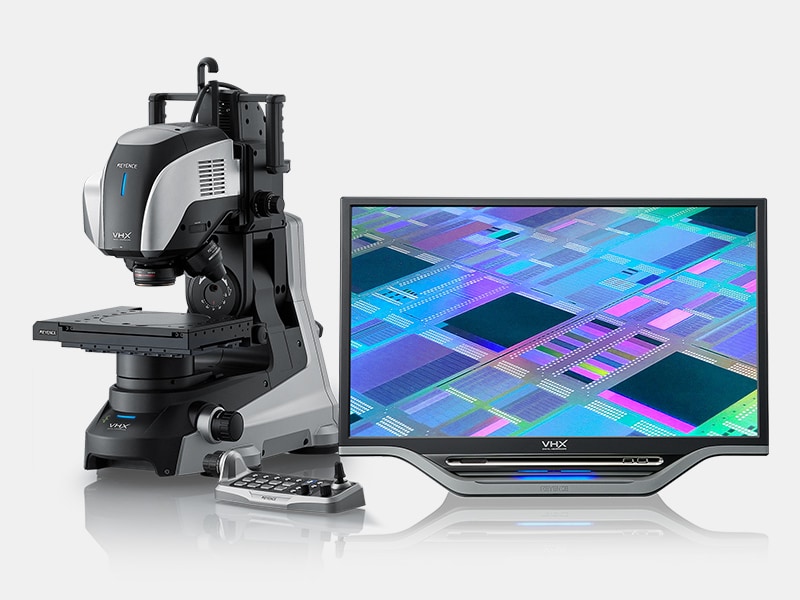
Two microscope types, yet very different experiences. The choice between digital and traditional optical microscopes comes down to what you actually need from inspection equipment—not just what looks good on a spec sheet. If you’re weighing image quality, documentation, collaboration, or budget, this breakdown covers what separates the two and where each one makes sense.
What Is a Digital Microscope?
A digital microscope captures images through a camera sensor and displays them on a screen. There’s no eyepiece to peer through. The image goes directly to a monitor or integrated display, where anyone in the room can see it at the same time.
The optics work similarly to traditional optical microscopes—light passes through the objective lenses before hitting the camera sensor, which converts it into digital data. Digital microscopes have changed how production teams handle inspection records, making it far easier to integrate findings into quality management systems. With digital microscopes, users are able to capture high-resolution images, videos, accurate measurements directly on the screen, and automate reporting.
Most functions run through an easy-to-use software. Lighting, focus, zoom—these can all be automated or preset with a digital microscope. New operators get up to speed faster, and the strain of long eyepiece sessions disappears entirely.
What Is an Optical Microscope?
An optical microscope uses visible light passed through glass lenses to produce a magnified image viewed directly through an eyepiece. No screens, no sensors, no conversion steps. What the optics produce is what you see.
Traditional optical microscopes come in a few distinct forms. Compound microscopes are useful for thin or transparent samples because they employ transmitted light. Three-dimensional views of solid objects are displayed by stereo microscopes. With metallurgical microscopes, polished cross-sections and grain structures are examined by reflecting light off metal surfaces.
It takes some practice to use an optical microscope effectively. Lighting, focus, and magnification all need to be manually adjusted. That hands-on control comes naturally to seasoned operators. For everyone else, it's a skill that needs to be developed.
Digital Microscope vs Optical Microscope: Key Differences
The digital microscope vs optical microscope gap isn’t just about how you perceive the image. It's about what you can do when you see something. For inspections involving just observation, traditional optical systems are quick and straightforward. Workflow differences become important when you need to measure, document, or discuss findings.
The inspection process is altered by digital platforms. The same image is seen in real time by several people sim. Even when not in the room, remote engineers can assess samples and capture measurements using the image captured on the digital microscope. Each measurement is automatically recorded with an image and a timestamp.
The cost breakdown is also different. Entry-level optical microscopes are less expensive but not as easy-to-use and could cost you more in the long term. Faster inspections, fewer mistakes, and integrated documentation can offset the higher initial cost of digital systems by saving you time and giving you the ability to spot issues faster.
Image Quality and Resolution
In optical systems, light travels directly from the sample to your eye without any conversion, creating a clear optical path. Some users believe this results in a purer image, particularly for fine surface texture or minor color changes.
However, more detail is resolved by high-end cameras on digital microscopes than the human eye can see through an eyepiece. Additionally, they are better at handling brightness variation: software can control exposure across the entire image, whereas a bright area would make it difficult to see shadow detail in direct view on a traditional optical microscope. The greatest digital microscope systems provide both digital convenience and optical quality.
Magnification and Field of View
Traditional microscopes use a turret of fixed objectives. You rotate to 10×, 20×, 40×. Each switch interrupts the inspection and changes your working distance. It works, but the process is mechanical and a little clunky for exploratory inspection as users then need to adjust focus to bring the sample into view again.
Continuous zoom digital systems allow you to switch between magnification levels with ease. To get a sense of the sample, start with a macro view, focus on anything of interest and increase magnification, and then zoom back out to examine the surrounding context. No manual focusing adjustments or lens shifting.
Image stitching is also supported by digital systems. You can see context and detail in a single view by combining multiple high-magnification frames into a single wide image. An optical microscope cannot duplicate that during a typical examination.
Ease of Use and Workflow Efficiency
Experience is rewarded with optical microscopes. It takes skill developed over time to get a clear, well-lit photograph of a sample. Inspection findings can vary because new operators frequently struggle with maintaining focus and selecting lighting.
A large portion of that judgment is eliminated by digital interfaces. A less experienced operator can generate repeatable findings right away thanks to auto-focus, saved lighting presets, and guided measuring methods. Some digital systems have software that can replicate image setting using a previously saved image - this is possible using the VHX Series Digital Microscope’s Quick Replay function. The operator focuses on the sample while the system handles setup.
Sharing results also changes. It is ineffective and subjective for one individual to describe what they see through an eyepiece. Every team member sees the same picture when using a digital system and it becomes feasible to collaborate remotely. Instead of being compiled by hand after the fact, reports are generated in just a few seconds.
Microscope Comparison for Quality Control and Manufacturing
The foundation of quality control is repeatability. On the same part, various operators shouldn't yield different outcomes. This is directly addressed by digital systems, which eliminate the variables that lead to inconsistency through automated measurement, recorded settings, and programmable inspection sequences. Measuring microscopes built for production environments pair dimensional accuracy with the documentation tools that audit trails require. Regardless of who is doing it or what shift it falls on, the inspection always proceeds in the same manner.
KEYENCE’s VHX-X1 puts that capability into a system designed specifically for manufacturing environments. A large depth of field handles uneven surfaces. Automated measurement reduces operator input. Data exports connect directly to downstream quality systems.
A microscope comparison that stops at magnification numbers and sensor specs misses the real question: what happens after you look at something? If the answer involves sharing, measuring, reporting, or integrating data into a larger process, digital systems carry the advantage.
Frequently Asked Questions
Which Is Better for Industrial Use: Optical Microscope vs Digital Microscope?
Because of their collaborative viewing, measurement automation, and documentation features, digital microscopes are generally better suited to industrial needs. When it comes to production, digital systems are preferred over optical ones when reproducible measurements or team-based quality assessment procedures are required.
Which Vendors Offer Combined Optical and Digital Microscope Solutions?
Several manufacturers produce hybrid systems that include both eyepieces for direct viewing and digital cameras for screen-based observation. However, purpose-built digital systems often outperform hybrids because they optimize the entire design for screen viewing.
What Are the Advantages of Optical Microscopes?
Optical microscopes cost less initially, require no power or computer systems, and provide pure optical image quality. They work well for simple observation tasks where documentation isn't required.
How Does a Digital Microscope Improve Quality Control?
Through automated measurements that reduce operator variance, instantaneous image capture for defect documentation, programmed inspection routines for consistency, and data interaction with quality management systems, digital microscope systems enhance quality control. These features increase accuracy while cutting down on examination time.