Machine Vision
Automated Positioning and Alignment Systems Using Machine Vision
Automated positioning and alignment systems use machine vision systems and vision sensors to capture and analyze objects, providing real-time feedback to mechanical equipment. While vision sensors offer an all-in-one solution for simpler pass/fail alignment, full machine vision systems provide the high-level processing power needed to guide material handling systems through complex inspections and manipulations on high-speed lines.
Choose Case of Positioning and Alignment
What Is an Automated Vision-Guided Positioning System?
An automated vision‑guided positioning system uses machine vision to determine part location and orientation, then translates that information into motion commands for mechanical equipment.
Vision data in these systems is used to support functions such as:
- Determining pick and place locations
- Aligning tools or fixtures
- Verifying placement before or after mechanical action
How Automated Positioning and Alignment Works
Automated positioning and alignment systems operate by converting vision data into physical motion. While machine vision identifies the location and orientation of a part, the automated system uses that information to drive mechanical equipment—such as robots, actuators, conveyors, or motion stages—to apply alignment corrections directly during production.
At a system level, the process follows a closed-loop workflow:
- Vision acquisition: Cameras capture images of moving or variably positioned parts.
- Position evaluation: Vision software determines the part’s location and orientation relative to a target position.
- Control handoff: Position data is sent to robots or motion controllers.
- Mechanical correction: Equipment physically adjusts tool paths, pick points, or placement positions in real time.
- Continuous feedback: The cycle repeats to maintain alignment throughout production.
In these systems, vision-based position correction provides the input data, while the automated positioning system applies the correction through mechanical movement.
Vision Sensors vs. Machine Vision Systems: Which to Choose?
Choosing the right tool depends on the complexity of your alignment needs:
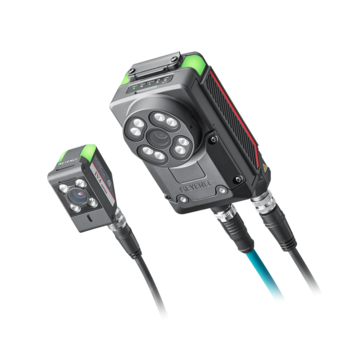
- Vision Sensors: Best for discrete tasks like detecting the presence of a part or basic alignment. They are cost-effective, compact, and integrate the camera, lighting, and processor into one unit.
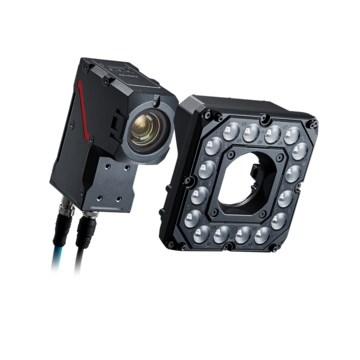
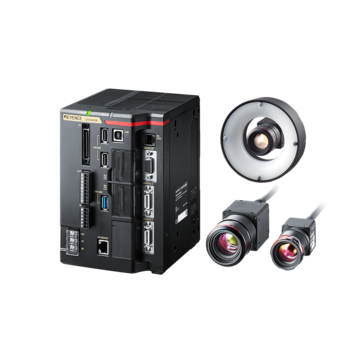
- Machine Vision Systems: Required for high-accuracy applications (like micron-level electronics assembly) or when multiple cameras must work in sync. These systems offer higher frame rates and more robust processing algorithms.
Common Use Cases Across Industries
Automated positioning and alignment systems are used in a wide variety of industries due to their easily adaptable system and software.
Electronics Manufacturing
Automated positioning and alignment systems are critical in electronics manufacturing. As everything is on a mini or even micro scale in electronics, parts have to be in exactly the right position at all times to ensure there are no defects. Even the smallest deviation in position here would render a part useless. The extreme accuracy machine vision systems can bring to the table here is vital to this industry’s success. Applications include PCB assembly alignment, solder paste inspection, and microchip placement.
Automotive
Everyone has seen the video of automotive manufacturing plants where the automated robotic arms are assembling the vehicles. That is a real-life depiction of the automotive assembly process, and it is made possible by the positioning and alignment that machine vision systems provide. It allows the mechanical arms to weld parts in place, assemble the vehicle, and ensure that assemblies like the engine and drivetrain are placed in exactly the right position.
Pharmaceuticals
Pharmaceuticals are another industry that depends on object accuracy for safety and compliance. Packaging inspection, vial alignment, and label verification all have a direct impact on safety. Vision sensors are often used here for high-speed label presence checks, while more complex machine vision systems like the CV-X Series handle 3D orientation and high-resolution defect analysis.
Key Features of Automated Positioning and Alignment Systems
Machine vision image processing systems possess a number of impressive features that make them very valuable to the industries mentioned above. Some of the most important features are:
- Extreme Accuracy: Mechanical positioning is guided by high‑resolution vision data, allowing parts to be placed with micron‑level precision.
- Flexibility: Machine vision image processing systems can work in a variety of environments and across many different shapes, sizes, and materials. Even reflective surfaces can be accurately processed.
- Constant Feedback Loop: Vision data continuously informs mechanical equipment so alignment corrections are applied during operation rather than through fixed setup.
- Scalability: Image processing systems support a wide range of applications due to their compatibility with single stations and multi-camera, industrial plant-size systems.
- Ease of Integration: The IV4 Series Smart Camera is PoE-enabled (Power over Ethernet), requiring only a single LAN cable for both power and communication — simplifying installation on existing lines. Machine vision systems provide the scalability needed for plant-wide data integration and complex industrial networking.
Solving Common Challenges with Machine Vision Image Processing
Automated positioning and alignment systems reduce production challenges by ensuring misaligned parts are corrected before mechanical operations occur. By applying vision‑guided corrections directly through equipment motion, these systems help maintain throughput and prevent alignment‑related defects on high‑speed lines.
If your production line could benefit from tighter accuracy and fewer errors, explore how KEYENCE’s advanced machine vision solutions can transform your operations. Learn more about KEYENCE Vision Systems today.
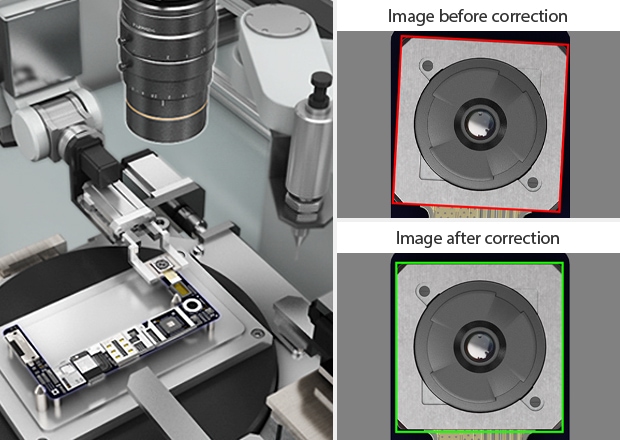
Alignment for Mounting of Camera Module
Using a high-pixel, 16x speed machine vision achieves high-accuracy positioning.
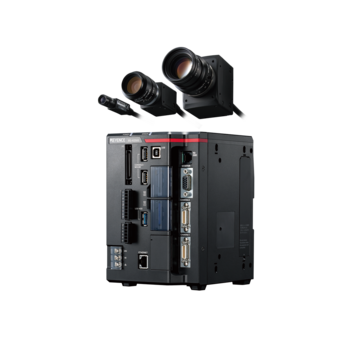
Customizable Vision System XG-X series
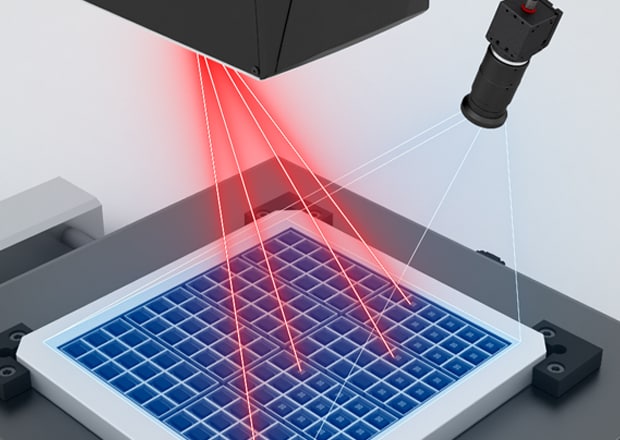
Electronic PCB Laser Alignment
In addition to being able to capture the entire field of view all at once, the camera’s angle sensor ensures reproducibility even when installed at an angle.
Customizable Vision System XG-X series
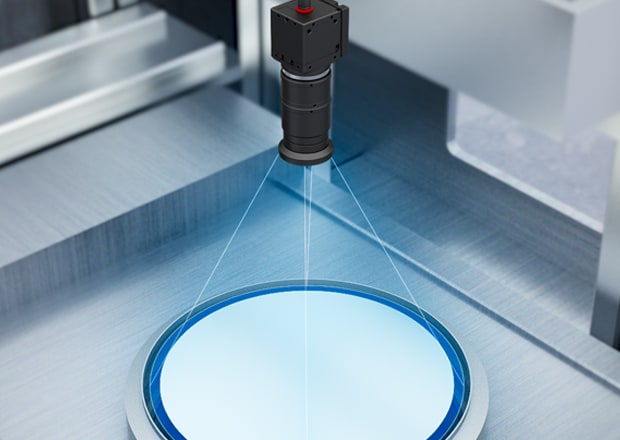
Wafer Alignment
Whereas conventional systems needed to capture separate images to ensure high resolution, wide-area imaging makes it possible to capture the entire field of view all at once for improved processing times.
Customizable Vision System XG-X series
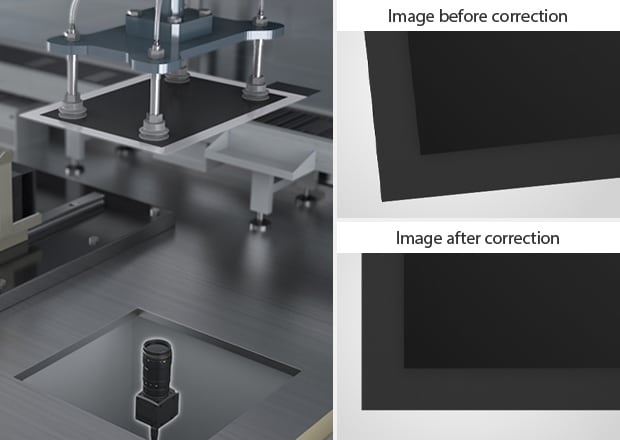
Battery Lamination Layer Alignment
Easy configuration and flexible customization support the alignment required in the battery cell manufacturing process. Using a 21 megapixel camera enables the inspection of large targets.
Customizable Vision System XG-X series

FAQs
How Do Automated Positioning Systems Use Vision Data to Guide Equipment?
Automated positioning systems use vision data as a feedback signal to detect positional deviations and guide mechanical equipment in real time. This continuous correction loop ensures parts remain within tolerance as they move through production.
How Do Automated Positioning and Alignment Systems Improve Production Accuracy?
Corrections are sent to the mechanical equipment constantly and in real-time to guarantee accuracy. This level of accuracy reduces rework, waste, and machine downtime, and also produces parts of the highest quality.
Can Automated Positioning Systems Detect and Correct Misaligned Parts?
Yes. Vision data detects misalignment or rotation, and automated systems use that information to guide mechanical equipment in correcting part placement in real time.
What Types of Applications Use Machine Vision Image Alignment?
Machine vision image alignment is used in a wide number of industries like automotive, pharmaceutical, electronics, and food and beverage.