Machine Vision
The Evolution and Impact of Machine Vision in Factory Automation
Key Takeaways
- Machine vision is essential for factory automation, delivering higher throughput, lower costs, and consistent quality.
- Core capabilities include high‑precision inspection, process optimization, traceability, and safety verification.
- The main applications in manufacturing are robot guidance, automated inspection, packaging/label verification, and precision measurement.
- New drivers—AI/deep learning, 3D vision, high‑res sensors, edge computing, advanced lighting—expand use cases and flexibility.
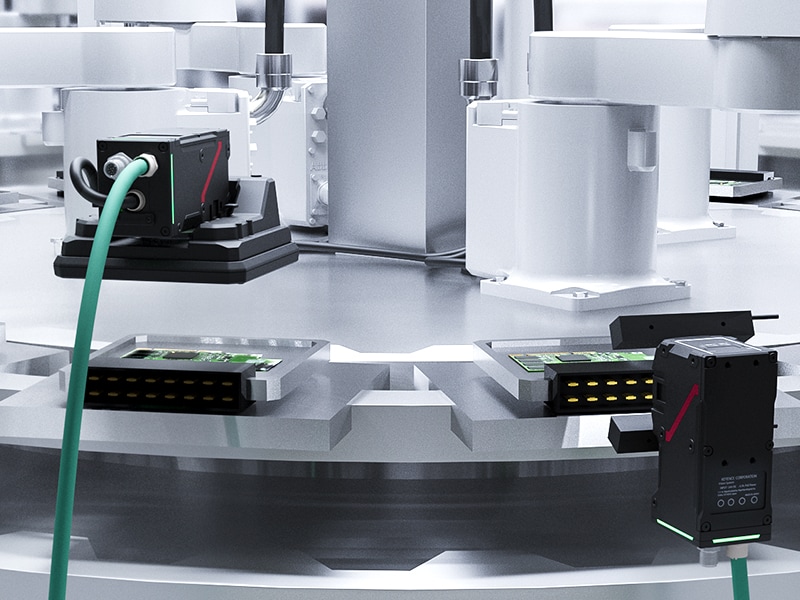
Automation has become an unavoidable trend for achieving low costs and high quality in manufacturing. From simple tasks to assembly and inspection processes that require advanced techniques, this work is rapidly being automated, and productivity has come to rise to levels greater than before.
Machine vision enables faster inspections, higher accuracy, and greater operational efficiency, making it one of the most impactful technologies in smart manufacturing. In this resource, we will explore a brief history of machine vision, as well as the various benefits and applications.
What Is Factory Automation?
Factory automation refers to the use of machines, robotics, sensors, and software to perform industrial tasks with minimal human involvement. Automated systems help manufacturers to reduce variability, improve throughput, lower operational costs and maintain consistent quality.
How Machine Vision Enhances Automation
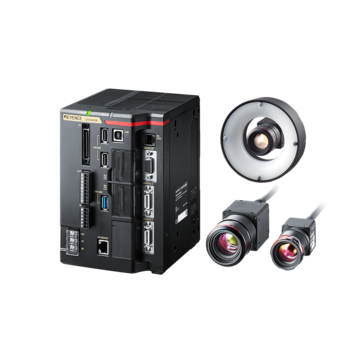
Machine vision systems combine cameras, lighting, optics, image processing filters, and AI algorithms to capture and interpret images. These systems deliver:
- High precision inspection — Detecting defects, dimensional errors, and assembly issues
- Process optimization — Identifying inefficiencies and reducing scrap
- Traceability — Reading barcodes, DPM codes, and text for compliance
- Safety and verification — Ensuring correct part placement and orientation
As factories adopt more advanced automation, machine vision becomes essential for maintaining quality and consistency.
Top Applications of Machine Vision in Manufacturing
Machine vision systems are used in different aspects of today’s automation-focused manufacturing processes:
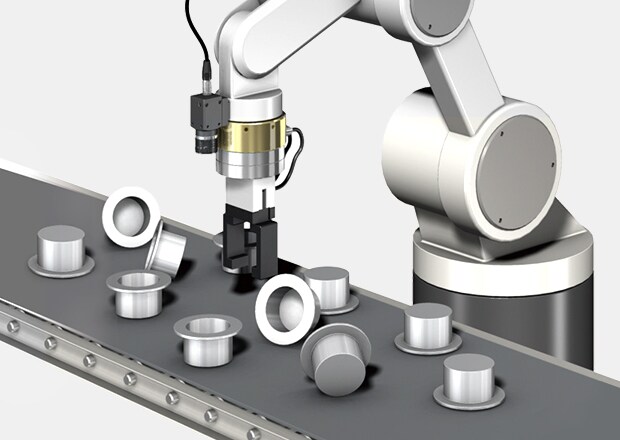
- Robot guidance — Directing robots for pick and place, assembly, welding, and material handling
- Automated inspection — Identifying defects, verifying dimensions, and ensuring product integrity
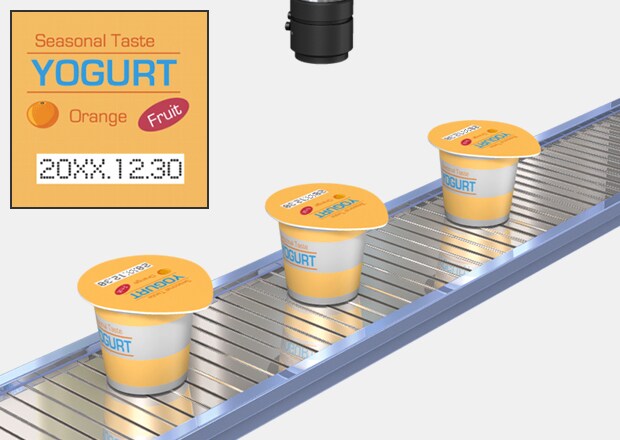
- Packaging and labeling verification — Checking label accuracy, reading codes, and confirming packaging quality
- Precision measurement — Performing high accuracy measurements at production speed
These applications reduce human error, increase throughput, and support continuous improvement initiatives.
Advances in Machine Vision and Factory Automation
Many efforts predate today’s advanced machine vision systems. For example, in the 1950s, psychologist James J. Gibson introduced the concept of optical flow. Optical flow is a machine vision technique for tracking movement by identifying pixel patterns between frames. It's commonly used in sports broadcasting to track players on the field or court or to identify objects as they move along a conveyor belt. In response, researchers started to create mathematical models for computing optical flow on a pixel-by-pixel basis.
In the 1960s, Larry Roberts’ PhD thesis at MIT explored the possibility of extracting the 3D geometry of objects from 2D representation. This prompted further research and developments in stereo vision and other 3D techniques.
In the late 1970s, through MIT's Artificial Intelligence Lab’s machine vision course, David Marr discovered a framework for analyzing raw image data and gradually building up a more abstract scene understanding. This framework is known as the bottom-up approach to scene understanding, inspiring more subsequent machine vision research.
The trade group Automated Imaging Association (AIA), founded in 1984, pioneered the movement to promote the use of machine vision technology and a platform where industry professionals can network and share knowledge.
By the 1990s, vision systems started to become commonplace, with many manufacturers adopting them in their operations.
Modern machine vision systems are well-formed and capable of handling simple to complex industrial tasks. They offer incredible speed and accuracy. To meet the ever-growing automation needs of industries, machine vision is continuously evolving for even greater flexibility.
Technologies Driving the Next Generation of Machine Vision
Machine vision continues to advance rapidly thanks to innovations such as:
- AI and deep learning for complex classification and anomaly detection
- High resolution sensors allowing for detailed inspections
- 3D vision for advanced robot guidance
- Edge computing for low latency processing
- Advanced lighting and optics for challenging surfaces and environments
These technologies allow manufacturers to automate tasks once considered too variable or difficult for traditional vision systems.
KEYENCE: A Leader in Machine Vision Solutions
KEYENCE has long been a global leader in vision systems designed for demanding industrial environments.
Some of the industries using vision systems from KEYENCE are medical, pharmaceutical, food and beverage, automotive, and electronics. Our systems are equipped with powerful, high-res cameras, vision software, AI capability, and industrial grade hardware.
For more information on how our machine vision systems can help boost your factory automation solutions, contact us today.

Related Products
Related Downloads
-
![A Technical History of Image Processing Vol.1 [Camera]](/img/asset/AS_46814_L.jpg)
A Technical History of Image Processing Vol.1 [Camera]
An Introduction to the History of the Camera and the Image Processing Advancements Achieved, From the Birth of the Camera to the Current Digital Cameras.
-
![A Technical History of Image Processing Vol.2 [Lenses]](/img/asset/AS_46815_L.jpg)
A Technical History of Image Processing Vol.2 [Lenses]
An Introduction to the History of the Lens from Its Origins Over 2000 Years Ago to the Historic Changes in Materials & Designs.
-
![A Technical History of Image Processing Vol.3 [Illumination]](/img/asset/AS_46816_L.jpg)
A Technical History of Image Processing Vol.3 [Illumination]
An Introduction to the History of Illumination from the Early Days of Open Fires and Torches to the Advanced Technological Developments with LED Lighting Today.Back-issues of This Series Are Currently Available to the Public as Well.
-
![A Technical History of Image Processing Vol.4 [Factory Automation & Image Processing]](/img/asset/AS_46817_L.jpg)
A Technical History of Image Processing Vol.4 [Factory Automation & Image Processing]
We Have Compiled Information That Will Show You How FA Has Come to Change. Feel Free to Take a Look at These Materials.Back Issues Are Also Available!
![A Technical History of Image Processing Vol.5 [Traceability]](/img/asset/AS_52287_L.jpg)