CMM (Coordinate Measuring Machine)
CMM for Plastics Industry
Key Takeaways
- Portable CMMs allow on-site inspection without moving parts, reducing deformation risks for plastic components.
- Non-contact measurement options are ideal for sensitive plastics, ensuring accurate mold and GD&T inspections.
- Choose CMM software with temperature compensation and CAD comparison to prevent environmental measurement errors.
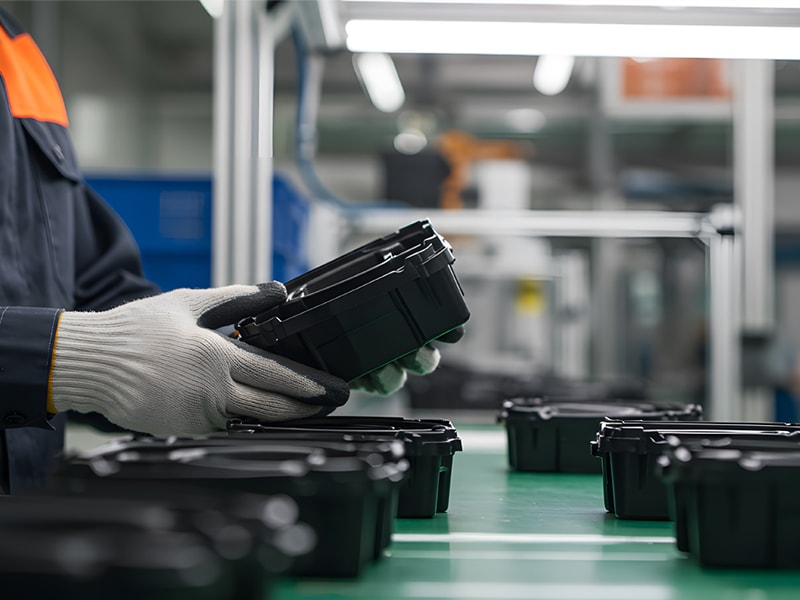
A coordinate measuring machine, also known as a CMM, is a metrology system used for dimensional and GD&T measurements. CMMs collect coordinate points from a part, then calculate measurements through software for accurate inspection and analysis.
If you’re in the plastics industry, a CMM can help improve and streamline your inspection process. From inspecting molded parts to verifying GD&T measurements, the right system can improve efficiency, accuracy, and consistency throughout production. In this blog, we’ll discuss how to choose the right CMM for plastics manufacturing applications.
How CMM Machines are Used in Plastic Manufacturing
Beyond final part inspection, CMMs play a significant role in the plastics industry. For example, they are often used as part of R&D and quality control in the production molds that are used for injection-molded components. This inspection process ensures that these parts meet specific standards and are defect-free.
In addition, some plastic parts can be sensitive to contact-based measurement methods, making non-contact inspection an important consideration for certain applications. Metal parts, however, are typically well suited for contact-based CMM measurements due to their durability and rigidity.
Choosing the Right CMM for Plastic Manufacturing Applications
Like most industrial equipment, CMMs are available in several models, each with advantages for different applications. The three main CMM categories are bridge/gantry, cantilever/horizontal arm, and portable arm systems. For many plastics manufacturing applications, portable CMMs paired with adaptable software are often the best fit. Let’s take a look at why.
Select the Proper Model
To select the proper CMM for the plastics industry, it’s best to pick one that can combat environmental changes, like variations in temperature or humidity. With these considerations, the proper CMM model for the plastic manufacturing industry is a handheld and portable CMM.
A handheld portable CMM measures and inspects parts by bringing the system directly to the plastic component and touching the probe to the surface. This allows inspections to be completed without moving the part to another room or removing it from the mold. There are also non-contact measurement options, allowing operators to inspect sensitive parts without making physical contact with the surface.
Alternative CMM models, such as bridge-style systems, require the plastic part or mold to be brought to the machine for inspection. Frequent transportation can cause deformities from temperature changes or handling, especially with sensitive plastic components. It also adds unnecessary time and inefficiency to the inspection process.
Select the Proper Software
The most effective CMM software for the plastics manufacturing industry should include features such as temperature and vibration compensation, visual guidance, and CAD model comparison.
Temperature compensation helps standardize measurements by accounting for changes caused by environmental conditions. This is especially important for plastic parts, which can expand or deform with temperature fluctuations. Vibration compensation also helps maintain accurate measurements in active production environments by reducing the impact of external movement.
Visual guidance is valuable for repeated inspections because it helps ensure every part is measured the same way, regardless of the operator. Reducing variation between technicians improves consistency and helps prevent measurement errors from affecting the rest of the production batch.
Integrate the CMM into Plastic Manufacturing Processes
Implementing a coordinate measuring machine in plastic manufacturing will prevent defects and improve inspection repetition.
KEYENCE’s portable and handheld coordinate measuring machines are specialized for the plastics industry, featuring 3D CAD model color map comparison to spot deformities, visual guidance with a touch screen for consistency, and temperature compensation for neutral measurements.
Measurement Example
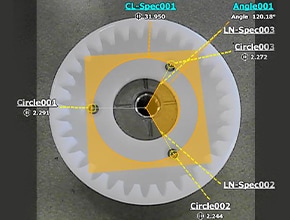
P.C.D./dividing angle measurement
The P.C.D. and the dividing angle can be measured.
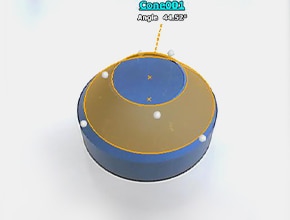
Taper measurement
The taper angle can be measured.
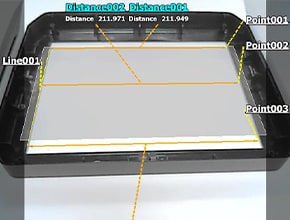
Frame distortion measurement
The frame distortion can be measured at various points.
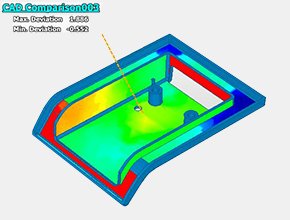
Warpage/curvature
The warpage and curvature of resin-molded products can be quantified through comparison against the CAD data.
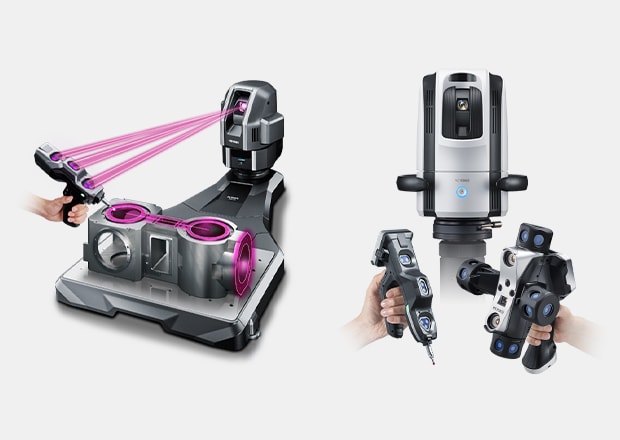
Handheld Probe Coordinate Measuring Machine XM Series / Wide Area CMM WM-6000 Series
Contact us today for a free demo of our CMM solutions and to go over any questions you have.

Related Products
Related Downloads
-
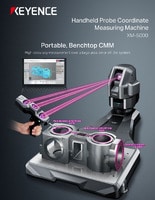
XM Series Handheld Probe Coordinate Measuring Machine Catalog
Brochure for the XM-5000 Series Handheld CMM. Portable CMM to easily and accurately measure 3D and GD&T features anywhere including the shop floor and in the machine tool.
-
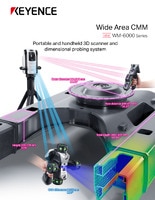
WM-6000 series Wide Area CMM Catalog
Brochure for the WM-6000 series Wide-Area CMM. A portable setup with a wireless handheld probe that enables users measure large parts and equipment.
![WM-6000 series Measurement / Application Examples [System Versatility Examples]](/img/asset/AS_116820_L.jpg)