Machine Vision
Advanced Color and Product Type Inspection Systems
Color and product type variation are a routine part of the modern-day manufacturing process. Parts can look nearly identical to the human eye but differ by model, orientation, finish, or configuration. Advanced color and product type inspection systems bring consistency to this process by applying a repeatable and in-line check that operates at speed with the production line. By replacing a subjective visual judgement with a data-driven inspection, manufacturers gain tighter control over their product flow while also reducing the risk of errors.
Choose Case of Advanced Color and Product Type Inspection
How Color and Product Type Inspection Improves Manufacturing Efficiency
Manufacturing inspection efficiency depends entirely on stable workflows and predictable outcomes, and when incorrect components are added to a sequence, the impact extends beyond a rejected part. It can also result in line stoppages and rework, and manual verification that slows throughput and introduces variability.
A color inspection system that is integrated into the production line helps prevent these disruptions by verifying part attributes before the assembly is allowed to progress. Color differences and surface shading are evaluated in real time, and visual readings of orientation cues flag incorrect parts immediately. Any product type inspection builds on these capabilities by confirming that the correct part or assembly is present, even when looking at different versions of the end product.
Ensuring Quality Control with Advanced Visual Inspection Systems
Consistent quality control inspection relies on objective criteria applied the same way each time. Manual checks often struggle to maintain that consistency, which is particularly helpful in high-volume or multi-shift environments where operator fatigue has been an issue or where lighting conditions vary.
An advanced visual inspection system applies the same inspection logic to every part, regardless of speed or operating condition; color verification, pattern recognition, and shape differentiation are handled through image data rather than operator interpretation.
While improving repeatability and reducing the likelihood of borderline parts slipping through the inspection process, these modern visual inspection systems adapt well to variation. Changes in part position or subtle surface variation do not require constant re-teaching or adjustment. That flexibility allows quality control inspections to remain stable even as production conditions change throughout the day.
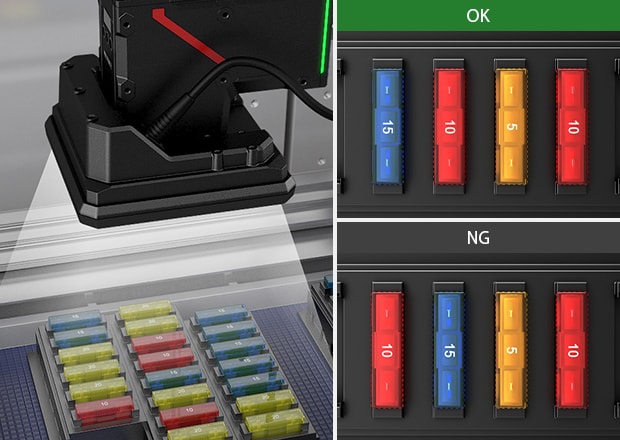
Incorrect Fuse Assembly Inspection
Fuse assembly mistakes can be inspected by checking color and characters. This makes inspection simple across a wide variety of products.
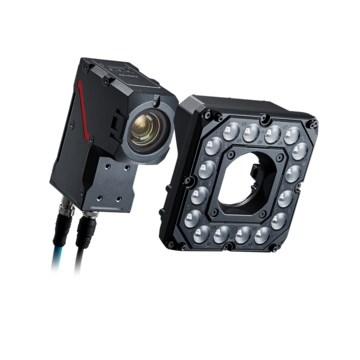
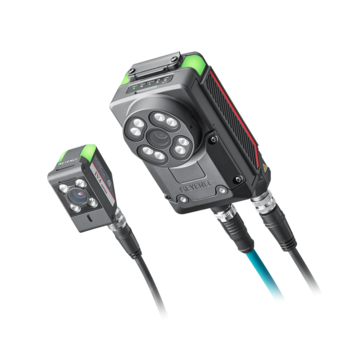
Vision System with Built-in AI VS series
Connector Cable Color Difference Check
Accurate detection is possible with a single unit, even in locations where multiple sensors are required and there is the risk of target displacement.
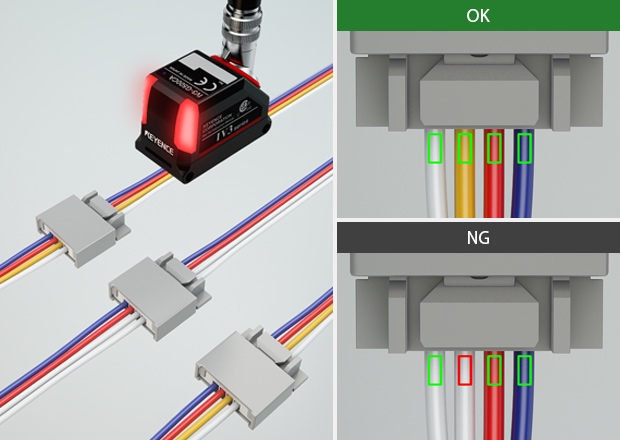
Vision Sensor with Built-in AI IV4 series
Inspection of Rubber Bushings
The Multi-Spectrum Lighting technology stably detects the slightest variations in color and shading to detect contamination.
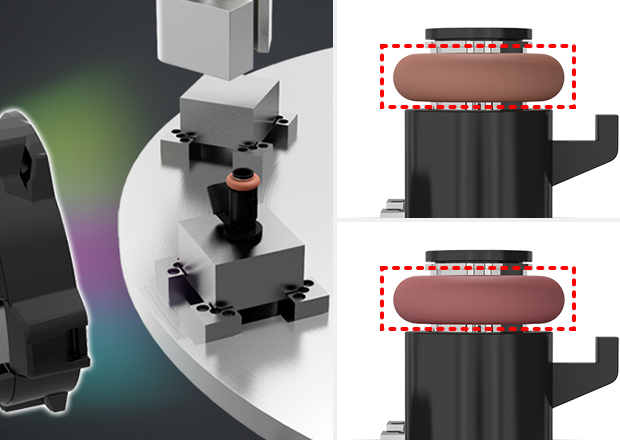
Vision System with Built-in AI VS series
Front/Back Differentiation for Pressed Metal Parts
Products can easily be differentiated according to front/back, orientation, shape, and size.
Vision Sensor with Built-in AI IV4 series
Product Type Differentiation of Injectors
With one unit, injectors can be differentiated according to multiple items, such as color and shape differences and component presence.
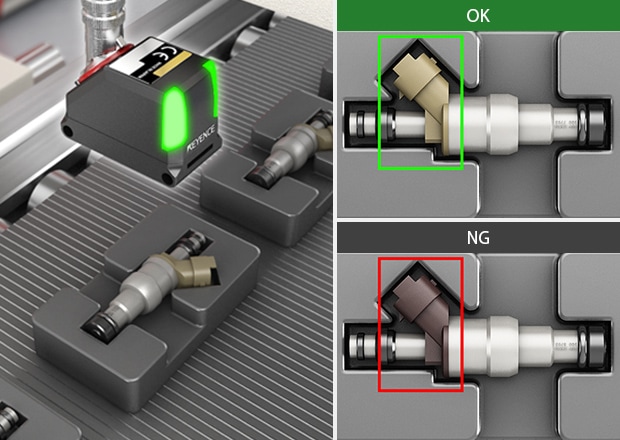
Vision Sensor with Built-in AI IV4 series
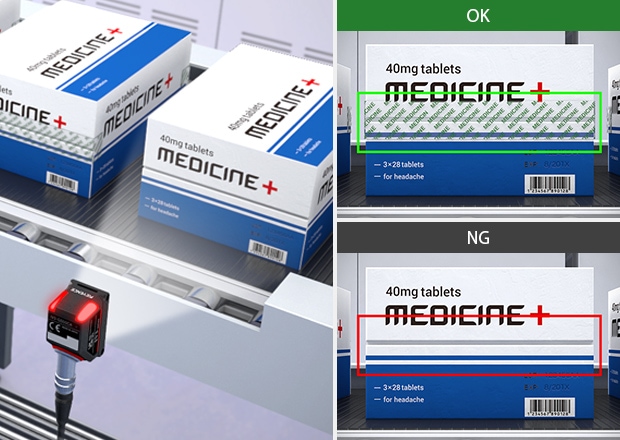
Sealing Tape Presence Detection
Translucent targets, mottled patterns, and other such items that reflective sensors have difficulty with are checked as surfaces for stable detection.
Vision Sensor with Built-in AI IV4 series
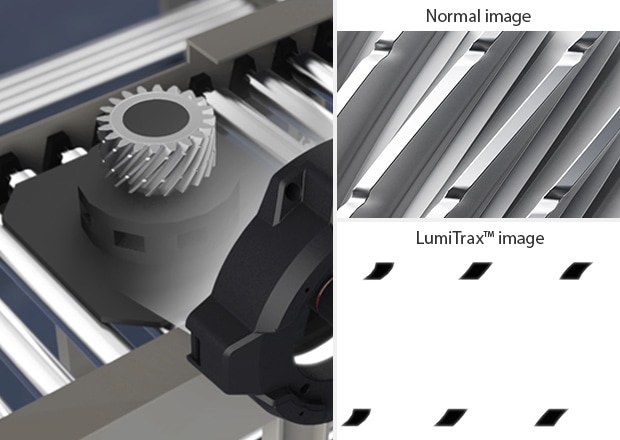
Identifying Groove Detection in Gear Assembly Processes
The shape and metallic finish of metal gears can make detecting the identifying grooves with a 2D camera unstable, but LumiTrax™ imaging ensures reliable inspection by extracting only the grooves.
Vision System with Built-in AI VS series
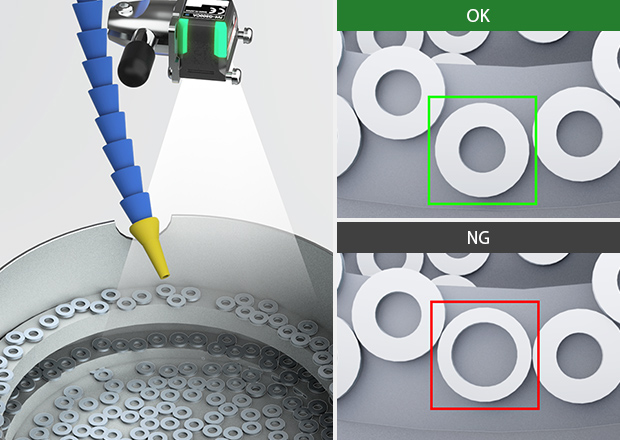
O-Ring Type Difference Checking
Product type differentiation can be performed directly from the parts feeder with accurate identification of shape differences, even in targets of the same size.
Vision Sensor with Built-in AI IV4 series
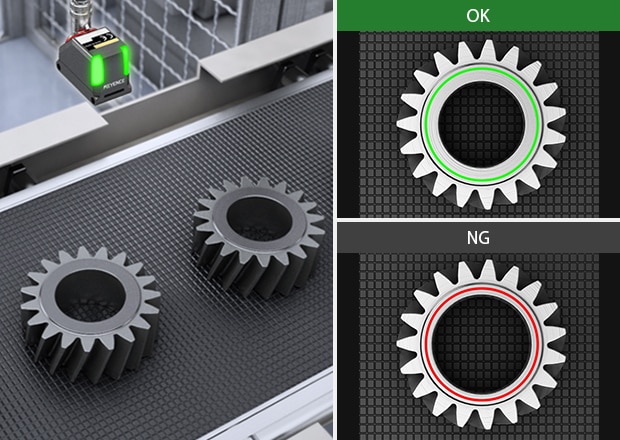
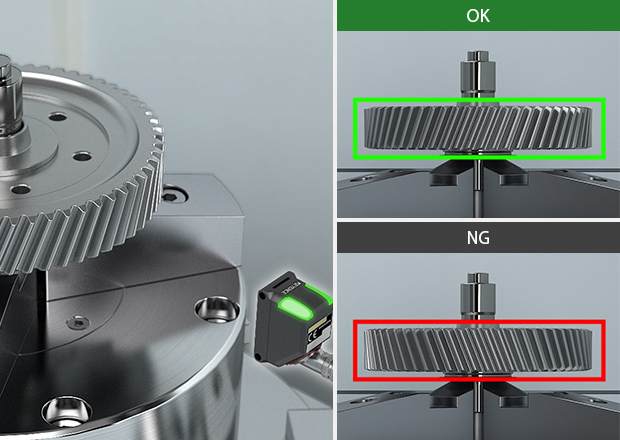
Gear Type Difference Checking
The IV4 Series can determine whether gears are set correctly by accurately identifying differences that are not easy to see with visual inspection.
Vision Sensor with Built-in AI IV4 series
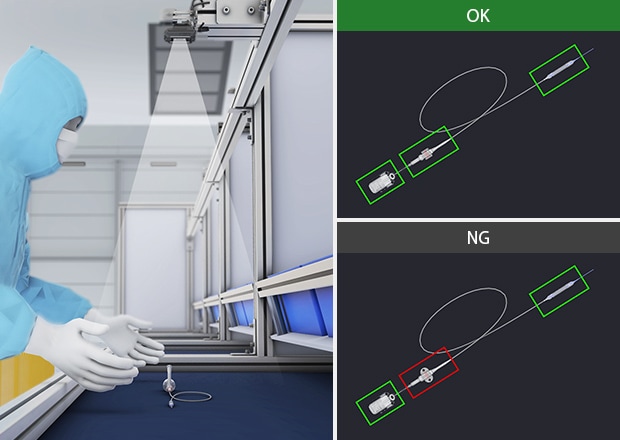
Tube-Based Pharmaceutical Product Assembly Check
Identifying the different shapes of products, even if the position or orientation varies, makes it possible to ensure medical tubing is installed correctly.
Vision Sensor with Built-in AI IV4 series
Benefits of Automating Color and Product Type Inspection in High-Volume Manufacturing
High-volume manufacturing environments place pressure on inspection processes to keep pace without becoming a bottleneck on the line. Automation addresses this by separating inspection performance from the ‘human’ workload, allowing operators to focus more on more meaningful tasks.
Automated color and product type inspection supports the continuous operation of a line without slowdown. Every part is evaluated (not just samples), which reduces the need to rely on statistical assumptions. The results from an inspection are available immediately, allowing corrective action to happen at the beginning of production and not at the end.
Automation also improves traceability within the inspection workflow. Inspection results can be logged alongside production data, supporting root-cause analysis when issues arise. Over time, this visibility helps manufacturers refine processes and reduce recurring inspection failures tied to specific components or suppliers.
Real-World Applications of Color and Product Type Inspection in Automotive and Electronics Industries
Automotive manufacturing frequently involves components that differ only by trim level, orientation, or regional configuration. Color inspection systems are commonly used to differentiate connector housings, seals, and fasteners that appear similar but serve different functions. Production type inspection verifies correct part selection before installation, which, overall, helps reduce the risk of mismatched assemblies that may not be discovered until later stages of production.
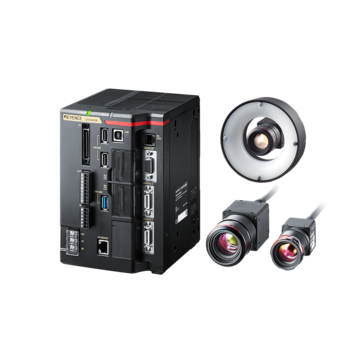
In electronics manufacturing, the visual differences between parts are often more subtle. Cable assemblies and molded parts share potentially similar geometries and small mechanical components that can vary by color, finish, or in their features. A visual inspection system, like the VS Series by KEYENCE, can safely distinguish between these parts' reliability, even when parts arrive in a mixed bag or if they are passing through the line at high speed.
Across both industries, these inspection systems help maintain consistency as the complexity of the product increases. As manufacturers introduce more product variants and more models without expanding their line’s footprint, color and product type inspection becomes a more practical way to maintain control of this process without adding any manual overhead.
Enhance your quality control with KEYENCE inspection systems.