Clamp-On vs Inline Flow Meter: The True Installation Cost
Key Takeaways
- The right choice between a clamp-on and an inline flow meter depends on total installation effort, downtime risk, accuracy needs, and pipe conditions, not just the purchase price.
- Inline flow meter installation requires stopping production, draining the system, and cutting the pipe, which adds labor, coordination, and risk well beyond the cost of the meter itself.
- Clamp-on flow meters mount to the outside of a live pipe with no pipe modification, no shutdown, no fluid contact, and no risk of pressure loss or contamination.
- Inline meters remain the better fit when the highest possible precision is required.
In a clamp-on vs inline flow meter decision, the purchase price of the meter is rarely the biggest cost. An inline meter requires shutting down the process, cutting into the pipe, installing the meter, resealing, and reintroducing flow to the system. A clamp-on flow meter mounts to the outside of a live pipe in minutes.
What Does It Take to Install an Inline Flow Meter?
Installing an inline flow meter means replacing a section of process pipe, so the labor, planning, and downtime usually cost more than the meter.
Typical inline installation cost drivers include:
- Pipe cutting and welding: Work performed by certified welders familiar with process piping.
- Bypass loops: Needed when the system cannot tolerate any flow interruption, with cost rising with line size, pressure rating, and materials.
- Hot-tap installation: Avoids a shutdown but requires specialized technicians and strict safety protocols.
- Shutdown coordination: Planning across instrumentation, mechanical, and operations teams.
- Commissioning: Full pressure testing and integration checks before the meter goes live.
Retrofits make the gap especially clear. Once spool fabrication, installation labor, bypass provisions, and commissioning are added, the total project can cost several times more than the meter itself.
What Are the Risks of Cutting Into a Process Pipe?
Every inline installation opens the process, which creates new chances for leaks, contamination, pressure loss, and measurement error.
Process and Contamination Risks
Before an inline meter goes in, production stops, the system is drained, the pipe is cut, and the plumbing is modified. Facilities handling acids, solvents, or other aggressive liquids face added exposure at every opened connection.
In food and beverage plants, any open connection puts product integrity and sanitary compliance at risk. Learn more about how clamp-on flow meters keep food and beverage lines running without contamination risk.
Mechanical and Measurement Risks
Improper installation is one of the most common sources of flow meter problems and can degrade measurement accuracy. Water hammer can damage sensor bodies and electronics, and high-velocity flow can erode internal meter components over time.
Inline meters also sit in the flow path, creating pressure drop and turbulence. That added load shortens pump service life and introduces more sources of measurement error.
Warranty and Specialist Requirements
Modifying manufacturer-approved systems can void equipment warranties. Many installations also require manufacturer-certified specialists with hazardous area qualifications.
How Does a Clamp-On Flow Meter Work?
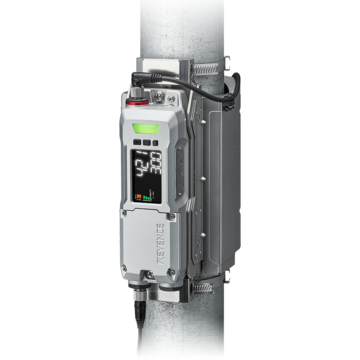
A clamp-on flow meter mounts to the outside of a pipe and measures the liquid inside using ultrasonic signals sent through the pipe wall. The sensor never touches the fluid, and no pipe modification is needed.
Most clamp-on ultrasonic meters use the transit-time method. Two transducers on the pipe exterior take turns sending and receiving ultrasonic signals, one traveling with the flow and one against it.
Sound travels faster with the flow than against it. The meter calculates fluid velocity from the difference in travel time, then uses pipe dimensions and fluid properties to determine the flow rate.
Because nothing enters the pipeline, clamp-on meters suit applications where fluid contact, contamination, or downtime would ideally be avoided. Explore the full range of KEYENCE flow sensors and flow meters.
How Fast Is Clamp-On Flow Meter Installation?
Clamp-on flow meter installation takes minutes, not hours or days, because there is no draining, pipe cutting, hot work, or process shutdown.
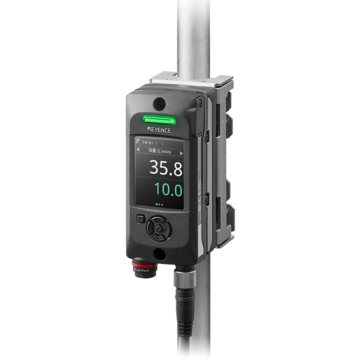
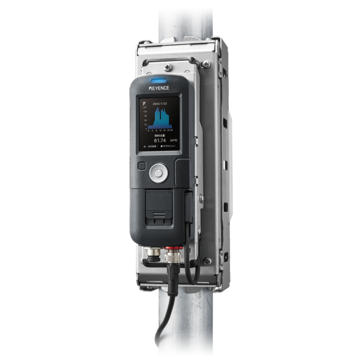
The KEYENCE FD-H Series clamp-on flow sensor mounts in 60 seconds using six standard screws, without shutting down the machine. The KEYENCE FD-R Series clamp-on flow meter secures with 4 or 6 screws, and its bracket ensures correct mounting by anyone using only a screwdriver.
No special knowledge, tools, or contractors are needed, and there is no loss of production during installation.
Clamp-On vs Inline Flow Meter: How Do They Compare?
Both meter types measure flow, but they differ in installation, maintenance, pressure loss, accuracy, and pipe requirements.
| Attribute | Inline Flow Meter | Clamp-On Flow Meter |
|---|---|---|
|
Installation time
|
Inline Flow Meter
Hours to days
|
Clamp-On Flow Meter
Minutes
|
|
Process shutdown
|
Inline Flow Meter
Usually required
|
Clamp-On Flow Meter
Not required
|
|
Pipe modification
|
Inline Flow Meter
Cutting, welding, or gluing
|
Clamp-On Flow Meter
None
|
|
Fluid contact
|
Inline Flow Meter
Direct contact
|
Clamp-On Flow Meter
None
|
|
Pressure drop
|
Inline Flow Meter
Obstructs the flow path
|
Clamp-On Flow Meter
None
|
|
Maintenance
|
Inline Flow Meter
Periodic cleaning and recalibration; often requires opening the line
|
Clamp-On Flow Meter
Minimal; sensors can be serviced without opening the process
|
|
Accuracy
|
Inline Flow Meter
Highest precision
|
Clamp-On Flow Meter
Suitable for most industrial applications
|
|
Pipe condition
|
Inline Flow Meter
Unaffected by external pipe condition
|
Clamp-On Flow Meter
Requires pipes free of heavy rust or cement/concrete coatings
|
|
Personnel
|
Inline Flow Meter
Welders and certified specialists
|
Clamp-On Flow Meter
Minimal training
|
|
Best fit
|
Inline Flow Meter
Highest precision needed
|
Clamp-On Flow Meter
Retrofits, corrosive chemicals, continuous and hygienic operations
|
Accuracy
Inline meters hold an edge in precision because of direct fluid contact and known internal geometry. The difference matters most when high accuracy is required.
Maintenance
Inline meters need periodic cleaning and recalibration, especially on dirty or corrosive service. Clamp-on meters have no moving parts and never contact the fluid, so maintenance needs are minimal.
Pipe Condition
Cement linings, concrete coatings, or heavy rust can interfere with ultrasonic signal transmission. Check pipe condition before choosing clamp-on technology.
When Is an Inline Flow Meter the Better Choice?
An inline flow meter is the better choice when precision is the top priority and the cost of downtime is acceptable. Typical examples include custody transfer, fiscal metering, and lines where pipe condition prevents reliable ultrasonic measurement.
Where Do Clamp-On Flow Meters Deliver the Most Value?
Clamp-on flow meters deliver the most value wherever downtime, fluid, or associated risks (pressure loss, contamination, leaks, etc.) of cutting a pipe carry a high cost.
- Retrofits: Unmetered lines found during audits can be measured without a shutdown. See why measuring flow matters more than just detecting it.
- Water and wastewater: Operators can monitor intake lines, chemical feed rates, and filter backwash without taking the system offline.
- Data centers and cooling loops: Coolant flow can be monitored without adding a new leak path.
- Food and beverage: External mounting removes sanitary concerns and clean-in-place verification.
- Chemical processing: Acid transfer lines, caustic circulation, and chemical dosing points can be measured without wetted sensor materials.
KEYENCE also offers clamp-on options for other needs, including the FD-X Series clamp-on micro flow sensor for dispensing and small tubes, and the FD-G Series clamp-on gas flow meter for compressed air and gases.
Which KEYENCE Clamp-On Flow Meter Fits Your Pipe?
- FD-R Series: For pipes up to 8" made of stainless steel, iron, copper, PVC, or resin, with integrated temperature monitoring. Designed for liquid flow.
- FD-H Series: For pipes, tubes, and hoses, including liquids with bubbles, high temperatures, or high viscosity. Size ranges from ¼" to 1 ¾". Designed for liquid flow.
- FD-X Series: Low flow meter compatible with metal pipes and resin tubes from 0.12" - 0.5". Designed for liquid flow.
- FD-G Series: Compatible with stainless steel and iron pipes from 3/4" to 8" and can measure compressed air, nitrogen, and other gases. Designed for air/gas monitoring.
- FD-EC Series: Compatible on tubes/hoses from ⌀6 mm (0.24″) to 12.7 mm (0.50″). Designed for air/gas monitoring.
Not sure which fits? Use the KEYENCE flow meter selection site to get a recommended parts list from a product expert.
FAQs
Q What is the difference between a clamp-on vs inline flow meter?
A
An inline flow meter is installed inside the pipe, so the fluid flows through the meter body. A clamp-on flow meter mounts to the outside of the pipe and measures through the pipe wall without touching the fluid.
Q Why does inline flow meter installation cost so much?
A
Inline installation involves pipe cutting, skilled labor, shutdown coordination, and commissioning. Bypass loops or hot tapping add further cost, so the total often exceeds the price of the meter itself.
Q Can a clamp-on flow meter be installed without stopping production?
A
Yes. Clamp-on flow meters attach to the outside of a live pipe without cutting or draining it. KEYENCE clamp-on flow meters install in minutes with a standard screwdriver.
Q Are clamp-on flow meters as accurate as inline flow meters?
A
Inline meters generally offer the highest precision because they contact the fluid directly. Clamp-on meters deliver reliable accuracy for most industrial applications when installed on suitable pipes.
Q What maintenance does a clamp-on flow meter need?
A
Very little. Clamp-on flow meters have no moving parts and never contact the fluid. Sensors can be inspected or replaced without opening the pipe or shutting down the process.
Q When is a clamp-on flow meter not the right choice?
A
A clamp-on flow meter may not suit custody transfer or fiscal metering, where the highest precision is required. Heavy rust, scale, or cement and concrete coatings can also weaken the ultrasonic signal.
Q What pipe materials work with KEYENCE clamp-on flow meters?
A
The KEYENCE lineup of clamp-on devices mount to stainless steel, iron, copper, PVC, resin pipes as well as flexible hoses and tubes.