Vision Systems
2D Vision for Pick & Place Guidance
Key Takeaways
- 2D vision converts images into X, Y, rotation coordinates to guide fast, repeatable pick‑and‑place motion.
- 2D systems suit planar/tray tasks: lower cost, simpler calibration, faster deployment than 3D imaging.
- Advanced lighting, HDR, autofocus and high‑speed pattern detection maintain accuracy under changing conditions.
- One‑click calibration and direct robot integration shorten setup, reduce handling errors, and enable quick product changeovers.
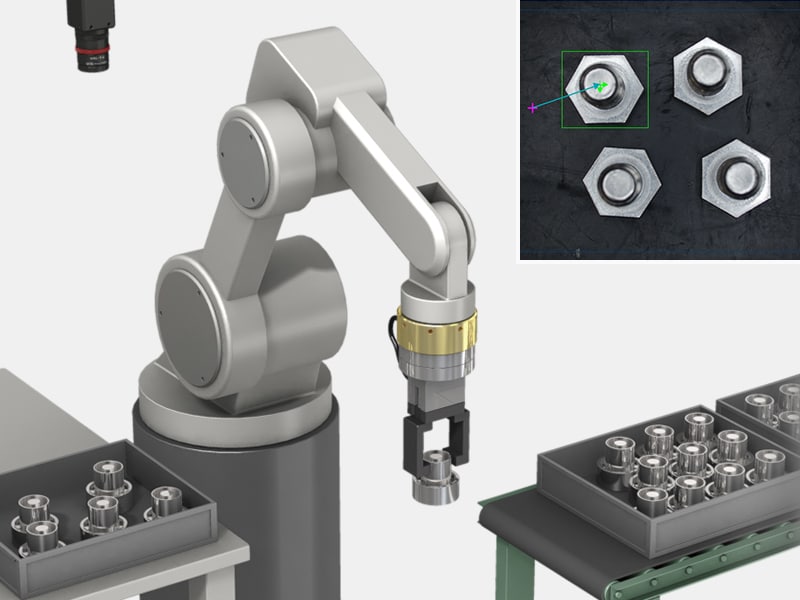
In modern automation, precision comes from the ability to see. Pick-and-place robots rely on fast and accurate visual data to handle parts at production speed, and that reliability comes from the camera system guiding them. A pick and place vision system uses machine vision to locate each part, guide robotic movement, and maintain positional accuracy across every cycle. For many lines, 2D vision pick and place technology delivers the best balance of speed, simplicity, and cost. By converting visual data into robotic coordinates, 2D vision turns a fixed process into one that adapts naturally to real-world variation.
What Is Pick & Place Guidance?
A 2D vision pick and place setup connects imaging, lighting, and robotic control in one workflow. The vision system captures an image of the work area, identifies each object, and determines its position and orientation. Those coordinates are sent to the robot controller, which moves the arm to pick, place, or assemble the part.
The process depends on consistency between vision and motion. A 2D camera reads contrast, pattern, or surface features to calculate the object’s X, Y, and rotation values. The robot then follows those coordinates to perform the task. When powered by high-speed image processing, this interaction creates an automated sequence that repeats with dependable accuracy. On a production floor, that means fewer manual adjustments and shorter setup times between jobs.
Explore how KEYENCE 2D vision-guided robotics brings high-speed accuracy to real-world 2D vision pick and place automation.

Why 2D Vision Is Ideal for Pick & Place Applications
For most planar or tray-based operations, 2D robot guidance delivers the precision needed without the complexity of 3D imaging. These systems excel at identifying part position, surface markings, and alignment differences in real time. They are also more compact, easier to calibrate, and faster to deploy.
2D vision captures both color and contrast data, allowing robots to distinguish similar shapes or packages by texture, label, or print, making it especially effective for tasks like pick and place with 2D vision on packaging lines, electronics assembly, or component sorting. High-speed image capture paired with advanced pattern detection allows accurate part identification even when lighting or orientation changes slightly.
KEYENCE 2D vision systems add stability through advanced lighting control, HDR imaging, and automatic focusing. With bright, uniform illumination and smart algorithms that adapt to each capture, they maintain consistent results under changing conditions. For teams aiming to optimize throughput, 2D vision-guided robotics provides the clarity needed to keep motion synchronized with vision from start to finish.
How 2D Vision Systems Work with Robots
A pick and place vision system integrates directly with robot controllers, helping translate imaging data into movement commands. KEYENCE 2D vision hardware connects to standard robot interfaces through a single setup window; the camera captures the field of view, calibrates with one click, and automatically maps coordinates to the robot’s workspace.
With KEYENCE 2D vision hardware, this link happens through one setup window rather than layers of programming. The operator selects the robot brand, confirms the connection, and the two systems start communicating immediately. From there, motion paths and pickup points can be created automatically, shortening deployment time and keeping the robot aligned with each new product run. Whether the robot is fixed-mounted or on-hand, KEYENCE 2D vision system hardware maintains precision with Ethernet connectivity, lightweight housings, and IP67-rated durability for use in demanding environments.
See how pick & place with 2D vision streamlines calibration and keeps robotic motion precisely aligned.
Get detailed information on our products by downloading our catalog.
View Catalog

Application Examples by Industry
2D vision-guided robots are used across industries to deliver precise motion control and consistent performance in automated handling and inspection tasks. Common applications include:
- Electronics: 2D robot guidance systems are used to place chips, resistors, and micro-connectors with precision beyond manual capability.
- Packaging: Operations use the same imaging data to check label position, confirm seals, and read lot codes before each product leaves the line.
- Automotive: Machine vision pick and place aligns connectors and fasteners where tight tolerances are critical to assembly quality.
- Logistics: High-speed 2D imaging tracks item orientation and reads barcodes to maintain steady material flow.
Operating at production speed, 2D cameras capture detailed images that identify parts, confirm orientation, and validate printed data in a single frame. This live feedback converts inspection into real-time process control, keeping each line stable and efficient.
The Value of 2D Vision-Guided Robotics
2D vision-guided robotics turns mechanical motion into visual coordination. The robot reacts to what the camera sees in real time. This change shortens setup, reduces handling errors, and keeps lines adaptable to different parts or trays.
With the KEYENCE 2D VGR Series, those functions come built in. High-intensity lighting sharpens contrast across wide fields of view, while fast pattern detection reads object positions instantly. A single-click calibration connects the camera and robot so operators can swap pallets or change product types without reprogramming.
Explore KEYENCE 2D Vision-Guided Robotics Systems
See how our high-performance 2D VGR systems are enabling faster, more accurate pick & place automation across industries.
Learn more about 2D Vision-Guided Robotics at KEYENCE today.

FAQs
What’s the Difference Between 2D and 3D Vision for Pick & Place?
2D vision pick and place systems capture flat images for X, Y, and rotation data, ideal for trays or conveyors. 3D vision adds depth for bin picking and stacked parts.
Can 2D Vision Systems Work With Collaborative Robots?
Yes. Lightweight cameras connect directly to cobot controllers, making KEYENCE 2D vision systems a reliable option for compact or shared workspaces.
What Industries Benefit Most From 2D Pick & Place?
Electronics, packaging, automotive, and logistics all use machine vision pick and place to maintain speed and accuracy on flat or tray-based lines.
How Accurate Are 2D Vision Systems?
2D vision systems can be highly accurate. High-resolution imaging and fast calibration keep 2D robot guidance repeatable within microns, even during continuous operation.
How Easy Is It to Program a Pick & Place Task Using 2D Vision?
Setup is quick. KEYENCE 2D vision tools generate robot motion paths automatically once the workflow is defined, minimizing downtime between runs.
Related Downloads
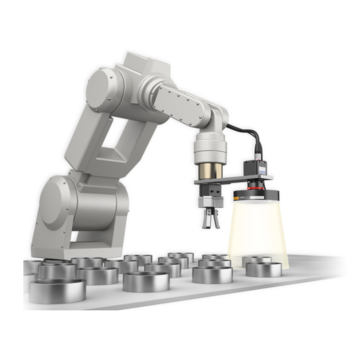
Related Products
Industries
- Aerospace
- Automation Equipment/Machine Building
- Automotive
- Commodities
- Defense
- Electric Vehicles
- Electronic Device
- Fabric/Textile
- Food/Beverage Packaging
- Logistics
- Machine Tools
- Marine
- Medical Device Manufacturing
- Mining/Metals
- Paper Manufacturing
- Pharmaceuticals
- Printing
- Semiconductor/Manufacturing Electronics
- Solar
- Tobacco
- Vision-Guided Robotics