Industrial Laser Marking Systems / Laser Markers
How Laser Marking Improves Cable Management and Tracking for Data Centers
-
Tags:
- Laser Marking , Plastic
Key Takeaways
- Laser marking provides permanent, solvent- and temperature-resistant cable IDs, preventing label failure.
- Laser etching adds no bulk and preserves fiber/cable integrity when using correct laser parameters.
- Systems support high-speed batch marking and integrate with asset databases via CSV/API for traceability.
- Readable laser IDs improve inventory accuracy, reduce mislabeling, and shorten troubleshooting/outage time.
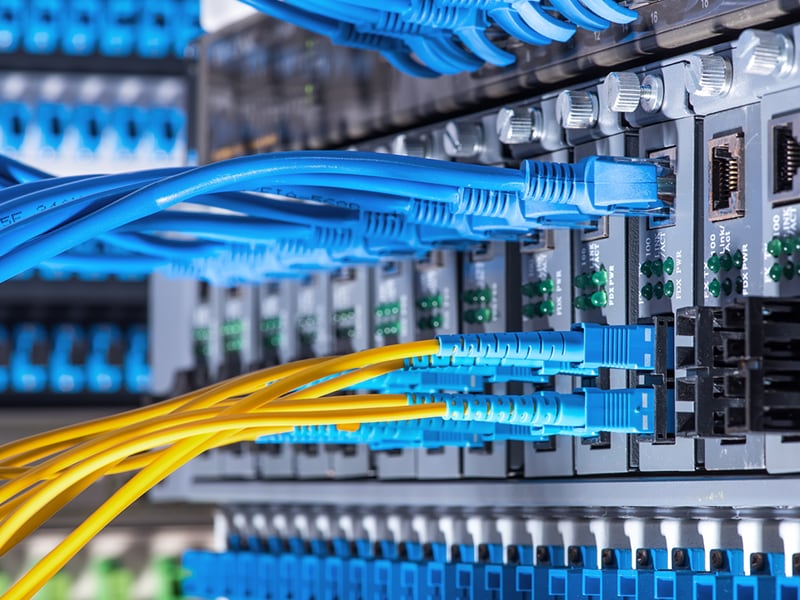
Managing the thousands of interconnected cables that connect servers, switches, and storage arrays is a difficult operation. Consider a technician attempting to identify a connection or swap out malfunctioning hardware with ambiguous or absent markings. When this happens, delays lead to expensive problems and system outages.
Although a challenge, there is a viable solution. Laser marking for cable management streamlines logistics, saves time, and improves operations.
The Challenges of Managing Dense Cable Environments
Forty servers, each connected to a redundant power supply, network switches, and storage backends, might be housed on a single rack in a colocation facility. When you multiply that by hundreds of racks, you can quickly reach tens of thousands of cables overall. Maintaining orderly cable runs presents a number of challenges for technicians operating in these areas.
When exposed to UV light from overhead lights, labels degrade. In hot aisles where exhaust temperatures are beyond 85°F, adhesive becomes weaker. When employees hold cables during installation or removal, printed text smears. Cable labeling standards change over time in older facilities that have had several ownership changes, resulting in a patchwork of incompatible identification schemes.
Label failure makes data center asset tracking marking all but impossible. A technician looking for a particular fiber connection may trace a single run for twenty minutes, inspecting both ends several times to make sure the link is correct. Constraints on physical space create an additional level of complexity. Adhesive labels overlap or fold upon themselves when cables in blade server settings or high-density fiber panels bunch together so tightly.

Why Laser Marking Outperforms Adhesive and Printed Labels
Utilizing concentrated laser energy, cable identification laser marking modifies the surface of cable materials. Adhesive or ink is not used in the process. Rather, it uses controlled material removal or color change to leave a lasting impression. The failure modes that afflict conventional labeling techniques are eliminated by this technology.
Extreme temperatures have no effect on laser-etched marks. The identification is unaffected whether a cable passes through a hot exhaust channel at 90°F or a cold aisle at 65°F. Chemical resistance is just as strong. Laser marks won't be harmed by cleaning crews using isopropyl alcohol or other solvents to maintain rack hygiene, unlike printed labels.
The labeling procedure does not give the cable any additional bulk or thickness. This benefit becomes important in tight bundling scenarios when every millimeter counts. In order to address the wide range of materials included in data center cabling, laser marker systems have developed. Aramid yarn and polymer jackets that react favorably to CO2 or UV laser wavelengths are commonly used in fiber optic cables. Although they require different laser parameters, copper Ethernet cables with PVC or LSZH jackets produce results that are just as durable.
In production settings, where thousands of wires must be marked before installation, speed is crucial. The latest laser marking for cable management technologies can integrate into continuous production processes or brand several cables at once. A complete shipment of patch cables may be marked in a single afternoon by a facility getting ready for a significant equipment refresh.
Permanent Identification for Fiber Optics, Patch Leads and Racks
There are particular marking difficulties with fiber optic infrastructure. Because of their delicate nature, the cables must be handled carefully to prevent signal deterioration. Permanent cable traceability is still required for maintenance and troubleshooting in spite of these limitations.
Laser marking for cable management adapts to components of different sizes and materials. Cable jackets allow whole alphanumeric IDs, whereas connection boots accept QR codes or abbreviated references. There are no stress points created by the labeling process that compromise cable structure or optical performance.
Laser-marked IDs are especially useful for patch leads that connect server ports to top-of-rack switches. When equipment is added, removed, or modified, these short cables are constantly in motion. Seldom do adhesive labels on patch leads last longer than a few moves. Laser marks remain readable for dozens of reconnection cycles.
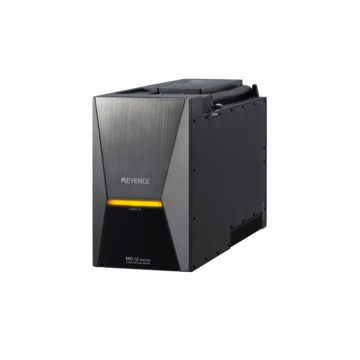
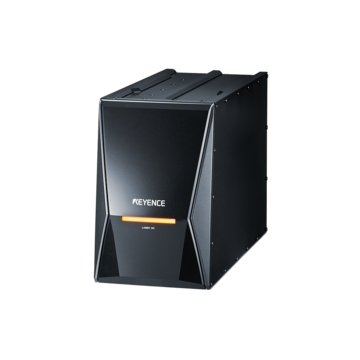
There is more to rack labeling than just individual cables. Cable management gear, such as vertical organizers, horizontal ducts, and even the rack frame itself, can have identification etched onto them by marking systems. With the ability to handle everything from tiny fiber connectors to bulky power cables, MD-U Series laser markers provide the accuracy required for these diverse applications.

Improving Asset Tracking Accuracy With Laser-Marked IDs
Large facilities' asset management systems keep track of thousands of individual parts. Every server, switch, storage array, and cable segment needs a distinct identification that lasts the duration of its operation. The process begins when the cable is being prepared. Cable labeling provides a laser-marked identification that corresponds to a record in the asset database prior to installation.
Technicians check cable ends to ensure connections before making any changes. This verification step detects errors before they cause interruptions. The system records each scan, creating an audit trail that shows which cables were accessed, when, and by whom.
Inventory accuracy significantly improves when markers are clear. Facilities that utilize adhesive labels often discover that 20–30% of their cable inventory lacks readable identification during audits. It is necessary to either replace or re-label these wires because they effectively become anonymous. This ongoing maintenance load is eliminated with laser labeling.
Applications of laser marking for cable management include related hardware such as cable trays, distribution frames, and breakout panels. Reducing the cognitive strain during troubleshooting and streamlining training for new personnel are two benefits of establishing a uniform labeling standard for all infrastructure components.
How Laser Marking Fits Into Data Center Record-Keeping Systems
The speed at which data center teams solve issues and make improvements depends on the quality of the documentation. Digital records and physical cables are connected by laser tagging. Through CSV imports or API connections that are compatible with the majority of asset management solutions, each indicated identification links physical wiring to database entries.
A laser-marked wire can be scanned to quickly recover configuration data, circuit paths, and connection information during maintenance. This eliminates the need for speculation, whether growing a network, transferring equipment, or troubleshooting.
Laser marking for cable management helps teams restore cable systems to their original specifications, accelerating catastrophe recovery when documentation is the only reliable source.
Still have questions? Speak with KEYENCE about laser marking for data-center cabling today.

FAQs
Can Laser Marking Reduce Mislabeling Incidents in Multi-Floor Data Center Builds?
Yes, since identifiers with laser markings don't move or come off when being handled. Identification integrity is maintained when construction workers move cable bundles across levels. Better quality control checkpoints, where supervisors can confirm proper cable positioning prior to concluding connections, are also supported by the marks.
Are Laser-Marked Identifiers Resistant to Cable Wear and Technician Handling?
Yes, laser markings etched into cable jacket material withstand repeated handling and friction, remaining readable throughout the cable's service life even in high-traffic areas with frequent equipment changes.
How Do Laser-Marked Cables Integrate With Barcode or QR Scanning Tools?
Standard scanning equipment reads laser-etched barcodes and QR codes just like printed versions. The key is achieving sufficient contrast between the mark and the background material. Most cable jackets provide excellent contrast when marked with appropriate laser parameters.