Machine Vision
One-Click Calibration for 2D Vision and Robotics
Key Takeaways
- Calibration converts camera pixels into precise robot coordinates; drift reduces pick accuracy and inspection reliability.
- One‑click calibration automates detection, distortion correction, and coordinate mapping in seconds, removing manual steps.
- Fast, repeatable calibration shortens commissioning and changeover time, increasing uptime across production lines.
- Calibration profiles can be duplicated and integrated with major robot controllers, enabling scalable multi‑cell deployments.
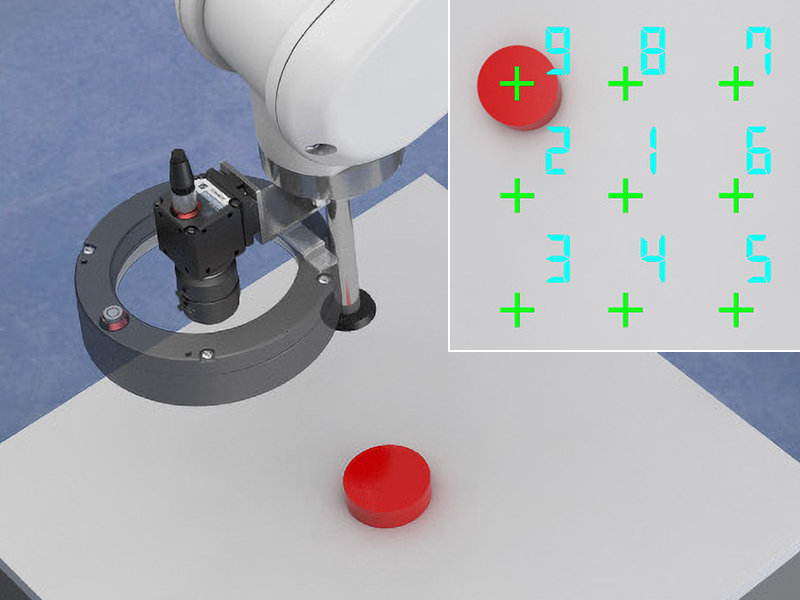
Modern production lines depend on precision; from robotic pick-and-place to inspection, every system that relies on visual feedback needs a way to translate pixels into motion. That translation happens through calibration. In fast-moving environments, calibration defines how cameras understand real-world positions and distances. When it’s slow or inconsistent, setup time stretches and output suffers.
KEYENCE has developed a one-click calibration process to make 2D vision calibration faster, easier to deploy on any line, and repeatable for any robot vision calibration workflow.
Why Calibration Matters in 2D Vision Systems
Calibration is what ties a camera’s field of view to the real workspace. In every KEYENCE 2D vision system, that alignment turns pixel data into usable coordinates that a robot can act on. When calibration drifts, even slightly, pick points shift, and inspection results lose precision. In high-speed production, that difference can mean more rework and wasted cycles.
Traditional 2D vision calibration accounts for the way lenses, sensors, and camera placement shape an image. It corrects distortion near the edges, adjusts for the camera’s position relative to the workpiece, and stabilizes measurements across the field of view. This step keeps image data consistent from one cycle to the next. In automated production, where reliability drives throughput, accurate calibration turns visual feedback into dependable performance.
Traditional vs. One-Click Calibration
Conventional calibration requires several steps in which engineers capture images of a known pattern, identify reference points, compute camera and lens parameters, and apply geometric transformations to align those values with the robot’s coordinates. Each step depends on experience, time, and judgment. Even with good software, the process can take minutes per setup and must be repeated whenever the camera moves, or during lighting or tool changes.
A one-click calibration process compresses this workflow into a single action. The system automatically detects the calibration plate, measures its position, and calculates both the internal and external camera parameters. Lens distortion and alignment corrections are applied automatically. The result is a robot vision calibration process that maintains the accuracy of traditional methods but takes only seconds. By removing manual input, this approach reduces setup time and operator variation while keeping positional data consistent across shifts and product changeovers.
How KEYENCE One-Click Calibration Works
KEYENCE 2D vision systems perform one-click calibration through integrated software and high-speed imaging hardware. Once the calibration target enters the field of view, the system detects its reference points and calculates camera orientation.
Advanced lighting control and CMOS imaging stabilize brightness and contrast so that calibration can run under normal or variable lighting. The software records those measurements in the robot’s motion program, linking camera data with real-world movement.
Lens distortion and rotation are corrected automatically, and calibration remains accurate even if the camera or part shifts during operation. It’s an easy calibration process designed for speed and reliability on any line configuration.
Explore KEYENCE one-click calibration and see how a 2D vision system with fast setup improves performance in pick-and-place and presence/absence inspection applications.
Benefits for Integrators and End Users
For integrators, a one-click calibration process reduces commissioning time. It shortens the interval between mounting a camera and running a verified program, helping projects stay on schedule. For production teams, it simplifies maintenance and daily checks, and recalibration becomes a one-button task instead of a full routine. That speed translates into more uptime and fewer bottlenecks during product changeovers, cutting overall setup time for any machine vision system.
Each recalibration follows the same steps; that way, accuracy doesn’t change from one run to the next. The KEYENCE 2D vision system reads geometry, lighting, and coordinate data under identical conditions, keeping results steady. Over time, that consistency removes user variation and helps maintain stable performance across the line. Teams working across multiple stations or duplicate cells can copy calibration data directly, maintaining identical performance throughout the line.
Real-World Use Cases and Time Savings
Production teams are able to apply 2D vision calibration anywhere robots depend on camera feedback along a fixed plane. Pick-and-place cells, packaging lines, and assembly verification stations all benefit from fast, repeatable setup. In these environments, one-click calibration removes the need for manual pattern alignment and parameter entry.
Integrators deploying multi-robot cells also gain from the ability to duplicate calibration profiles. A camera mounted above one work zone can be copied to another with minimal adjustment, saving hours during commissioning and supporting scalable automation across production lines. The combined effect is a measurable reduction in total setup time for every machine vision system.
Experience KEYENCE One-Click 2D Vision Calibration
Simplify setup and reduce downtime on your production line with KEYENCE’s intuitive, one-click calibration feature, engineered for fast deployment and repeatable accuracy.
Explore the 2D VGR System

FAQs
What Is One-Click Calibration in Machine Vision?
It’s an automated calibration process that captures, measures, and applies camera and coordinate data in one step. The same calculations used in manual workflows (distortion correction, orientation detection, and coordinate mapping) are performed automatically.
How Long Does It Take to Calibrate a KEYENCE 2D Vision System?
Calibration completes in seconds. Once the calibration target is detected, the system measures and applies all parameters automatically.
Does One-Click Calibration Support All Robot Brands?
Yes. KEYENCE systems communicate directly with major robot controllers and generate programs without custom coding.
Can One-Click Calibration Be Redone or Fine-Tuned?
Yes. Recalibration can be performed at any time. The process updates both the internal camera model and external positioning data without manual entry or additional setup.
What Are the Benefits for Small Manufacturers?
Small teams gain advanced accuracy without specialized training. Quick calibration minimizes downtime during changeovers and allows flexible use of shared robots and vision systems.