Industrial Laser Marking Systems / Laser Markers
Data Matrix Code vs QR Code: What's the Difference?
-
Tags:
- Laser Marking , Laser Labeling , Laser Engraving
Key Takeaways
- Data Matrix codes are ideal for small parts and tight marking spaces because they stay readable even at very small sizes.
- QR codes are better known in consumer applications, where fast smartphone scanning and easy access to digital content matter most.
- Data Matrix codes are commonly used in manufacturing because they support direct part marking and reliable product traceability.
- Choosing between Data Matrix and QR codes depends on the application: industrial tracking typically favors Data Matrix, while customer engagement often favors QR codes.
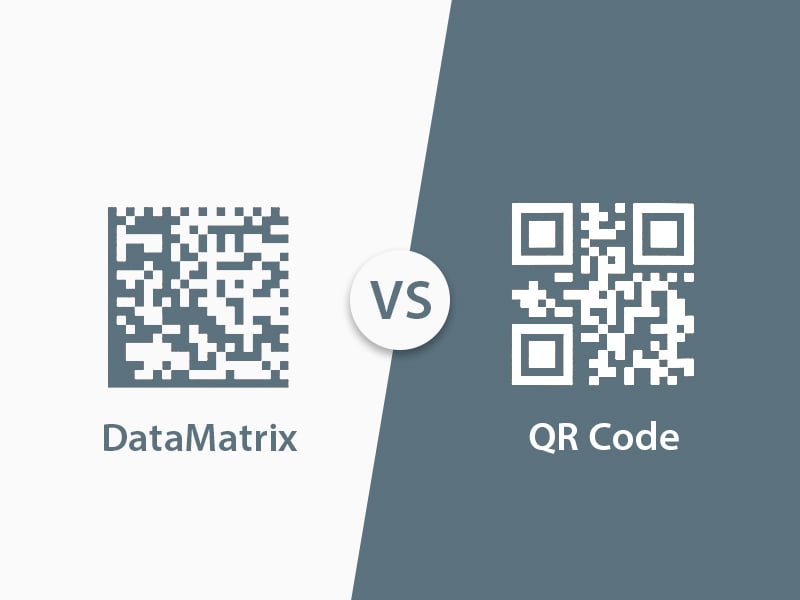
Both QR codes and Data Matrix codes store data in two-dimensional patterns that are easily decoded by computers. Although they initially appear similar, their designs show diverse objectives. You can adapt the technology to your particular application by knowing when to employ each type. To begin, let’s do a deep dive into the Data Matrix code and its origin.
What Is a Data Matrix Code?
A two-dimensional barcode that holds data in a grid of black and white cells is called a Data Matrix code. With a characteristic L-shaped border on two sides and an alternating pattern on the opposing edges, the design is always square or rectangular. This border aids scanners in appropriately orienting and locating the borders of the code.
Data Matrix codes, which were created in the late 1980s, are excellent for encoding data in extremely small places. With industrial scanning equipment, they can be printed as small as two to three millimeters square and yet be readable. Because of their small size, they are useful for identifying precision parts, medical equipment, and small electronic components where surface area is scarce.
Additionally, error correction is integrated into the code structure. Scanners can recover the encoded data even if a portion of the code is worn out or broken during use. In challenging industrial settings where components are subjected to abrasion, chemical exposure, or other circumstances that could eventually deteriorate markings, this resilience is necessary.
Data Matrix codes typically store between 1 and 2,335 alphanumeric characters, though most industrial applications use far less. A typical serial number or product identifier might only require 20-50 characters. In contrast, the widely recognized QR code offers a different approach to 2D data storage.
What Is a QR Code?
QR codes (Quick Response codes) were developed in 1994 by a Japanese automotive supplier looking to track parts through manufacturing. The technology quickly expanded beyond factories into consumer applications. Today, QR codes appear on product packaging, restaurant menus, event tickets, payment systems, and marketing materials.
Its consumer-friendly adoption is partly due to the unique structure designed for rapid, flexible scanning. The QR code structure uses three large square patterns in the corners for positioning. These distinctive squares help smartphone cameras quickly locate and orient the code from any angle.
QR codes handle larger data volumes than most Data Matrix implementations. A standard QR code can store up to 4,296 alphanumeric characters or 7,089 numeric characters, making them suitable for encoding URLs, contact information, Wi-Fi credentials, or longer text messages. The technology includes four levels of error correction that allow codes to remain readable even if up to 30% of the pattern is damaged.
Consumer familiarity represents a major advantage. Most people recognize QR codes immediately and can scan them with their smartphone camera, making them effective for customer-facing applications.
How Each Code Stores and Encodes Data
Both technologies use two-dimensional matrix patterns to encode information, but their encoding schemes differ in meaningful ways.
Data Matrix codes use a more compact encoding algorithm optimized for small physical sizes. The format achieves higher data density per unit area, meaning you can fit the same information into a smaller physical space compared to a QR code. This density advantage comes from the simpler border structure and more efficient use of the internal cell pattern.
In terms of QR code vs. Data Matrix, QR codes use multiple data regions and function patterns in their encoding. The three large position markers occupy significant space but enable faster scanning from various angles and distances. The format also includes timing and alignment patterns that help ensure reliable reading but reduce the area available for data storage.
Both systems use Reed-Solomon algorithms to build error correction into the encoded pattern, adding redundant data that allows reconstruction of missing or corrupted information.
Key Differences Between a Data Matrix Code vs. QR Code
When it comes to differences, size requirements clearly contrast these technologies. Data Matrix codes remain readable at much smaller physical dimensions—often as small as 3 mm square in industrial applications. Meanwhile, QR codes typically need at least 20 mm square for reliable smartphone scanning. This difference becomes critical when marking small components like circuit boards, medical instruments, or precision-machined parts.
QR codes are preferred for large payloads due to data capacity. Several kilobytes of data, sufficient for a URL, contact card, or lengthy text message, can be stored in a QR code. A Data Matrix code vs. QR code is more effective at handling smaller datasets, but they become infeasible for longer material.
Additionally, different kinds of reading equipment are needed for various applications. QR codes are perfect for smartphone cameras because of their huge size and distinctive corner patterns. A Data Matrix vs QR code usually requires sophisticated industrial scanners with appropriate lighting and optics.
Aspect ratios vary in their adaptability. Data Matrix codes provide alternatives for both square and rectangular configurations for marking on thin surfaces. There are fewer options in certain places because QR codes are usually square.
When to Use Data Matrix vs QR Codes
Choose Data Matrix codes for industrial manufacturing and direct part marking. The small size capability makes them perfect for laser marking on components where surface area is precious. Electronic assemblies, automotive parts, medical devices, and aerospace components commonly use Data Matrix codes for permanent identification and tracking.
Data Matrix is preferred for product traceability systems in regulated sectors. Data Matrix codes are essential for meeting regulatory standards in the manufacturing of electronics, pharmaceutical packaging, and medical device serialization. It is feasible to mark individual objects throughout intricate supply chains thanks to the format's modest size and endurance.
In situations involving consumers, QR codes perform exceptionally well. Restaurant menus, shop displays, product packaging, and marketing materials all profit from expertise with QR codes. Consumers don't need to download any extra apps in order to rapidly scan codes.
Harsh environments often justify data matrices. Parts that experience high temperatures, chemical exposure, or abrasion benefit from Data Matrix durability. Even if part of the code wears away, enough typically remains readable. Part traceability applications rely on this resilience.
Industrial Applications and Product Traceability Systems
Data Matrix codes are used in manufacturing processes in a variety of production settings. Permanent codes that endure decades of use are applied by automotive suppliers to safety-critical assemblies and engine parts. These IDs make it possible to precisely identify which production batch generated the impacted items in the event of a warranty issue or recall.
Data Matrix codes are used in electronics production to trace materials during assembly, testing, and quality control for circuit boards, semiconductors, and individual components. In order to establish an uninterrupted chain of custody from raw materials through patient use, medical device makers employ them on surgical instruments, implanted devices, and diagnostic equipment.
Pharmaceutical serialization relies heavily on Data Matrix codes. Regulations in many countries now require unique identifiers on medication packaging down to the individual bottle or blister pack to prevent counterfeit drugs from entering the supply chain.
A comprehensive product traceability system links Data Matrix codes to databases containing manufacturing dates, material certifications, test results, shipping histories, and maintenance records. Modern laser marking systems establish permanent Data Matrix codes by directly modifying the surface of the material, rather than using a separate label.

FAQ
What Is the Main Difference Between a Data Matrix Code and a QR Code?
Size and application emphasis are the primary distinctions. While QR codes are bigger, more user-friendly, and more appropriate for smartphone scanning and marketing applications, Data Matrix codes operate at considerably lower physical dimensions and are intended for industrial labeling on small parts.
Which Is Better for Industrial Marking: Data Matrix or QR Codes?
Data Matrix codes are generally better for industrial marking because they remain readable at very small sizes, survive harsh environmental conditions well, and work reliably with industrial scanning equipment.
Can Data Matrix Codes Store More Data Than QR Codes?
No, QR codes can store significantly more data—up to 4,296 alphanumeric characters compared to 2,335 for Data Matrix codes. However, Data Matrix codes store equivalent small datasets in less physical space, which matters more in most industrial applications.
Why Are Data Matrix Codes Used in Manufacturing Traceability?
Data Matrix codes aid in manufacturing traceability because they remain readable at sizes small enough to mark on individual components, can withstand harsh production environments, retain readability even after partial damage, and integrate easily with automated scanning systems throughout the manufacturing process.

Related Products
Related Downloads
-
Laser Marker 2D Code Marking for Traceability
2D codes are used to store date codes, lot codes, serial numbers, and more. Users who are considering 2D code marking should read this laser marking guidebook.
![MARKING APPLICATIONS Component Traceability in Automotive Manufacturing [Body and Exterior Parts]](/img/asset/AS_101893_L.jpg)
![LASER MARKER APPLICATION GUIDE [Food, Packaging, & Cosmetics]](/img/asset/AS_46960_L.jpg)