Static Control
Static Control Solutions for the Glass and Rubber Industries
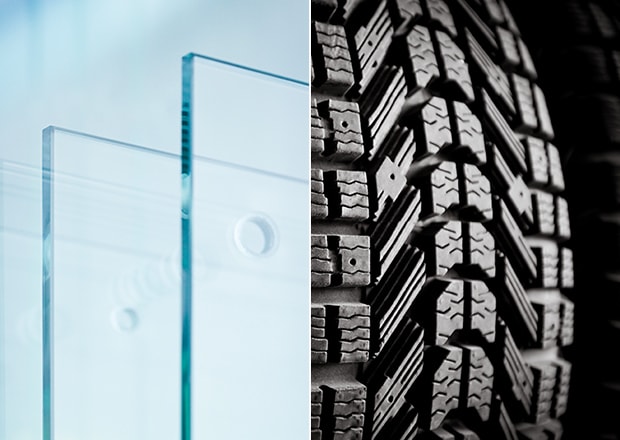
Static electricity issues in glass and rubber industries often appear when production runs are at their highest. They’re also common when materials are heated, stretched, transported, or wound. Glass panels that are moving out of ovens or lenses going to coating stations can accumulate static electricity on their surfaces. Additionally, rubber components, under tension, can also experience these charges. Since these materials are insulating, the static electricity does not readily dissipate. It remains on the surface and can alter the way the material behaves in the next stage of the process.
Static elimination for glass and rubber manufacturing focuses on controlling this static charge at the point where it is generated.
Static Electricity Challenges in Glass and Rubber Manufacturing
As glass and rubber share the same insulating properties, they both resist the flow of electrons. When these materials move across rollers and screen or when they undergo tooling, the static electricity charge transfers with it and remains on the surface of the material. This can happen at any stage of production, as elevated temperatures and rapid movements increase the likelihood of an initial charge forming.
Rubber processing presents additional challenges. Elastomeric materials are stretched and compressed during tire building and when handling rubber sheeting. Repeated deformations can contribute to potential surface changes and defects. As lines move quickly, the rate of contact and separation increases, which means that the surface level charge can increase as well. Electrostatic control for rubber processing must account for both the frictional contact and mechanical tension.
Environmental conditions also influence how long a static charge may remain on the surface of the material. Lower humidity levels tend to allow charges to persist, while higher humidity supports more gradual dissipation, and, even in controlled environments, static electricity problems in glass and rubber industries often remain present at key process points.
Five Key Problems Caused by Static Electricity
Electrostatic charges affect production in distinct ways. In glass and rubber environments, the most common issues include:
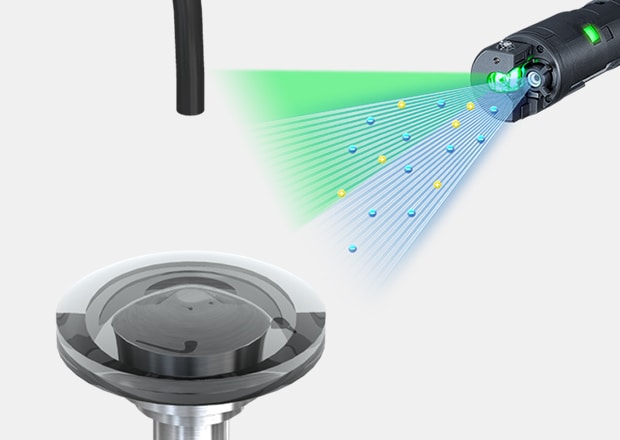
1. Adhesion of Foreign Particles
Glass surfaces that hold an electrostatic charge attract airborne particles and fine debris. In the optical coating processes, contamination between cleaning and deposition can reduce surface clarity and coating consistency.
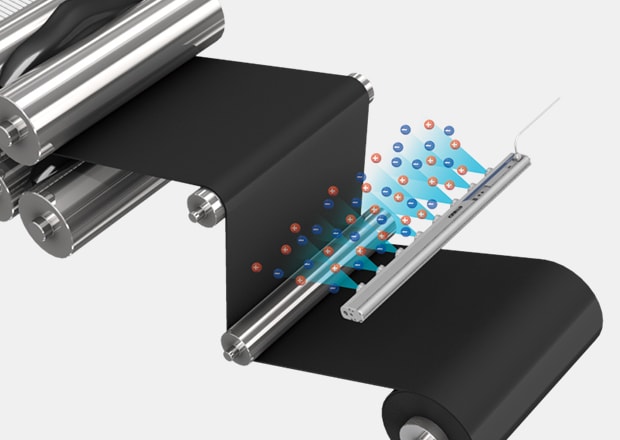
2. Material Misalignment, Sticking, and Clogging
Rubber sheets may cling to rollers or resist proper alignment as materials charged with static can repel or attract adjacent layers.
3. Employee Risk
When operators come in contact with charged surfaces like glass panels or rolls of rubber, sudden electrostatic discharge can interrupt manual adjustments and slow down the flow of production.
4. Equipment Disruption or Sensor Interference
Electrostatic discharge near sensitive electronics or inspection systems can negatively impact how accurate measurements are and the ability to repeat a process.
5. Fire Risk
In environments where flammable vapors are present, an unmanaged static spark from a charged surface or underground component can introduce safety concerns.
Each of these problems originates from surface charges that are allowed to remain and go unmanaged during production. Effective static elimination for glass and rubber manufacturing focuses on neutralizing that charge where it forms.
Among these, adhesion of foreign particles, clogging, sticking, and scattering, and worker discomfort tend to be problematic.
How KEYENCE Static Eliminators Improve Production Quality
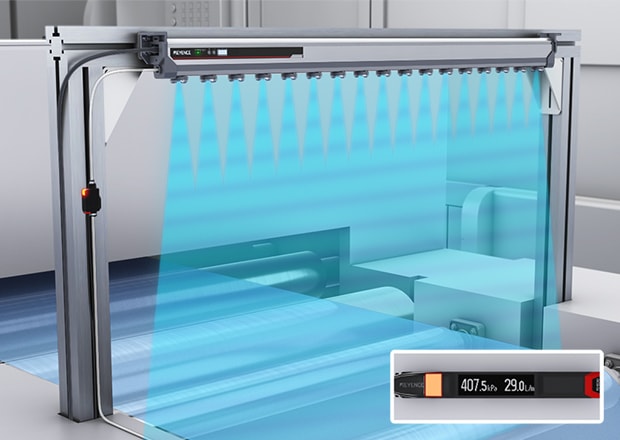
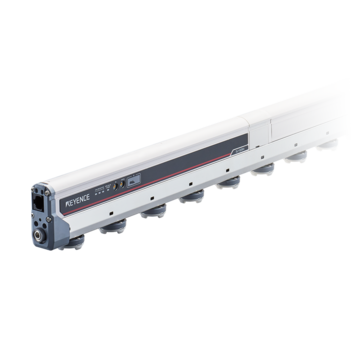
Static eliminators for industrial environments, like the KEYENCE SJ-Q Series, neutralize surface charge by introducing balanced ions into the surrounding air, and, when ionized air reaches a charged surface, excess positive or negative charges are reduced.
In glass applications, ionizers positioned near printing or coating stations reduce the imminent static charge issues in glass production before contamination or misalignment can occur. For heated glass leaving the oven, ionized airflow can help neutralize static charges on surfaces before the material moves down the production line.
For rubber operations, electrostatic control for rubber processing is applied at winding stations and wrap points. Because deformation and speed contribute to how static electric charges generate. The continuous support of an ionizer helps keep material surfaces stable without reducing throughput.
KEYENCE static eliminator systems are designed to be integrated into automated production lines and have monitoring capabilities that allow operators to observe surface potential trends and adjust settings in response to process changes.
Application Examples From Glass and Rubber Facilities
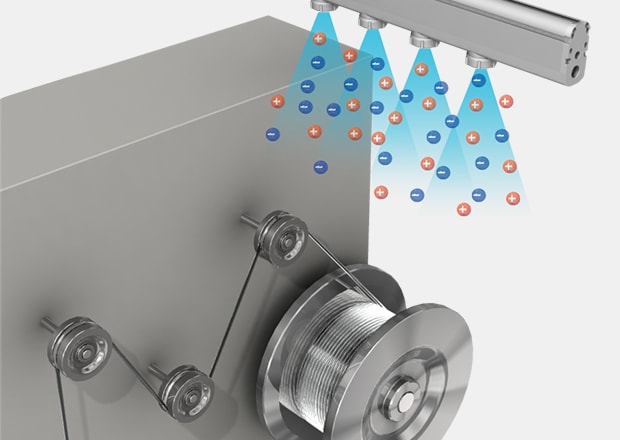
In optical fiber winding, static buildup can disrupt layering and cause uneven spooling. Ionization at the winding point reduces attraction between adjacent layers.
During lens manufacturing, dust can adhere to surfaces between cleaning and coating, compromising surface finish. Installing ionizers before deposition lowers particle attraction and improves coating consistency.
In glass printing, heated panels may carry residual charge as they exit the printing area. Applying Ionized airflow immediately afterward helps reduce contamination.
For tire wrapping and rubber sheet handling, static generated during stretching can cause materials to cling or misalign. Targeted ionization along the wrap path improves separation and adjustment.
Learn how to prevent static problems in your process. Contact KEYENCE today.