Static Control
Defective Bumper Coating Due to Dust Adhesion
Key Takeaways
- Residual static on molded TPO bumpers attracts airborne dust, causing coating defects.
- Low humidity and molding/handling friction increase triboelectric charge retention.
- Humidity alone is insufficient; insulating plastics require active neutralization.
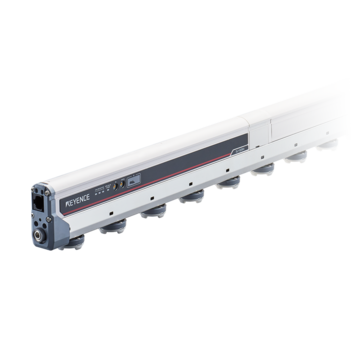
- Deploy balanced, fast ionizers (e.g., SJ-Q Series, SJ-F700 Series) near trim/inspection to prevent re-adhesion.
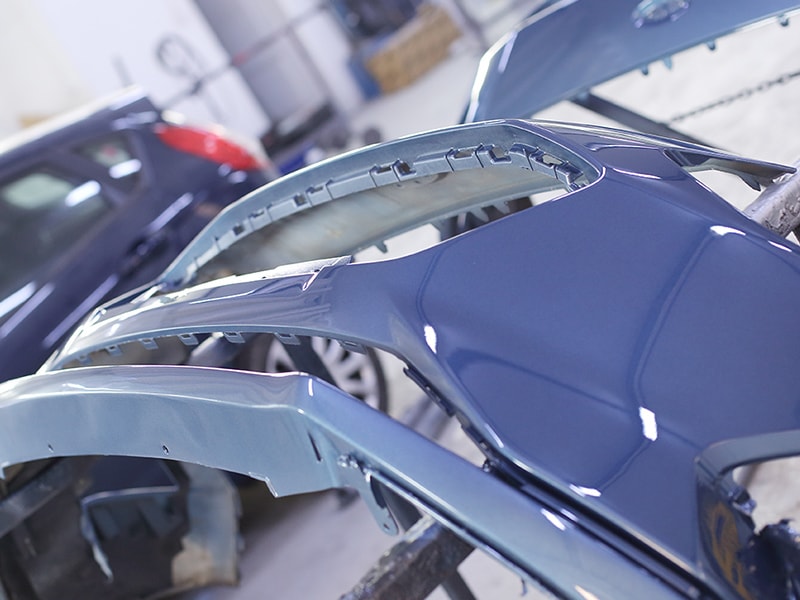
Automotive paint lines operate within tight appearance standards, and a single particle that becomes embedded in the base coat of a bumper can force sanding and polishing or require the piece to be fully reworked. In many cases, bumper coating defects from static electricity begin long before the part reaches the spray booth. The static buildup after bumper molding can create a charged surface that pulls in airborne contamination to the part, even after cleaning.
Static Buildup After Bumper Molding
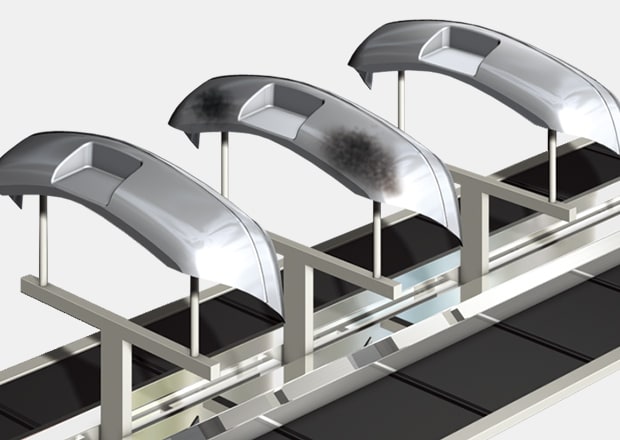
Plastic bumpers are commonly molded from low-surface-energy materials such as thermoplastic polyolefin (TPO) and similar polyolefin blends. These materials are lightweight and impact-resistant, which makes them perfect for automotive applications, but they are also electrical insulators. When these parts are ejected from molds and then trimmed and conveyed to their next station, the friction and separation generate electrostatic charges.
Because TPO is an insulator, any accumulated charge will struggle to naturally dissipate through grounding alone; instead, the static remains distributed across the surface of the bumper.
Static builds up after molding, particularly in low-humidity environments. As parts travel towards their coating stage, any retained static electricity changes how that surface will interact with the surrounding environment.
Conventional Countermeasures
- Humidity control
-
- Condensation in the equipment or facility will be a problem.
- Conventional static eliminator
-
- The static elimination speed is insufficient.
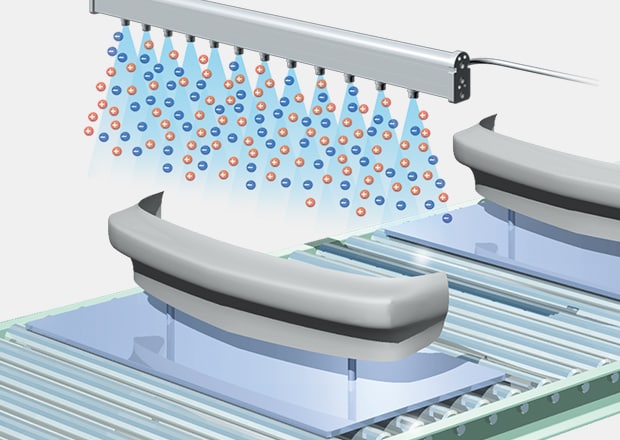
Countermeasures with Static Eliminators (Ionizers)
An ionizer can prevent foreign particle adhesion to improve coating quality. It also helps reduce the disposal cost of defectively coated bumpers and the labor cost for wiping.
Reduced Costs of Disposal Due to Foreign Particle Adhesion
Disposal cost of bumpers: $1,000/month × 12 months = $12,000/year
In addition, the cost for the labor of workers wiping the parts is reduced.
How Coulomb Force Causes Dust to Re-Adhere
The reason dust adheres to plastic bumpers is rooted in electrostatics. Opposite charges attract through Coulomb’s law, and the strength of that force increases as the distance between the charges decreases. For small particles like shop dust, fibers, or lint, the attraction can become very dominant at a very short range.
This interaction is the basis of Coulomb force dust adhesion. When a bumper’s surface carries any residual voltage, it creates an electrical field that extends outward. Micro-scale particles entering that field will move faster to the surface, the closer it is.
Testing shows that these micron-scale particles can cling to a charged surface even when separated by fractions of a millimeter. Larger charged objects are able to attract contaminants from further away, which, in practical terms, means that a bumper that has just been wiped or blown off may still pull new debris from the surrounding air.
Limitations of Humidity Control and Conventional Ionizers
Relative humidity can influence how easily charges accumulate and how quickly they dissipate. In dry conditions, triboelectric charge can increase significantly.
Even at a relatively high level of humidity, some measurable electrostatic charges can still remain. Humidity control should only be considered as a supportive measure and should never be used as a standalone solution for bumper coating defects from static electricity. Automotive paint facilities are already balancing temperature, airflow, and moisture for coating performance. However, if the humidity level is raised beyond the optimal conditions for painting, then the bumper is subject to corrosion concerns as well as quality variability.
Humidity is useful to help reduce the retention of static electricity charges on some materials, but it does not neutralize the surface of an insulating bumper in a controlled or measurable way. For applications that are focused on preventing dust re-adhesion before coating, they will need more than just an environmental adjustment.
Preventing Automotive Paint Defects with Ionizers
An ionizer for automotive paint lines addresses the electrical condition of the bumper surface directly, and by generating balanced positive and negative ions, the ionizer supplies a charge that can migrate to the polymer surface and combine with any excess charge. When ionizers are applied correctly, the likelihood of a surface maintaining a charge can drop near zero.
Reducing surface voltage means weakening the electrical field surrounding the bumper. As that field collapses, the Coulomb force that drives dust adhesion on plastic bumpers is also reduced. Any present airborne particles are less likely to be pulled toward the surface as the part moves through inspection and into the coating stage.
The SJ-Q Series by KEYENCE is designed for rapid static elimination with a rated elimination speed of 0.1 seconds and an ion balance of ±3 V. This helps maintain a tight ion balance to limit any static charge on the targeted surface. At the same time, for large molded components or conveyor zones, the SJ-F700 Series provides a wide-area static elimination up to 3 m 9.8′, with an ion balance of ±1 V and a rated elimination speed of 0.5 seconds.
Whatever their needs, manufacturers can address bumper coating defects from static electricity at their source. Once ionizers have been deployed, contamination becomes less a matter of attraction due to static and more a matter of the environment. Managing static buildup after bumper molding through properly specified ionization can help reduce dust re-adhesion before coating and support more consistent bumper coating results.
Reduce disposal costs and improve coating quality. Assess static buildup in your bumper molding and painting process today.