Static Control
Static Control for Trapping of Paper Sheets During Roll Transfer
Key Takeaways
- Static control in paper roll transfer prevents sheets sticking, skews, wrinkles and multi-sheet rewinds.
- Low humidity (below ~45% RH) and high transfer speed increase charge buildup on coated or lightweight paper.
- Charged sheets attract dust and cause sensor/tension issues.
- Use inline detection plus widthwise ionizers (e.g., SJ-Q Series) to stabilize transfer.
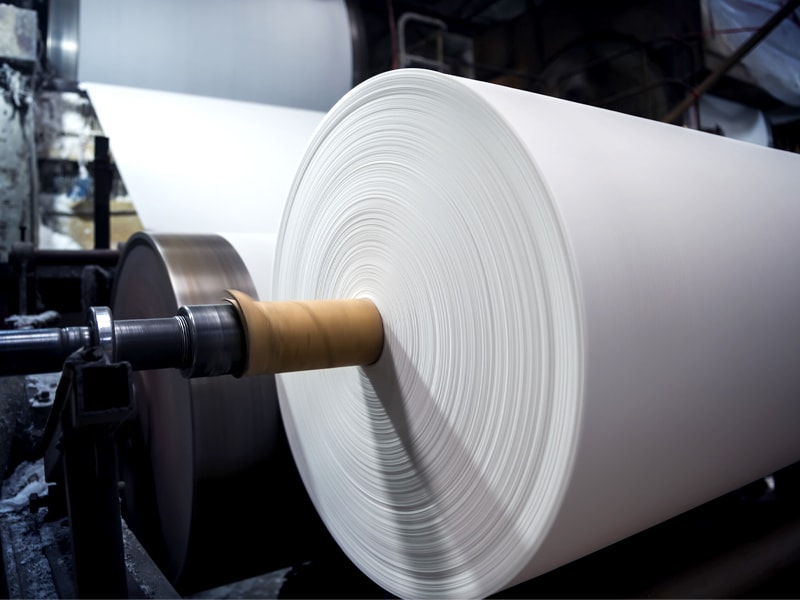
Static electricity in paper roll transfer is a persistent challenge in high-speed production and printing environments. As paper unwinds from a roll, passes through equipment, and then rewinds into finished rolls, static charge can build up on the paper’s surface. When that charge isn’t dissipated and remains unmanaged, paper sheets sticking to rollers and getting trapped during transfer can interrupt production and affect the quality of the finished product.
Roll transfer sections bring several static-generating conditions together with the paper repeatedly contacting and separating from rollers. In dry environments, the static changes on these sheets can quickly accumulate, and without a discharge path, the charge will remain on the surface. This static electricity can influence how the material is released from the equipment and transferred through the line.
How Static Electricity Causes Paper to Stick to Rollers
When paper touches and separates from rollers, any static electricity present will transfer between surfaces. As speeds increase across production lines, the constant contact creates and amplifies the buildup. The separation point (where the paper from the roll comes away from the roller) is often where operators see static charges at their most intense.
Paper grade can also influence how the substrate deals with static electricity. Products with low surface conductivity or a smooth coating can hold onto a charge instead of letting it dissipate easily. The resulting electrostatic attraction can draw the sheet back toward the roller surface instead of allowing it to cleanly release.
When a paper sheet sticks to a roller and interferes with the transfer of the material, it can create skews, wrinkles, and uneven tension on the finished roll. In winding applications, adjacent layers may also attract each other, which increases the likelihood of multiple sheets getting trapped together in rewinding.
The Role of Friction and Humidity in Static Generation
Friction initiates most static electricity buildup in paper roll transfers, but environmental conditions will typically determine how long it remains. Paper absorbs moisture from the surrounding air, and its surface conductivity can change with the humidity levels.
In dry environments, particularly when the relative humidity drops below the mid-40% range, static elimination becomes more difficult because charges have fewer ways of dissipating naturally. Low moisture content allows static charges on the paper sheet to persist longer on surfaces.
Transfer speed also influences static charge buildup. The faster the paper moves through the equipment, the more it makes contact and separates from it. This gives static charges more opportunity to accumulate, especially in lightweight and coated or glossy finished paper products. Heavier papers like cardstock hold onto less static electricity as they are less likely to bend and crease. They also hold onto more moisture, making it more difficult for static to accumulate.
Humidity control can reduce the severity of static electricity in paper roll transfer, but in high-speed roll handling applications, adjusting the environment on its own is rarely enough to resolve the issue.
Effects of Static on Paper Transfer and Product Quality
Paper sheets sticking to rollers is one of the most visible symptoms of static electricity in paper roll transfers, but the impact of static goes further than just that.
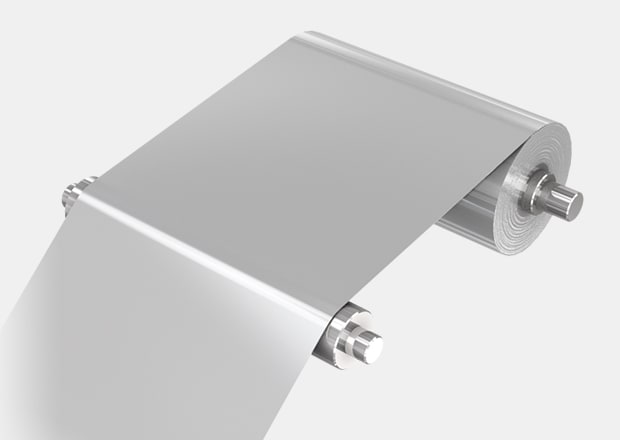
Transport stability: Misfeeds and uneven winding tension can develop as charged paper responds in unpredictable ways to nearby metal components.
Contamination: Charged substrates attract dust and fibers, all of which can embed into a surface and affect final printing or coating performance.
Equipment response issues: Sensors that depend on the paper moving consistently may produce unstable or abnormal readings if the paper roll does not release cleanly.
Operator interaction: Accumulated charge in winding slitting areas can discharge onto an operator during handling.
Conventional Countermeasures
Conventional static eliminator
The static elimination speed is insufficient.
The static elimination status is not clear.
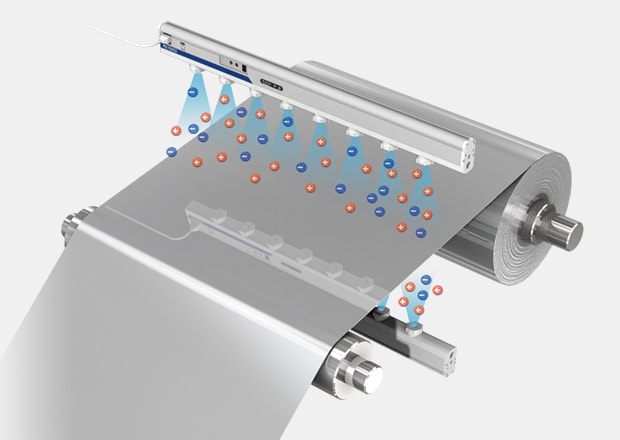
Countermeasures With Static Eliminators (Ionizers)
An ionizer can eliminate static electricity, which cannot be eliminated completely with conventional methods, while visualizing the effects.
Reduced Cost for Preventing the Release of Defective Products
Although the disposal cost when complaints arise depends on the product type or frequency, significant losses are expected. Consequently, measures against static electricity were mandatory.
KEYENCE Solutions for Charge Detection and Elimination
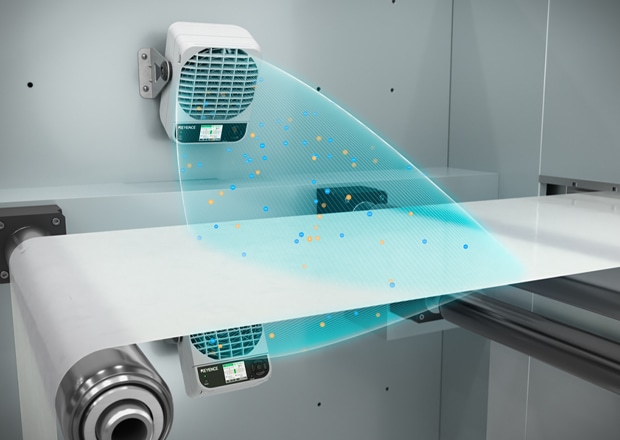
Effective electrostatic control in paper production starts with identifying where static charge on paper sheets accumulates during roll transfer. Inline monitoring provides continuous data on static electricity in paper roll transfer, so that process changes can be tied to real change behavior and not just assumptions.
After charge concentration points are identified, ionization can be applied at the locations that cause paper sheets to stick to rollers. In transfer sections, static elimination in dry environments is often concentrated near separation points and winding areas. As the paper is released from one roller and transitions to the next, static charges can increase rapidly, especially when the humidity is low.
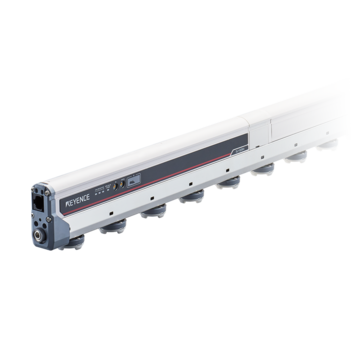
The SJ-Q Series bar-style ionizer from KEYENCE supports these applications by delivering ionization across the width of the substrate, which helps reduce overall residual charge that can contribute to static problems in paper transport. When monitoring and ionization are applied together, roll transfer behavior becomes more stable and less sensitive to day-to-day shifts in environmental conditions.
Explore static control for paper roll transfer with KEYENCE today.