Vision Systems
Using Artificial Intelligence in Machine Vision
Key Takeaways
- AI extends, not replaces, traditional machine vision for adaptive visual interpretation.
- AI models reduce manual retuning by learning acceptable part appearance across production.
- The KEYENCE VS allows for traditional rule-based inspection and AI inspection to work hand in hand
- Inline AI enabled vision systems handle variation better than rule-based inspection, meaning less downtime for adjustments
- AI models train on a small number of images, without sacrificing accuracy or traceability
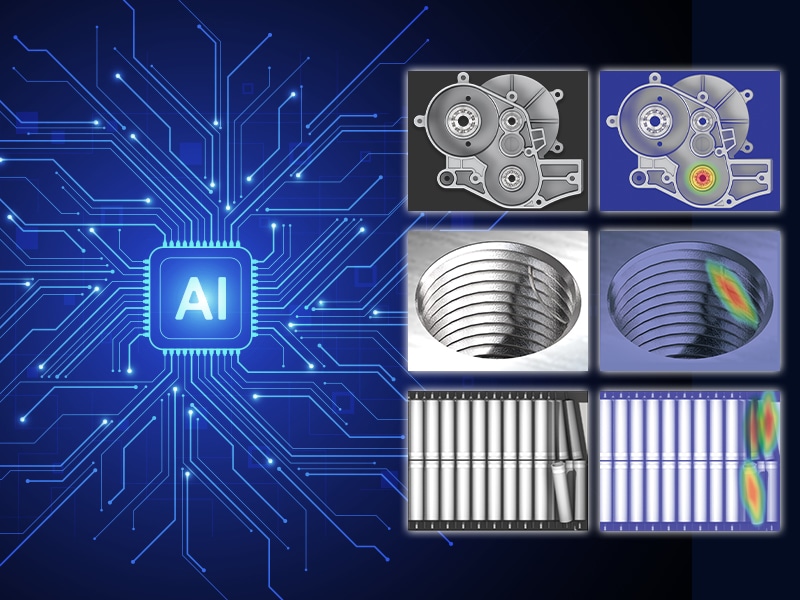
Artificial intelligence (AI) is now part of everyday industrial inspection, not as a replacement for machine vision fundamentals, but as an extension of how visual data is interpreted during production. As manufacturers demand tighter tolerances, faster line speeds, and greater variation within processes, traditional rule-based methods struggle to accommodate these changes.
AI introduces new ways for a vision system to interpret patterns, evaluate deviation, and support measurement tools, all while eliminating the need for engineers to constantly adjust inspection logic as conditions change.
The Role of AI in Enhancing Vision Systems
Inspection logic in many vision systems applies fixed image rules at the inspection point. In measurement applications, those rules are set around known geometry, lighting, and part positioning defined during setup. AI becomes useful when those conditions change, allowing the system to interpret visual variation based on how acceptable parts actually appear during production rather than how they were originally defined.
Instead of relying only on explicit rules, AI-based vision tools analyze how acceptable parts appear across a range of real production conditions. Systems can then interpret variation in surface finish, lighting, or orientation that would otherwise require extensive rule tuning, so, in practice, AI becomes another inspection tool within the vision system, operating alongside measurement tools, edge detection, and geometric analysis.
Modern KEYENCE vision platforms support this layered approach. Systems such as the VS Series Vision System allow AI processing to coexist with conventional inspection tools, giving engineers flexibility in how inspection logic is applied across different inspection points.
Get detailed information on our products by downloading our catalog.
View Catalog
Key Benefits of AI in Machine Vision
AI-based inspections are the most helpful when inspection conditions no longer remain fixed from run to run; if there are variations in surface finish or presentation, those can introduce edge cases that fall outside predefined inspection logic. In these situations, AI-trained models can evaluate visual patterns based on prior production data without having to rely on fixed thresholds.
In automated dimension inspection workflows, AI-driven evaluation reduces variability caused by operator judgment or shift changes over time. Throughout the process, measurement automation remains tied to defined tolerances. This remains true even as line speed increases.
AI-based tools also change how inspection systems are deployed and maintained. Production teams can introduce new inspection points or adjust precision measurement solutions without obscuring how decisions are made, keeping inspection logic visible while reducing the effort required to bring systems online.

Case Studies: Successful AI Implementation in Vision Systems
Across the board, AI has already proven itself effective where traditional inspection logic finds its practical limits.
Automated Machining and High-Precision Production Environments
In automated machining environments, inspection challenges often emerge from surface characteristics rather than part geometry alone. Reflective finishes, textured materials, and process-related variation can complicate measurement when image-based thresholds require frequent adjustment.
In these cases, AI-enabled vision systems have been deployed to interpret surface appearance as it develops during production, allowing dimensional evaluation to proceed without redefining inspection parameters for each material or finish change.
Packaging and Consumer Goods Production Lines
In packaging and consumer goods environments, the input presented to inspection cameras rarely stays consistent. Simple changes like those in lighting behavior and material presentation show up as the line continues to operate. This alters the image characteristics from one product to the next.
To address this, AI-based inspection systems have been introduced to interpret visual behavior over extended runtimes, rather than relying on fixed thresholds at a single moment. Inspection logic adapts to evolving image patterns instead of requiring repeated manual adjustment. Automated dimension inspection and verification continue inline, allowing measurement automation to operate at line speed without pauses or corrective intervention, even as operating conditions drift during production.

How AI Improves Accuracy and Efficiency in Manufacturing
Inspection accuracy in manufacturing is shaped by how inspection logic behaves under real production conditions. When visual evaluation accounts for normal variation in materials, surface finish, or part presentation, inspection results stay aligned with downstream measurements. In measurement tools, AI-based evaluation helps separate acceptable visual variation from conditions that indicate functional or dimensional risk, reducing discrepancies between image-based inspection and physical measurement data.
On production lines running for extended periods, inspection systems draw attention only when visual logic no longer reflects what the camera is capturing. Any shift in lighting, material behavior, or part presentation can trigger retuning, which pulls operators away from their work on overseeing the line. When inspection logic adapts to variation observed during runtime, those interventions become less frequent. The inspection pace remains governed by imaging and processing limits rather than manual review.
AI-Based Defect Detection: Real-Time Benefits
AI-based defect detection changes how inspection feedback reaches the line.
Instead of relying on post-process review, results are generated while production is still underway.
- Inspection results are available while parts are still in motion. This helps limit the number of defective parts produced before an issue is noticed.
- Visual deviations often appear before measured features move out of tolerance, giving earlier visibility into process drift during automated dimension inspection.
- Inline evaluation removes the delay associated with batch review, so feedback remains aligned with actual line conditions instead of being discovered in a post-run analysis.
- Exception-based image capture helps reduce data volume without removing traceability, making long production runs easier to manage.
- When visual changes are identified early, adjustments can be made without interrupting measurement automation or slowing line speed.

Integrating AI with Traditional Machine Vision Systems
AI performs best when integrated with traditional machine vision tools. Any isolation from those tools makes any benefit of the AI system moot. With this hybrid model, rule-based inspections remain effective for precise measurements, alignment checks, and presence verification. AI just adds value in areas where variation or surface complexity limits rigid logic.
Hybrid inspection strategies allow engineers to apply each tool where it fits best. A vision system might use geometric measurement for critical dimensions while applying AI to surface inspection or cosmetic evaluation. This approach supports scalable measurement automation without forcing every inspection task into a single method.
KEYENCE vision systems are built to seamlessly integrate both AI and traditional inspection methods for enhanced performance. Platforms such as the VS Series allow AI tools and rule-based inspections to coexist within the same workflow, simplifying deployment in existing production lines.
See how AI can enhance your vision system today.

FAQs
How Does AI Improve the Efficiency of Machine Vision Systems?
AI reduces how often inspection logic needs adjustment by adapting to normal variation during production, allowing measurement automation to remain stable as line conditions shift.
Can AI-Based Vision Systems Detect Defects in Complex Objects?
Yes. AI is well-suited for objects with complex surfaces, mixed materials, or natural variation. By learning acceptable appearance from real images, the system identifies deviations that may not follow fixed patterns, supporting reliable defect detection alongside measurement inspection.
What Are the Key Challenges in Integrating AI Into Existing Vision Systems?
Successful integration depends on representative training data, result validation, and keeping inspection logic transparent within existing workflows.
Related Downloads
Related Products
Industries
- Aerospace
- Automation Equipment/Machine Building
- Automotive
- Commodities
- Defense
- Electric Vehicles
- Electronic Device
- Fabric/Textile
- Food/Beverage Packaging
- Logistics
- Machine Tools
- Marine
- Medical Device Manufacturing
- Mining/Metals
- Paper Manufacturing
- Pharmaceuticals
- Printing
- Semiconductor/Manufacturing Electronics
- Solar
- Tobacco
- Vision-Guided Robotics