3D Scanner
How to Measure Volume Non-Destructively
-
Tags:
- 3D data acquisition , R&D
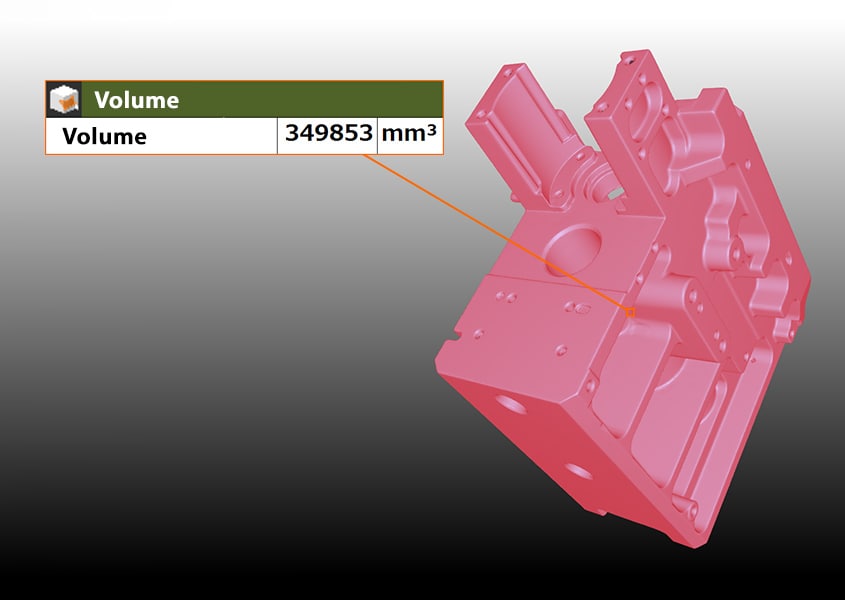
Volume is a key measurement for liquids, gases, and solids. Unlike length, width, and height, which are measured directly, volume is derived from those dimensions using mathematical formulas. This article covers the fundamentals of volume measurement and explores non-contact measurement techniques, including the KEYENCE VL Series 3D Scanner CMM, which rapidly captures 3D geometry to enable fast, accurate, non-contact volume calculations.
What is Volume?
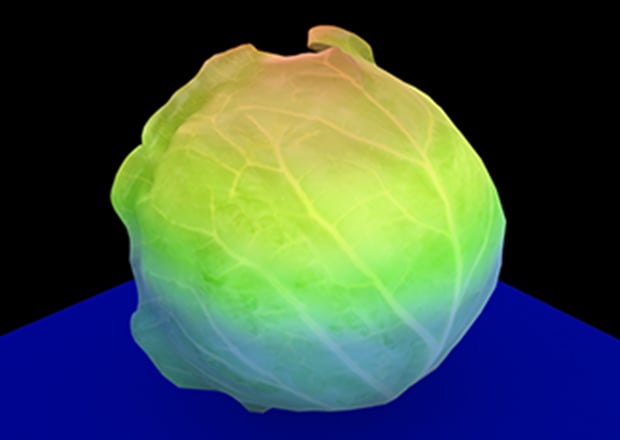
Volume is the amount of space an object or substance occupies. The SI unit for volume is the cubic meter (m³), though in the United States, cubic inches, cubic feet, and gallons remain common depending on the application. Mathematically, volume is calculated by integrating over a shape in 3D space, but in practice, dedicated instruments are used to measure it directly.
Common applications include measuring irregularly shaped raw materials, inspecting food product dimensions, and determining engine cylinder capacity. Capacity refers specifically to how much a container can hold, with units varying by industry — gallons for fluid systems, cubic inches or liters for engine displacement, and cubic feet for bulk storage.
How to Calculate Volume
Volume can be calculated using formulas for simple geometric shapes such as cubes, rectangular prisms, cylinders, and spheres. However, these formulas break down for complex or irregular shapes, where dedicated measurement tools are required.
Volume of a cube
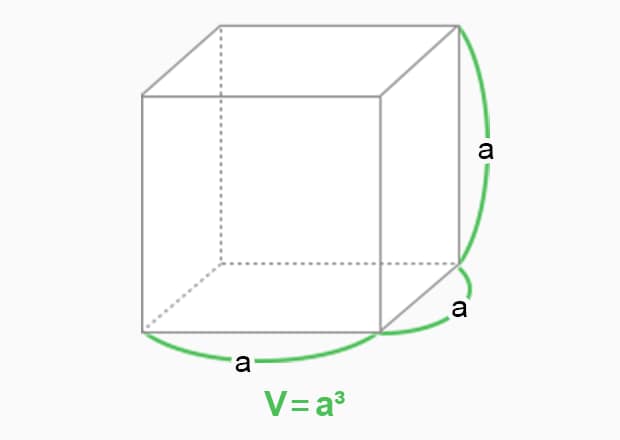
V: volume
a: length of one side
Volume of a rectangular prism
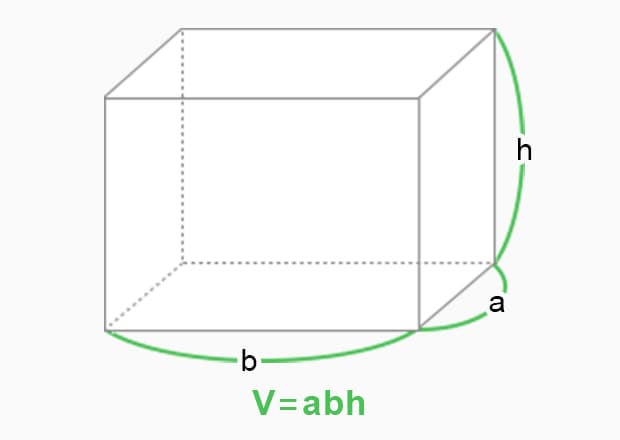
V: volume
a: length (vertical)
b: width (horizontal)
h: height
Volume of a prism/cylinder
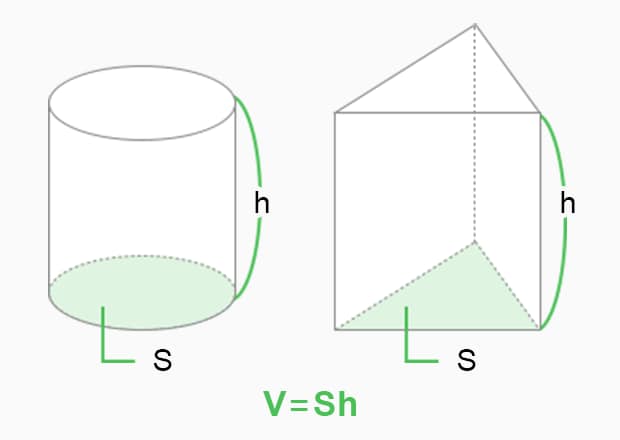
V: volume
S: base area
h: height
Volume of a pyramid/cone
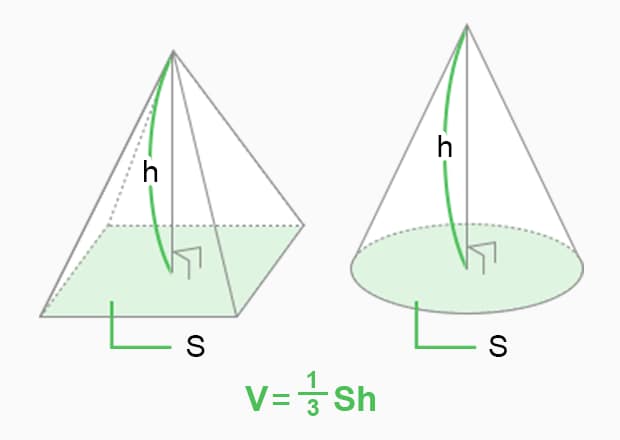
V: volume
S: base area
h: height
Volume of a sphere
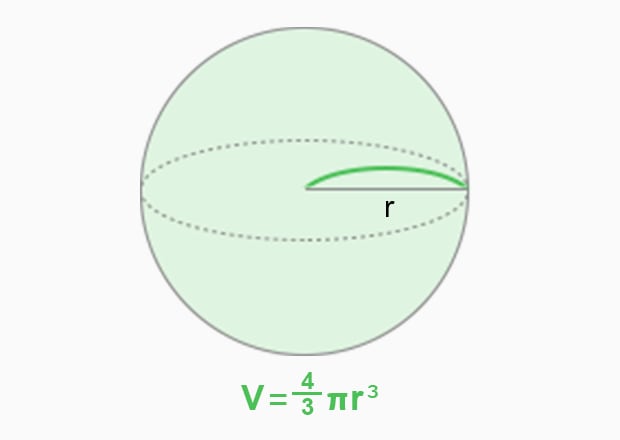
V: volume
r: radius
Volume of a regular tetrahedron
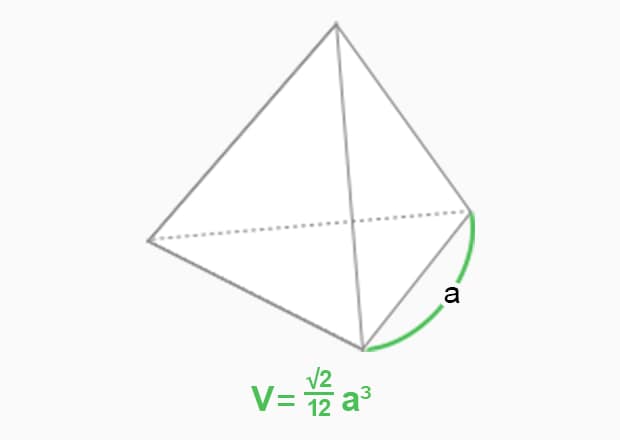
V: volume
a: length of one side
Volume of a regular octahedron
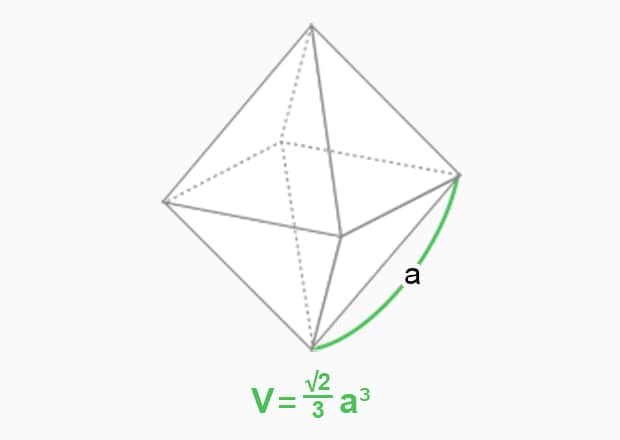
V: volume
a: length of one side
Types of Volume Meters
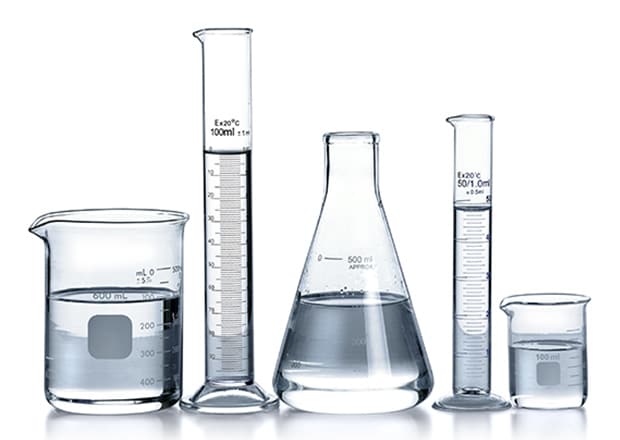
Volume meters range from traditional measuring containers, such as flasks, graduated cylinders, pipettes, and burettes, to advanced non-contact methods. These include acoustic volume meters, which measure volume using sound pressure, and laser volume meters, which use lasers to capture geometry without touching the part.
Common Methods for Measuring Volume
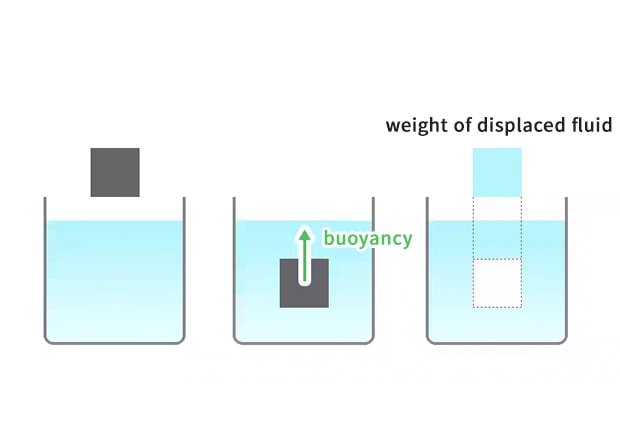
Buoyancy = weight of the displaced fluid
Archimedes' principle
Archimedes' principle states that an object immersed in fluid displaces a volume of fluid equal to its own volume. In practice, this is measured using a graduated cylinder: submerge the object in liquid, record the change in liquid level, and that difference equals the object's volume.
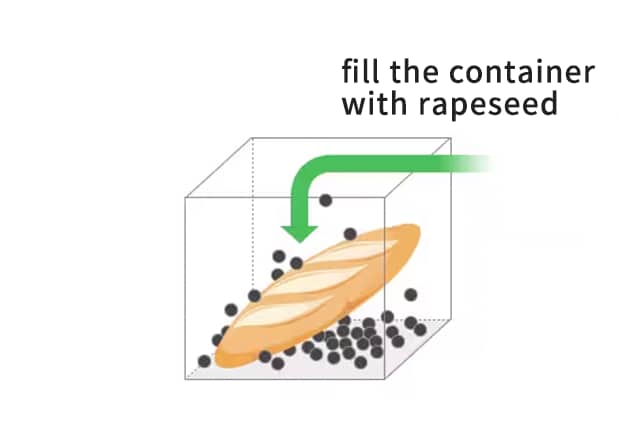
Seed displacement method
The seed displacement method works on the same principle as Archimedes' method but uses seeds instead of liquid, making it suitable for items that cannot be submerged, such as bread or confectionery. Similar approaches include the bead displacement method, which uses small beads as a pseudo-fluid, and the sand displacement method.
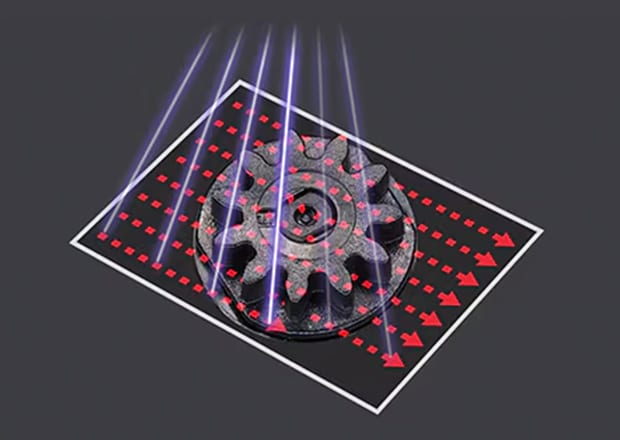
Laser volumeter
Archimedes-based measurement is precise but wets the object. Seed displacement avoids this but can compress soft materials, producing inaccurate results. When either method falls short, a laser volumeter offers an effective alternative. By scanning an object with lasers to capture its distances and geometry, a laser volumeter enables fast, contact-free volume measurement.
Acoustic volumeter
An acoustic volumeter is a non-contact method for measuring volume or capacity, commonly used in applications such as engine cylinder capacity. The system consists of two chambers — a reference chamber and a measurement chamber — with a speaker and microphone positioned in the reference chamber. When the speaker emits sound at the interface between the chambers, the air in both chambers vibrates. Because vibration amplitude is inversely proportional to volume, the system uses this relationship to calculate the object's volume.
Challenges in Conventional Volume Measurement
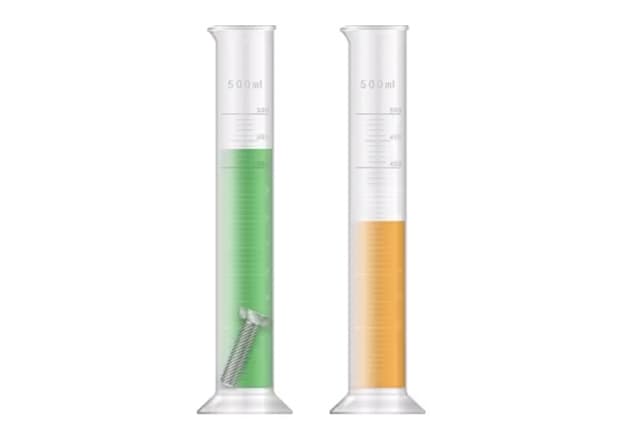
Challenges of volume measurement using Archimedes' principle
Archimedes' method can yield precise volume measurements with minimal equipment, but the requirement for liquid immersion introduces several limitations. Objects become wet during measurement, ruling out porous materials such as sponges and raising hygiene concerns for food products. Accurate results also depend on careful control of conditions, including stable liquid temperature and the removal of air bubbles.
Seed displacement avoids wetting the object and can achieve accuracy comparable to liquid-based methods. However, soft materials risk compression during measurement, leading to inaccurate results. Measurements are also susceptible to environmental factors such as temperature and humidity, as well as variability in operator technique.
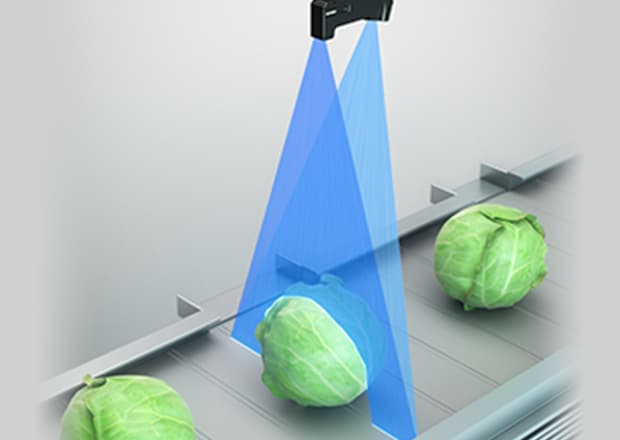
Challenges of volume measurement using a laser volumeter
Laser volumeters offer several advantages: no contact means nothing gets wet or damaged, and they deliver fast 3D readouts that make volume and shape quantification straightforward. The key limitation is line-of-sight dependency, as the laser can only capture surfaces it can directly see, making large objects or geometrically complex shapes difficult to measure completely.
Solutions for Achieving Non-Contact Volume Measurement
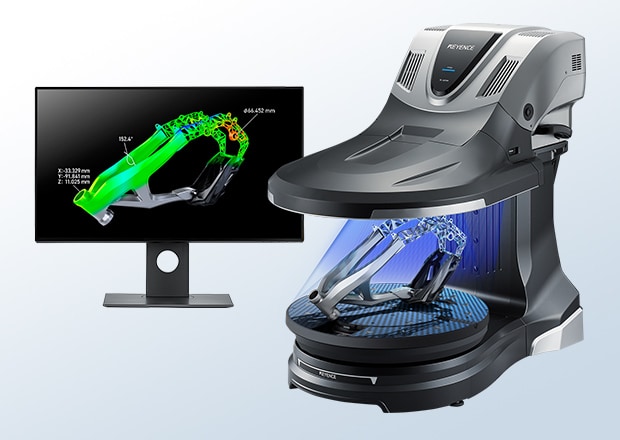
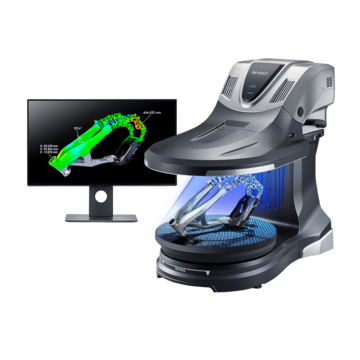
While each of the methods described above has its limitations, the KEYENCE VL Series 3D Scanner CMM addresses them through fully non-contact volume measurement. The VL Series performs a full 360° scan in minutes, capturing an object's complete 3D geometry with high accuracy. Volume is calculated directly from the scanned data, and because no contact is required, even complex or irregular shapes can be measured reliably.
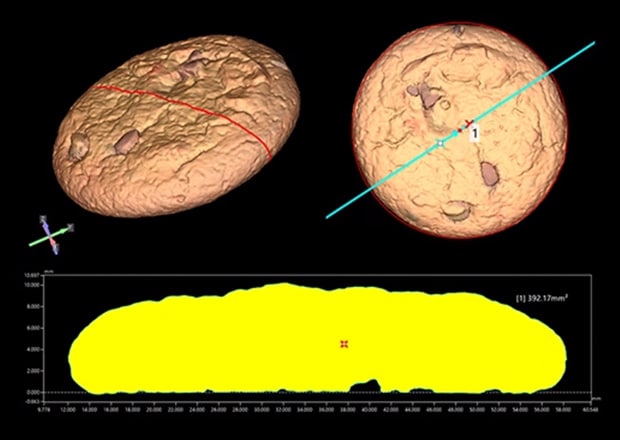
Benefit 1: Accurate volume measurement of soft items
Contact-based methods can deform soft samples during measurement, introducing errors that make accurate volume measurement unreliable or impossible. The KEYENCE VL Series 3D Scanner CMM eliminates this risk through non-contact optical scanning, capturing precise geometry without applying any force to the part.
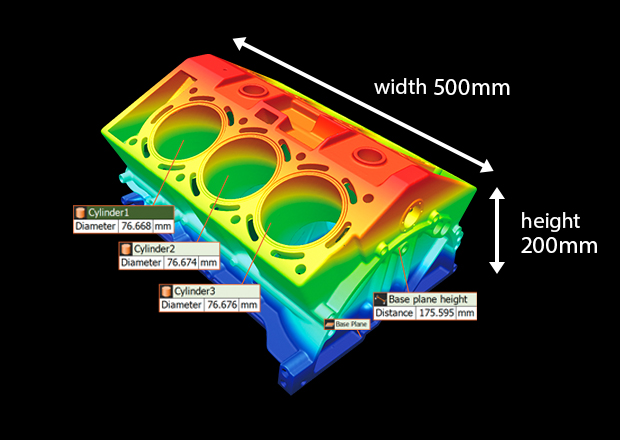
Benefit 2: Measure internal volumes such as cylinder capacity
Accurate cylinder capacity measurement is critical in engine applications, yet conventional methods often struggle to deliver the required precision. Where the cylinder bore is open and accessible, the KEYENCE VL Series captures full 3D geometry in a single scan, calculating cylinder capacity directly from the scanned data with high accuracy and significantly reducing inspection time.
Using a 3D Scanner Enables Non-Contact, High-Accuracy, and Fast Volume Measurement
Conventional volume measurement methods present well-documented challenges, such as wetting the object, causing deformation, or struggling with complex geometry. The KEYENCE VL Series 3D Scanner CMM overcomes these limitations, delivering non-contact, high-accuracy volume measurement in minutes.
- A full 360° scan completes in minutes, significantly reducing measurement time compared to conventional methods.
- Non-contact scanning eliminates deformation, producing reliable results even for soft or delicate parts.
- Complex and irregular shapes that are difficult to measure conventionally can be captured with confidence.
The VL Series handles complex shapes and large parts within a single workflow, consolidating what would otherwise require multiple tools or methods into one device. The result is faster, more accurate volume measurement with less operator effort.