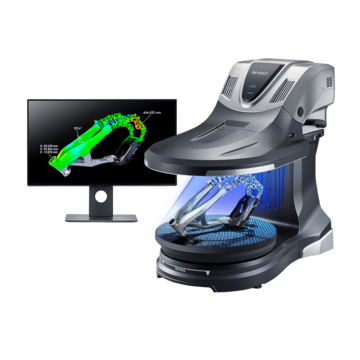
3D Scanner
Utilizing 3D Scanners for Predictive Maintenance for Die and Mold Wear
Key Takeaways
- Use 360° non-contact scans to quantify die/mold wear and detect minute dimensional trends.
- Compare periodic scans vs baseline CAD to set threshold‑based alerts for predictive maintenance.
- Batch scanning reduces inspection man‑hours.
- Scan dies directly to monitor wear, schedule repairs based on data (not fixed intervals) to avoid premature maintenance.
- Easily program OK/NG rules and visual color‑map reports for root‑cause analysis.
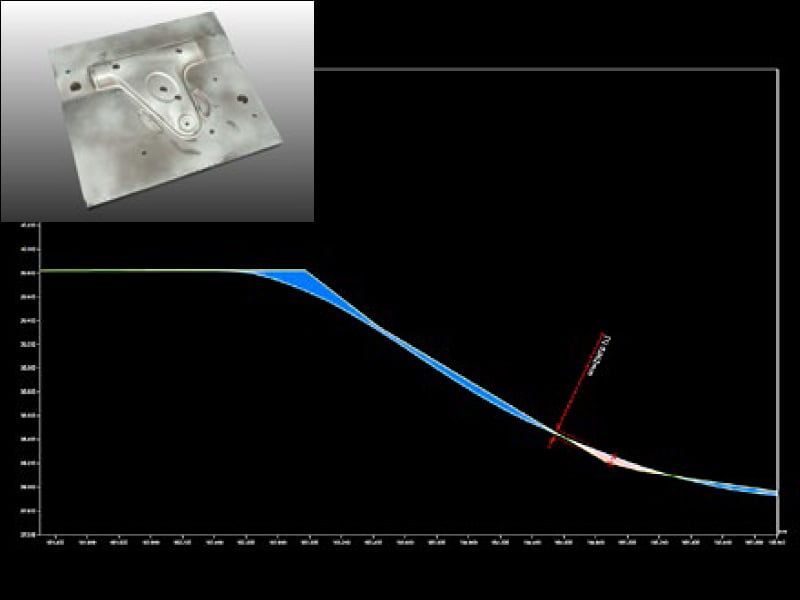
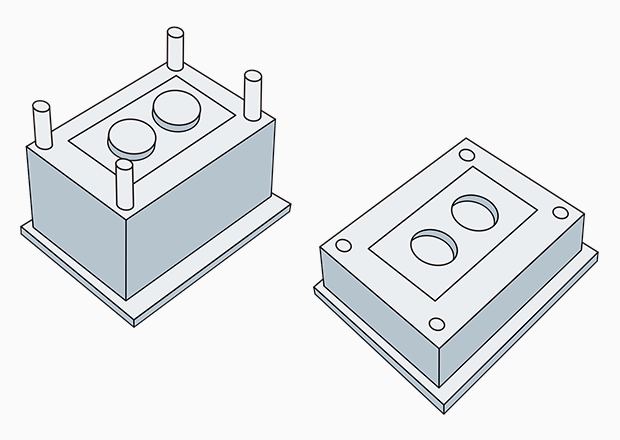
Dies and molds make parts through stamping and injection molding. They’re affordable and consistent for big runs, but constant use wears them down, which can cause defects and slow production. How fast molds wear depend on their settings and materials, so it’s hard to know exactly when to fix them. Because of that uncertainty, molds are often repaired earlier than needed, which lowers productivity and raises costs. Predictive maintenance helps, but it’s difficult to know exactly when repair is needed.
This article walks through predictive maintenance for die and mold wear. It explains what dies and molds are, how they’re managed, the different maintenance types, and ways to avoid downtime from failures. We’ll also look at the limits of traditional measurement methods and how the KEYENCE VL Series 3D Scanner CMM overcomes them.
Types of Die and Mold Wear
Die and mold wear falls into two categories: abnormal and normal. Normal wear is just the gradual surface breakdown from regular contact and sliding between parts. Abnormal wear comes from issues like wrong materials and shapes, metal fatigue, or corrosion.
Types of Abnormal Wear
Abrasive Wear
Abrasive wear is split into two categories: two-body and three-body. Two-body abrasion is when a hard surface grinds directly into a softer one. Three-body abrasion happens when loose hard particles get between surfaces and cut away the die or mold material.
Adhesive Wear
Adhesive wear (also known as “seizure”) occurs when surface protrusions contact and weld together, then break away during motion, taking material with them. That repeated sticking and tearing leads to wear.
Fretting Wear
Fretting wear is a fine, pitting-type damage caused by tiny, repeated movements under friction on fitted surfaces. It creates microscopic cracks in the die or mold. The affected area's fatigue strength can drop by over 50 percent.
Corrosive Wear
Sometimes known as “chemical wear”, this type of wear happens when material is worn away because of the potential difference in metals, with friction only furthering the issue.
Types of Normal Wear
Initial Wear
Also known as “running-in wear”, this type occurs when small bumps and rough spots on surfaces are worn down as operation begins.
Steady-State Wear
Steady state wear is the gradual damage that builds up while a die or mold is in regular use. Routine inspections and timely repairs can prevent steady state wear from causing problems.
Preventing Wear with Maintenance
Manufacturers can prevent die and mold wear by inspecting and maintaining them at the right times. But abnormal wear can happen suddenly, so routine maintenance by itself is not enough. That is why teams check product dimensions and appearance every day on the shop floor. Measuring parts helps stop defective items from being shipped and also reveals the wear that causes defects. Tracking dimension trends makes it possible to predict wear to some degree. A sudden rise in defects may point to wear, flaking, or other problems with the die or mold.
Types of Maintenance
Corrective Maintenance
Corrective maintenance happens after a die, mold, or machine shows a functional decline or stops. It means finding the cause, replacing parts, and fixing the problem. If the issue is clear and small, repairs can be done quickly using spare parts. If parts are hard to get or the repair is complex, production stoppage can become long.
Preventive Maintenance
Preventive maintenance means following a schedule for inspections, parts changes, and repairs. There are two types of preventative maintenance. Time based maintenance runs inspections and replacements at fixed intervals. Condition based maintenance schedules work according to the actual condition of parts. For both approaches you need to know part lifespans and build a maintenance plan using time, past work, and failure history.
Predictive Maintenance
Predictive maintenance means monitoring the condition of dies, molds, and equipment and analyzing the data to predict where and when failures will occur, letting manufacturers inspect and replace parts before a breakdown. Judging die and mold wear is hard, and deciding if wear is acceptable often depends on the experience and intuition of staff, which can vary. It is also hard to detect early wear from product inspections alone.
Predictive Maintenance to Minimize Downtime
Traditionally, die and mold care has relied on corrective maintenance and preventive maintenance. Both methods can still cause downtime and stop production. Predictive maintenance seeks to avoid that by spotting problems early and fixing them before they cause stoppages. Below is a summary of the advantages and disadvantages of each maintenance approach.
Pros and Cons of Corrective Maintenance
- Pros
-
- Simplified Troubleshooting: Since maintenance and parts replacement are performed only after a failure occurs, identifying the root cause is straightforward.
- Swift Recovery: With spare parts on hand, repairs can be completed quickly and easily, minimizing the repair window.
- Cons
-
- Unplanned Downtime: Because actions are reactive rather than proactive, unexpected equipment downtime is inevitable.
- Risk of Major Production Loss: In the event of a critical breakdown, extensive repair times can lead to significant downtime in production schedules.
Pros and Cons of Preventive Maintenance
- Pros
-
- Prevention of Wear-Related Failures: By carrying out inspections and swapping parts on a regular, planned schedule, issues can be prevented before they start.
- Enhanced Operational Predictability: When maintenance tasks are scheduled in advance, planning the production timeline becomes simpler and more efficient.
- Cons
-
- Requirement for Specialized Expertise: Effective maintenance planning requires collecting historical data and having operational expertise.
- Risk of Over-Maintenance: Unnecessary inspections or replacing parts too early can lead to higher overall maintenance costs.
Pros and Cons of Predictive Maintenance
- Pros
-
- Elimination of Unplanned Downtime: By monitoring tool and mold wear in real time, you can spot problems before they turn into failures, so maintenance can be done smoothly without disrupting the production line.
- Cost Optimization: Unlike standard preventive maintenance, this approach removes unnecessary servicing and optimizes replacement cycles and labor costs.
- Cons
-
- High Dependency on Technical Expertise: Implementing predictive maintenance requires strong engineering knowledge and additional man hours to fine tune the process.
- Significant Initial Investment: Integrating technology like IIoT sensors and AI analytics requires substantial upfront costs on hardware, software, and infrastructure.
Limitations of Conventional Predictive Maintenance Methods for Die and Mold Wear
Predictive maintenance is useful for managing die and mold wear, but it can be hard and costly to put in place. Determining wear by inspecting finished parts is common, but it is not always precise.
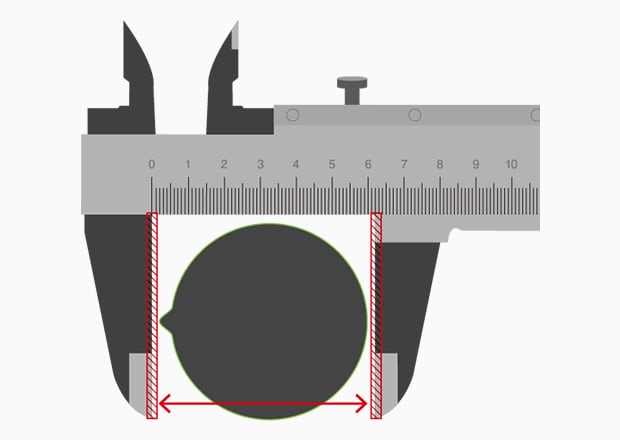
Drawbacks of Caliper-Based Measurement
One method for monitoring mold and die wear is to infer it from the dimensions of the molded parts. However, calipers struggle to detect small dimensional shifts over time, so early-stage wear can be missed. Because of this, teams often end up using corrective maintenance, discovering and fixing wear only after defective parts have been made.
The Hidden Costs of Preventive Maintenance
Given the shortcomings of caliper-based measurement, accurately forecasting die and mold wear is challenging. Many teams adopt preventive maintenance, replacing parts on a fixed schedule or based on elapsed time or usage rather than actual condition. That plan is well meaning but often wastes parts that are still fine and raises costs for replacements and inspections.
Solving the Challenges of Die and Mold Predictive Maintenance
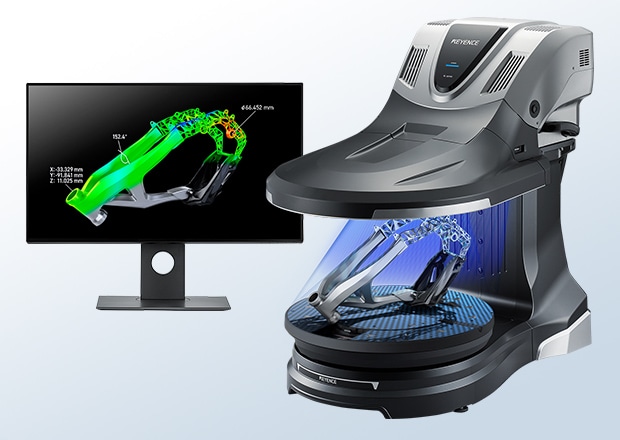
Predictive maintenance for dies and molds is something most manufacturers know they need, but actually pulling it off, especially when it comes to tracking dimensional changes over time, is easier said than done. That's where the KEYENCE VL Series 3D Scanner CMM comes in.
The VL Series can quickly do a full 360° scan of a part, giving you a highly accurate 3D measurement without slowing down your workflow. What makes it especially useful for predictive maintenance is that it doesn't just measure your finished products, it can also scan the dies and molds themselves. That means you can keep an eye on how your tooling is wearing over time and set dimensional thresholds so you're only replacing parts when they actually need it, rather than guessing.
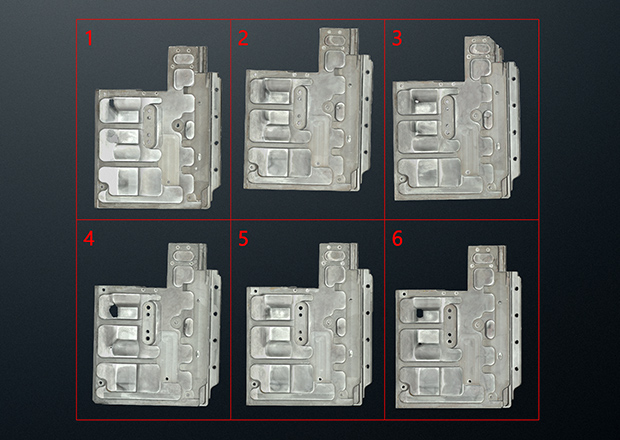
Benefit 1: Scan multiple parts at once for easy batch data acquisition.
Traditional 3D scanners have long been held back by the inability to measure multiple parts at the same time. Each component had to be handled individually, making the process slow and labor-intensive.
The KEYENCE VL Series 3D Scanner fixes that by letting you scan multiple parts all at once. Its built-in data-splitting feature takes care of the rest, automatically sorting and capturing accurate measurements for each individual part in a single pass. The end result is a much faster inspection process with significantly less manual effort, which can make a big difference in your overall workflow.
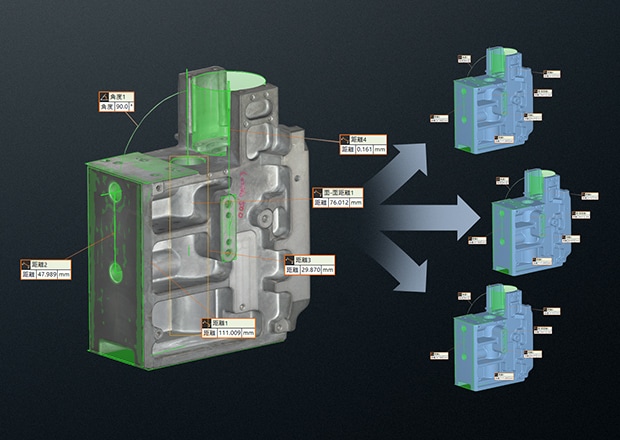
Benefit 2: Programmable pass/fail function.
A major challenge with conventional measurement methods has been the inconsistency in data due to operator dependency. The KEYENCE VL Series 3D Scanner tackles this head-on with automated analysis templates that ensure every part is measured under identical conditions, eliminating operator-to-operator variability. User-defined tolerance ranges enable instant pass/fail judgments, removing the risk of manual verification errors. Combined with the system's batch measurement capability, this allows for comprehensive data collection across multiple parts at once. Over time, analyzing these cumulative dimensional changes gives users the accurate, reliable trend data they need.
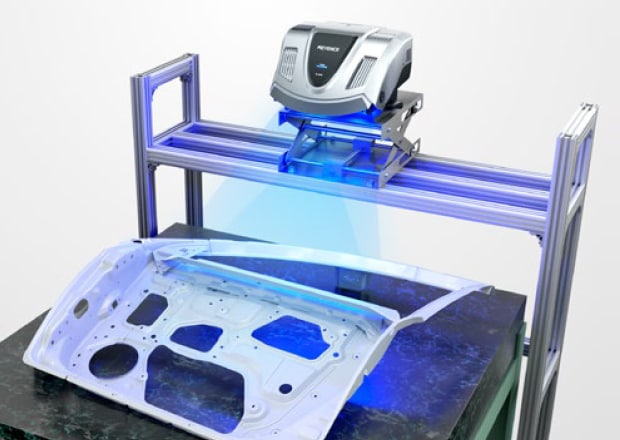
Benefit 3: Flexible measurement for large-scale parts like dies and molds.
The KEYENCE VL Series 3D Scanner is designed as a compact, all-in-one system with an integrated camera and stage, but its modular design ensures it isn't limited to small or mid-sized parts. The measurement head can be detached from the main body, allowing the system to measure oversized objects that would otherwise exceed the stage capacity, including large industrial dies and molds.
Beyond the standard hardware, KEYENCE also offers customized fixtures and fully integrated systems tailored to your specific measurement needs. Our specialists are ready to help you find the right solution for your production environment.
From Molded Parts to Dies: Achieving Predictive Maintenance for Wear with 3D Scanners
Predictive maintenance for die and mold wear has traditionally been difficult and costly to implement, often demanding complex IoT infrastructure and AI-driven systems. The KEYENCE VL Series 3D Scanner changes that by offering a straightforward, cost-effective alternative that delivers the same critical insights with far less effort.
The VL Series can quickly and accurately measure everything from finished molded parts to the dies themselves, providing a full 360° scan. Its ability to scan multiple parts at once eliminates repetitive manual setups, dramatically reducing total inspection time and workhours. Scan data is automatically converted into a CAD model, and CAD-to-part comparisons and make trend management effortless. Combined with the system's built-in tolerance analysis function, operators gain the data they need to make informed maintenance decisions and get ahead of issues before they lead to costly unplanned downtime.
This versatility extends beyond standard molded parts to include large-scale tooling and molds as well. By consistently monitoring and comparing all components over time, manufacturers can optimize their maintenance schedules, reduce unnecessary servicing costs, and maximize the longevity of their tooling. What once required a complex network of sensors and real-time IoT monitoring can now be achieved with a single, easy-to-use 3D scanner.