3D Scanner
3D Scanners for the Automotive Industry
Key Takeaways
- Automotive 3D scanning captures accurate 3D data for inspection, design, prototyping, and reverse engineering.
- 3D scanning helps improve quality control by comparing manufactured parts against CAD models.
- Automotive 3D scanners support product development, tooling, casting inspection, and assembly validation.
- The right scanner depends on part size, accuracy requirements, portability, and ease of use.
- 3D scanning for automotive applications helps reduce rework, speed up development, and improve measurement repeatability.
This page covers how automotive 3D scanning works, where it adds the most value, and what to look for when choosing the best 3D scanner for car parts and auto applications.
What Is Automotive 3D Scanning?
Automotive 3D scanning captures the precise shape and surface geometry of vehicle parts, assemblies, or full bodies. The scanner collects millions of data points, forming a detailed digital model of the physical object.
That model can then be used for quality inspection, design validation, reverse engineering, or tooling development. Unlike traditional measurement methods, 3D scanning captures complex curves and surfaces quickly without contact, making it well-suited to the variety of shapes found in automotive components.
Key Benefits of 3D Scanning for Automotive Applications
3D scanning provides several distinct advantages over traditional measurement tools, helping automotive teams optimize their workflows.
Speed
A 3D automotive scanner can capture an entire part in minutes without programming required by a CMM, and without the variability of caliper measurements.
Repeatability
A scanner produces consistent results regardless of who operates it. 3D scanning also creates a digital record of each measured part for traceability and audits.
Visual Feedback
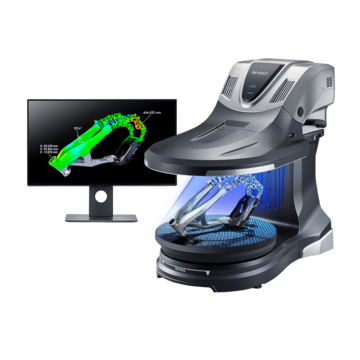
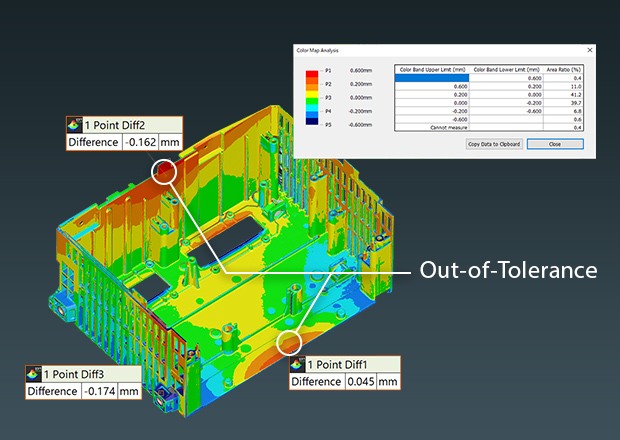
For development teams, comparing a physical part directly to its CAD model with color deviation maps gives engineers an immediate, visual view of where parts meet tolerances and where they do not.
3D Scanning in Automotive Product Development
Across the product development cycle, 3D scanning serves as a versatile tool for validating designs and ensuring high-quality parts.
Prototype Verification
Engineers use scan data to compare early prototypes to the intended design to catch differences and make adjustments before further development is done.
Reverse Engineering
An automotive 3D scanner exports scanned data into a variety of CAD formats, saving a lot of time compared with recreating a model from scratch when the original CAD is missing, or adjustments on existing parts must be made.
Fitment Research
Scan data shows how parts align in real assemblies. When you scan multiple components together, you can see how real-world variation affects fit and finish, letting you fix issues before anything goes on the assembly line.
3D Scanning in Automotive Manufacturing
On the manufacturing side, a 3D car scanner is used for incoming inspection, in-process checks, and final part validation.
Cast parts benefit particularly from the speed and surface coverage that scanning provides, since cast parts carry complex geometry that’s difficult to measure fully with contact-based tools. The VL-800 Series is designed for exactly this type of high-resolution surface scanning across large and complex part geometries.
Scanning is also valuable for tooling and fixture checks, because fixtures, molds, and dies wear over time and periodic comparisons to the original specs catch drift before part quality is affected.
How to Choose the Right Automotive 3D Scanner
Choosing the right 3D scanning solution involves evaluating several key factors to ensure the equipment meets your specific production needs.
Part Size
Fuel injectors, brake pads, and other small parts may be more suitable for a desktop 3D scanner. Larger components like body panels may require handheld scanners.
Accuracy and Resolution Requirements
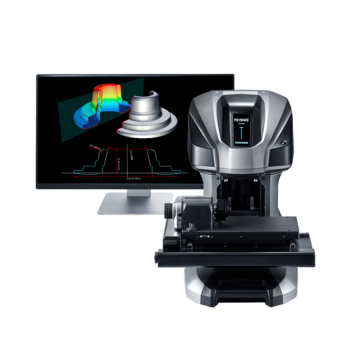
Ensure the scanner’s accuracy matches your specific application. Machined parts with tight tolerances require high accuracy, such as that provided by the VR-6000 Series. For a broader range of options, explore the full 3D scanner range.
Ease of Use
Even with great specs, a scanner that takes an hour to set up isn’t practical. Consider who will use the scanner on a regular basis. A simple interface and guided workflow reduce the chance of error and variability.
Real-World Automotive 3D Scanning Examples
Body Panel Gaps
Manufacturers replace manual gauges with faster, more reliable results by scanning completed panels to ensure that gaps are within specification.
Powertrain Components
In one scan, 3D scanning captures many critical features of engine blocks, cylinder heads, and gearbox housings, delivering a complete digital record for inspection and analysis.
Restoration / Aftermarket
3D automobile scanner technology is also used in restoration and aftermarket operations. CAD models can be generated directly from scan data, making it perfect for creating digital backups of outdated or legacy parts.

Frequently Asked Questions
What Is the Best 3D Scanner for Automotive Coating Thickness Measurement?
Due to the resolution required to measure and analyze coatings, handheld or other large-area 3D scanners cannot typically be used. In these cases, a 3D optical profilometer is the best option, as they both measure the thickness and the surface topography of any coatings or films.
What Is Automotive 3D Scanning Used For?
Automotive 3D scanning is used for part inspection, reverse engineering, prototype validation, tooling verification, and assembly fitment checks across both development and production environments.
How Accurate Are Automotive 3D Scanners?
Industrial-grade automotive 3D scanners typically achieve accuracy within tens of micrometers depending on part size and scanning conditions.