Static Control
Preventing Dust Adhesion in Camera Parts Assembly
Key Takeaways
- Ionizers neutralize charge at source, preventing dust adhesion on lenses and sensors.
- Point-of-use ionizers outperform fan-driven units in compact optical workstations.
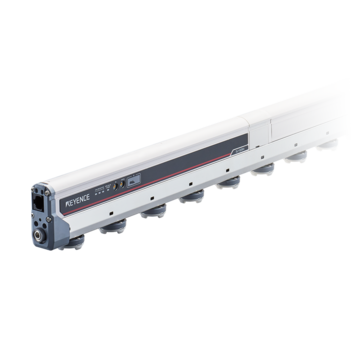
- Compact, airless models (e.g., KEYENCE SJ-H Series) fit tight lines and maintain consistency.
- Real-time feedback from modern ionizers reduces cleaning labor and rework costs.
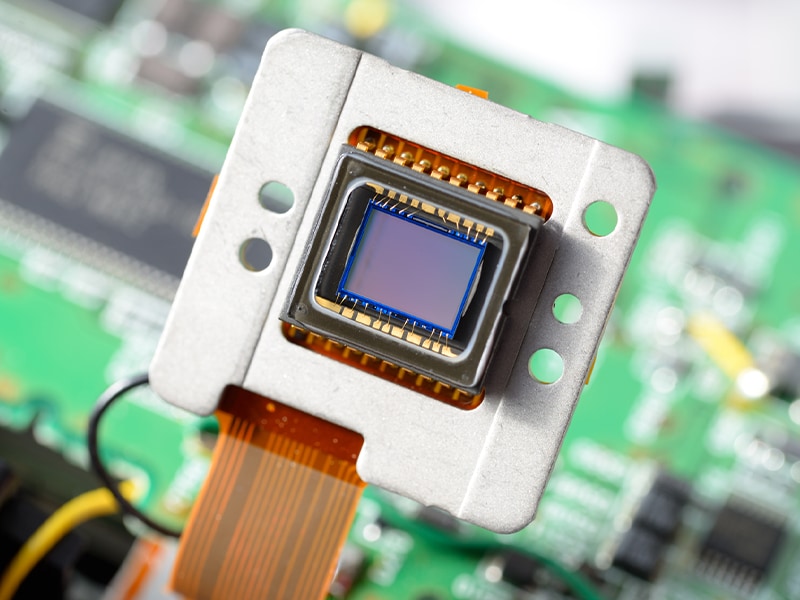
Static control in camera parts is an integral part of the assembly process, as even the smallest particles of dust can interrupt performance. As parts like lenses and sensors move through the production line, static charge naturally builds up and attracts these particles. Though dust particles are not always visible during handling, the presence of these particles can disrupt the optical clarity and functionality of the camera once sealed.
Static control for camera parts plays a direct role in limiting this risk by reducing the conditions that allow dust to cling to sensitive optical surfaces in the first place.
Ionizers Suited for Optical Component Production
Cameras need robust static control during assembly to help prevent defects. The movement of components through key stages, like alignment and handling, results in static charges naturally accumulating. This buildup then attracts dust, which can impact image clarity and camera performance once in the hands of the consumer.
Rather than relying on inconsistent environmental factors like humidity, ionizers target and neutralize this charge directly at the source, maintaining a stable, controlled environment throughout the entire assembly process.

Fan-Driven vs Point-of-Use Ionizers in Optics Assembly
Ionization in optics assembly must be precise, and the method of delivery plays a significant role. Fan-driven ionizers work well in wide-open areas, but in a compact optics workstation, precise static control is key. Point-of-use ionizers target any static charge that is directly on lenses or sensors. It neutralizes it right at the source and stops it from spreading further down the assembly line. This targeted approach eliminates the need for unnecessary airflow, which can disturb delicate optical components.
In workstations where parts are handled within tight spaces, proximity to the components is more important than sheer coverage. Additionally, ionizers designed for specific tasks can provide optimal static elimination for lens assembly at each handling step. This further reduces the risk of dust adhesion without introducing unwanted airflow disturbances.
Choosing Compact Ionizers for Tight Assembly Lines
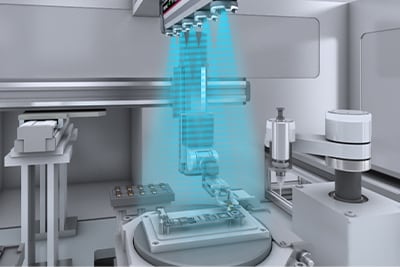
Camera production lines are typically cramped. Fixtures, inspection tools, and protective equipment occupy much of the available space. In these environments, compact ionizers integrate seamlessly, positioning easily near transfer points or handling stations without the need for layout adjustments.
The KEYENCE SJ-H Series ionizer, which operates without the need for air, helps minimize variations at each workstation. In optical assembly, precise placement and consistent neutralization are vital; this is especially true when handling delicate components like lenses and sensors.
Risks of Dust Contamination in Camera Manufacturing
Dust contamination in camera manufacturing often goes unnoticed until later on in the production process, when it becomes evident during testing or field use. Even the smallest of particles can obscure lenses or interfere with internal components.
By neutralizing static during lens assembly, ionizers for camera manufacturing can minimize the risk of particles settling on sensitive surfaces. Tackling static directly helps prevent dust from accumulating throughout production, reducing the chances of defects, additional cleaning, and costly rework later. Taking proactive steps at the assembly stage keeps the production line smoother and more efficient, minimizing disruptions down the road.
Limitations of Conventional Static Eliminators
Static control methods that work well for other materials fall short in optics assembly. Grounding eliminates static on conductive surfaces. However, it has a limited effect on plastics and other materials used in camera components. Humidity control methods may help, but they fail in most environments due to their dependence on variable conditions.
As a result, these methods often provide inconsistent outcomes, which often lead to unreliable static management during assembly. Some eliminators offer feedback; however, older static eliminators also provide very little. This leaves operators unsure whether the charge has actually been neutralized.
In camera manufacturing, failing to track static levels can lead to inconsistent results. Without a reliable way to measure static, operators may repeatedly clean components or adjust the process without addressing the root cause of the issue.
Conventional Countermeasures
Conventional static eliminator
- The static elimination speed is insufficient.
- The static elimination status is not clear.
Countermeasures with Static Eliminators (Ionizers)
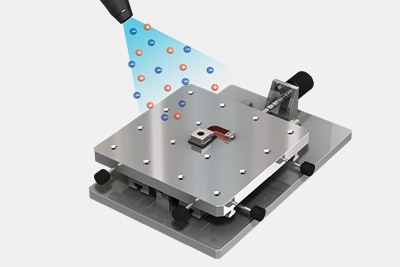
An ionizer effectively eliminates charged particles and provides a visual for the static elimination status.
It can reduce the labor for cleaning the foreign particles that could not be removed.
Reduced labor for cleaning foreign
particles
Labor cost for cleaning
Labor cost per line $200/month × 10 lines × 12 months = $24,000/year
In addition, there are other resulting effects, such as improved levels of trust.
Ionizers as the Optimal Countermeasure
Ionizers directly neutralize static charge where it builds, preventing dust from sticking to camera components. They work by releasing ions into the air, breaking through electrostatic forces that attract dust, all to help keep parts cleaner during assembly.
Modern ionizer models, like the KEYENCE SJ-Q Series, offer real-time feedback through visual indicators and alarms. This allows operators to monitor static levels while fitting easily into compact spaces. These ionizers are ideal for optical assembly, where consistency and verification are important.
Static control for camera parts becomes most effective when it is treated as part of the assembly process rather than a secondary safeguard. By applying ionization close to handling and alignment steps, manufacturers can reduce dust adhesion. Ionizers reduce the need for rework by eliminating static-related issues early in the assembly process.