Static Control
Static Ionizers for Mobile Phone Assembly and Electronics Lines
Key Takeaways
- Frequent part transfers generate persistent electrostatic charge, increasing dust adhesion and ESD risk.
- Inline static ionizers reduce particle adhesion and lowered vacuuming from 50% to 10% in the text.
- Early ionization reduces end-of-line cleaning, decreases handling, and stabilizes final inspection quality.
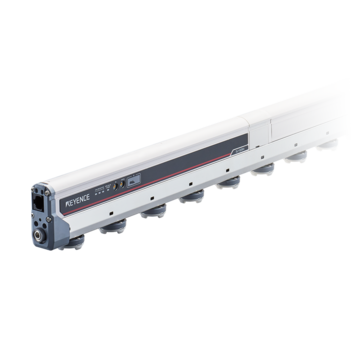
- Compact continuous ionizers (e.g., KEYENCE SJ-Q) fit tight layouts and operate at production line speeds.

Mobile phone assembly environments invite interesting conditions when it comes to static control. These production lines typically involve high component density and lightweight insulating materials that create conditions that can quickly produce electrostatic charges. In this setting, static becomes more than a background risk as it directly influences dust adhesion in mobile phone assembly, ESD exposure, and downstream quality stability. Addressing those interactions requires static control electronics manufacturing strategies that operate in-line and keep pace with production.
Challenges of Static in Smartphone Assembly Lines
Smartphone assembly lines are constantly moving as parts lift from fixtures, slide across tooling, and transfer between stations without much time at rest. Each separation introduces friction, which leaves static behind.
Many phone components, plastic or otherwise, are made from materials that hold that charge once it forms. When a housing or panel leaves one station and moves to the next, the static travels with it. Nothing pulls it away.
As line speeds increase, fewer steps exist where charge can dissipate naturally. Manual handling plays a smaller role, while product movement becomes the primary source of static.
Conventional Countermeasures
Vacuum
- Additional work cost
- Longer takt time
Countermeasures with Static Eliminators (Ionizers)
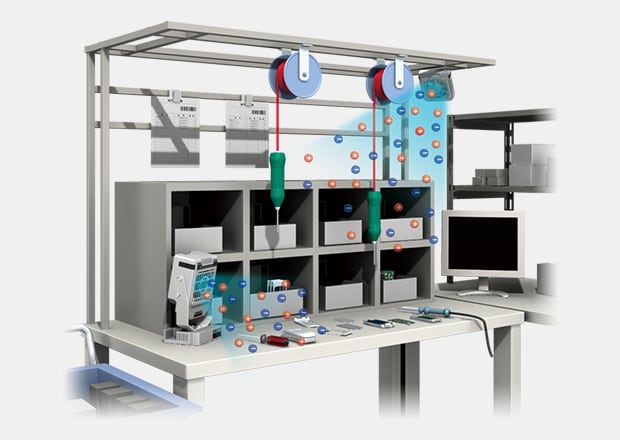
An ionizer reduces the adhesion of foreign particles, which leads to reduced costs and improved delivery times.
It is also effective for improving the level of trust in terms of quality.
Reduced Vacuuming Rate After Assembly
Vacuuming rate before the measures: 50%,
vacuuming rate after the measures: 10%
Although calculating the labor is difficult because the number of lines and assembly details varies, there is definitely an improvement.
In addition, there are other invisible effects, such as improved trust level in terms of quality.

ESD Risks During PCB and Connector Assembly
Circuit boards are repositioned multiple times before they are enclosed. Connectors are brought into contact while assemblies are still exposed and not yet tied to a common ground. Under these conditions, charge moves through the path available to it.
The result is not always visible at the station where it happens. Instead, they weaken internal structures and create latent defects that surface later as intermittent failures or reduced service life. Therefore, ESD prevention in smartphone production encompasses more than just grounding operators; it also involves actively managing the electrostatic charge on parts as they transition between various stages of production.
Static’s Impact on Screens, Casings, and Internal Components
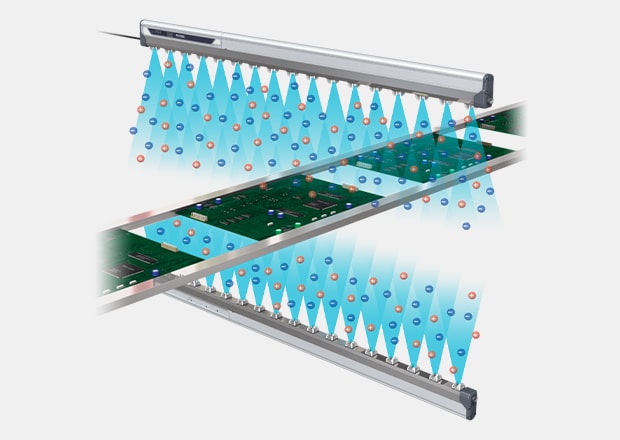
As parts move through smartphone assembly, charge builds on exposed surfaces and travels with the product. That charge changes how dust behaves around the device. Fine particles in the surrounding air settle more easily and are harder to dislodge once they attach.
The effect becomes noticeable after final assembly. Dust on glass can disrupt visual inspection or remain visible beneath the surface. Particles drawn toward openings may work their way inside the device, where they interfere with fit, movement, or long-term performance; therefore, reducing charge on exterior surfaces limits how strongly contamination is pulled toward finished components.
Why Dust Adheres During Mobile Phone Assembly
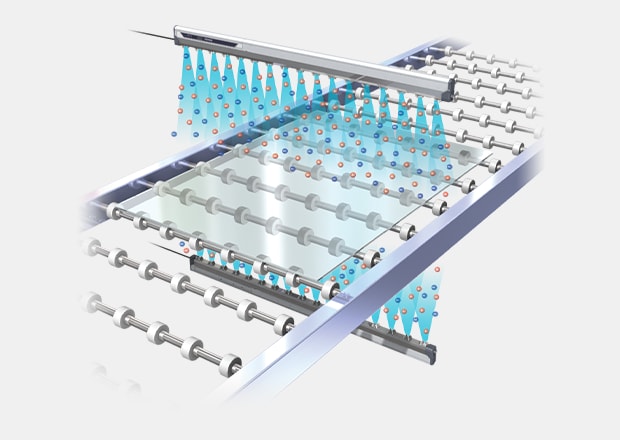
During smartphone assembly, parts move continuously between stations, all while exposed to the surrounding air. Even in cleanroom settings, fine particles can circulate through the space and settle wherever surfaces allow them to linger. When a housing or film carries a static charge, that surface becomes a point where dust can collect.
Once particles attach themselves to the parts, airflow alone can do little to move them. They commonly remain in place and often reach later stages of assembly unchanged. Operators often have to shift their efforts toward cleaning or containment near the end of the line. Even though this process adds time and introduces extra handling, it is often where defects are easiest to see.
Limitations of Conventional Countermeasures
In smartphone assembly, cleaning steps are often added to stabilize the output at a specific station. A vacuum pass or wipe-down can address what is visible at that moment—usually while housings, glass, or camera components are still exposed—instead of having to tackle everything at the end. From there, the rest of the process can continue without delay.
Parts move through transfers and short staging areas where charge can rebuild between operations. Cleaning stays fixed to one location. Over time, additional handling is added to keep those stations working.
How Ionizers Reduce Dust Adhesion in Smartphone Assembly
Ionizers are typically installed before steps that would enclose the parts assembly, like areas where parts are still exposed and moving between stations. These areas tend to be where housings, glass, and films are separated and then rejoined, which is also where charge tends to linger as components advance.
With ionizers active in these sections, parts carry less residual charge than they would otherwise because particles have a harder time staying attached to the materials. With ionization, particles do not remain attached as consistently during transfer. Any contamination is less likely to follow the part into later assembly steps where access becomes limited.
Because the effect happens earlier, cleaning does not have to compensate as aggressively near inspection or final assembly. Systems such as the KEYENCE SJ-Q are used in these locations because they can operate continuously in tight layouts and keep pace with line speed without changing how parts are handled.