Optical Comparator (Profile Projector)
Optical Measurement for Large Applications
Key Takeaways
- Optical measurement systems overcome the limitations of CMMs for large parts, enabling non-contact inspection of components up to 500 mm × 400 mm (19.69″ × 15.75″).
- Capture up to 5,000 dimensions in seconds with one button and reduce programming time by 80% by importing CAD or PDF files for automated setup.
- A multisensor platform integrates optical, laser, touch probe, and rotary units to inspect complex parts from all sides within a single measurement cycle.
- Achieve high precision on large parts using a 20-megapixel sensor, temperature compensation, and an optional 360° rotary unit for cylindrical features.
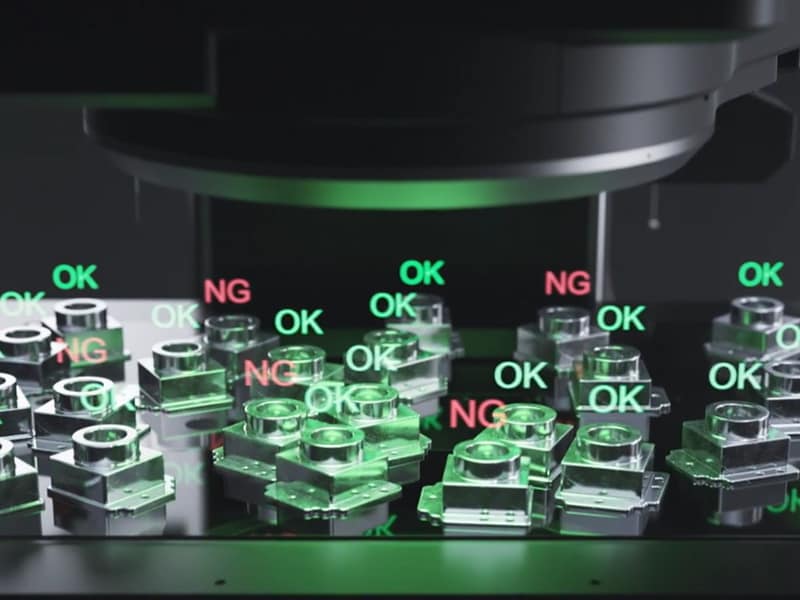
If you've attempted to measure fuel injector housings or transmission valve bodies, you understand the aggravation. You have to decide between fitting the part into your measurement apparatus and obtaining precise data.
When parts exceed the capacity of standard inspection equipment, manufacturers have traditionally faced three suboptimal choices: outsourcing measurements to a third party, repeatedly repositioning the part for measurement, or sampling only a few units and relying on assumptions. These methods often compromise accuracy, efficiency, and reliability. For years, manufacturers have dealt with this compromise, but an optical measurement system for large parts is finally catching up to real-world needs.
Why Optical Measurement Excels on Large & Complex Parts
Contact measurement methods become impractical with large workpieces. CMMs require complex fixturing setups, while manual tools are dependent on operator skill. Additionally, using probes on parts can introduce the risk of shifting or deforming flexible materials, compromising measurement accuracy.
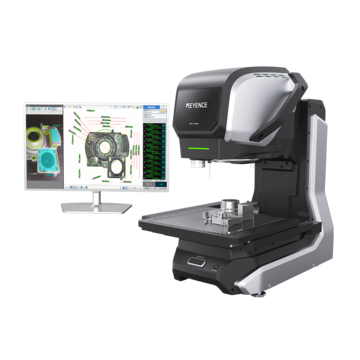
An optical measurement system for large parts technology sidesteps all of this by using vision instead of touch. The IM-X Series handles parts up to 500 mm × 400 mm (19.69″ × 15.75″) in stage area, with a maximum measurable height of 200 mm (7.87″), sizes that older systems couldn't accommodate. You just set the part on the stage.
Looking at the specs, you get more stage area compared to earlier models. The height range now reaches 200 mm (7.87″), which means tall assemblies, transmission housings, and structural brackets that used to be out of reach are now measurable.
The shop floor benefits greatly from this. You can measure parts much more quickly without the need for fixturing. Materials that would traditionally be compressed or deformed by a probe are now measured accurately without affecting their integrity. Additionally, your operators are no longer struggling with part placement. In reality, they are analyzing data and coming to conclusions. You can capture up to 5,000 dimensions in a matter of seconds by pressing a single button.
Inside the IM-X Series: Extended Range and Large-Part Workflows
What's interesting about the IM‑X optical measurement systems is its modular design. The stage and changeable measurement head are separate pieces, so you can set up what you need now and upgrade components later without tossing the whole system.
Three available staging options include:
- 1. The IM-X1220 small stage works for precision parts that don't take up much space.
- 2. The IM-X1330 medium stage covers most general machining applications.
- 3. The IM-X1540 large stage gives you that full 500 mm × 400 mm (19.69″ × 15.75″) capacity.
Depending on what you want to view, the measurement heads change. The Wide-Field IM head, with its 100 mm (3.94″) diameter lens, quickly captures large areas, while the High-Accuracy LM head offers 50× optical zoom with repeatability as precise as 0.1μm for more detailed magnification. There's no need for a technician to replace the heads.
Large applications for part measuring in the automotive and aerospace industries receive precisely this kind of competence. Auditors and quality managers like a complete recording of every dimension while keeping accuracy across the whole measurement range.
Precision Needs with Large Part Measurement Applications
In most measurement methods, size and accuracy are difficult to balance. However, the IM-X maintains precise tolerances even when measuring large areas, up to half a meter. Its 20-megapixel CMOS sensor captures fine edge details while simultaneously covering the entire field of view, allowing you to detect features just a few micrometers across without losing the broader context.
Temperature throws off measurements more than people realize. The system offers a temperature compensation tool that adjusts calculations based on the temperature you input into the machine to judge how much your specific material expands or contracts.
When you need rotational data (information like how circular a feature is, whether axes line up, or checking runout), there's an optional 360° rotary unit that captures the complete surface in one automated sweep. Multisensor metrology capabilities pull together this rotational information with fixed measurements to fully describe cylindrical features: bearing journals, shaft diameters, or turned components.
Programming at Scale: CAD/PDF Import and Smart Assist Tuning
Engineering hours are consumed in the creation of measurement programs. By using intelligent parameter optimization and automated drawing import, IM‑X optical measurement reduces that time by 80%.
Add a PDF drawing, a DXF file, or even a scanned copy of a paper print and dimensions and tolerances are automatically extracted by the system. The software determines which measuring instruments are appropriate for that geometry.
Smart Assist automation helps achieve consistent edge detection, optimizing focus, lighting, and accuracy. For parts with height variation, depth composition merges multiple focal planes into one sharp image. Choose from two camera heads:
- 1. The IM camera head uses a 100 mm lens to capture large areas in a single shot, reducing stage movement.
- 2. The LM head delivers 50× optical zoom with 0.1 µm repeatability for tight-tolerance inspections.
To improve feature visibility and edge detection on challenging surfaces, both pair with a programmable ring light that cycles LED colors.
When to Choose Optics, Laser, Probe, or Rotary (and Why It Matters)
A multisensor platform combines a variety of measurement methods to inspect complex parts from all sides in one cycle.
- 1. An Optical measuring system captures 2D features in the XY plane, including hole diameters, distances, angles, and profiles.
- 2. A Multi-color laser captures Z-axis height with a 50 µm spot, ideal for soft plastics, rubber seals, and finished surfaces that can’t be contacted.
- 3. A Touch probe delivers true 3D contact measurement with ultra-low force (0.015 N) to avoid part movement or deformation.
- 4. A Rotary Chuck measures cylindrical features such as circularity, cylindricity, and runout.
The right sensor depends on budget, dimensional callouts and tolerances. For example, a casting may use optics for hole patterns, a laser for surface heights, and a probe for boss perpendicularity, all within a single measurement cycle.
Industry Applications: Large Part Optical Measurement
In high-volume production, optical measurement for automotive parts provides practical solutions. Suspension components, door panels, transmission housings, and structural reinforcements are all well within the range of sizes where the IM-X makes sense.
Die-cast components have unique difficulties, such as thin walls, intricate internal geometry, and surfaces requiring flatness inspections. Without using contact probes for an extended period of time, optical measurement provides the necessary speed and coverage to confirm flash conditions, wall thickness fluctuation, and mounting face parallelism.
Tighter tolerances at comparable sizes are required for machined parts and aerospace brackets. The production of medical devices is also embracing large-format optical measuring. Sterilization containers, equipment housings, and surgical instrument trays all combine size with stringent specifications.
Parts too large for traditional vision systems but needing the speed and data density that contact methods just can't deliver. When your inspection spec lists hundreds of dimensions, how fast you can measure becomes just as critical as how accurately you can measure.
Network connectivity pushes measurement data straight into your enterprise quality systems. Configuration files are shared across multiple systems, so inspection procedures stay consistent at different facilities.
You don't have to compromise between accuracy, speed, and capacity when measuring large parts. The IM-X Series delivers the measurement range, sensor flexibility, and automation to inspect components that used to make dimensional verification a nightmare.
Book a demo to see the IM-X Series with the Largest Stage Size with KEYENCE today.