Optical Comparator (Profile Projector)
Lathe Machining and CNC Technology
Lathes machining is a manufacturing process used to produce rounded components by rotating a piece of material against a cutting tool. As the material spins, the blade shaves the surface to shape the exterior. This process is commonly used to produce cylindrical components such as furniture legs, bowls, shafts, bushings, and threaded pipes. Lathe machining can also create features like stepped diameters, tapers, and precision threads across a variety of materials. Early turning operations depended on manual machine control and operator adjustments. Today, modern manufacturing relies on computer numerical control (CNC) machines, which follow programmed instructions to precisely control tool position and spindle speed. Each machining cycle follows the exact same tooling path, ensuring parts are produced with consistent dimensions and high accuracy.
Key Functions and Features of Cutting Tools
Numerically controlled (NC) machine tools have drastically advanced metalworking since their emergence in the 1950s. Operations previously performed by hand could now be automated with NC machine tools. Not long after their emergence, NC machine tools began to be embedded with computers, a technical evolution that led to the adoption of the name CNC (Computer Numerical Control) machine tool. Notably, NC lathes were originally developed at a Japanese university in the late 1950’s. Afterwards, existing lathes were commonly equipped with servo mechanisms, and both of these developments showcased and resulted in a significant evolution of the lathe up to the present day.
A lathe is a machine tool that rotates a cylindrical material and cuts off unnecessary parts by putting a tool bit (cutting tool) against it. Besides turning using a basic right-cut tool, other lathe methods include drilling, boring, grooving, and threading. An NC lathe by comparison can selectively use several dozen types of tool bits in a preset procedure on numerical control-based automated machining. Not only does this make it possible to control the precise cutting or other machining positions through the use of a triaxial coordinate system, but it is also possible to achieve flexible machining by controlling the rotational speed and tool feed speed according to the material of the workpiece and the desired shape.
Common Types of NC Lathes
When machining with a lathe, various shapes can be created by using different types of cutting tools, such as basic right-cut tool bits, parting tools, and boring tools. The ability to use a set of tools continuously used without changeover can improve machining efficiency as well as prevent deterioration in machining precision that might otherwise occur when changing the orientation of the workpiece or exchanging different tool bits.
Mainstream NC lathes are generally equipped with a turret―a rotating unit with multiple mounted tool bits―that rotates to enable machining using different cutting tools. This enables a seamless transition from one completed process to the next while holding the workpiece chucked in position. A multi-spindle automatic lathe has more than one spindle, which makes it capable of operating different processes at the same time, giving it the characteristic of high production efficiency. In contrast, a single-spindle automatic lathe is suitable for continuous machining of a single process. Such lathes have an autoloader that loads workpieces automatically and can manufacture same-shaped products in large volume. Other special machine tools include face lathes and vertical lathes for large workpieces, and wheel lathes for machining railroad car wheels.
Evolution of NC Lathes
Today, NC lathes have become so computerized that there is little to no distinction between NC lathes and CNC lathes. With the goal of ever greater production efficiency, models equipped with multiple spindles and turrets capable of machining several dimensions at a time with a single chucking are becoming common. At the same time, precision is also improving thanks to high-precision lathes that support submicron-order machining, commonly used for precision machining in the electronic device industry. Additionally, the automation of peripheral functions such as feeding, delivery, washing, and measuring of workpieces also significantly contributes to streamlined manufacturing.
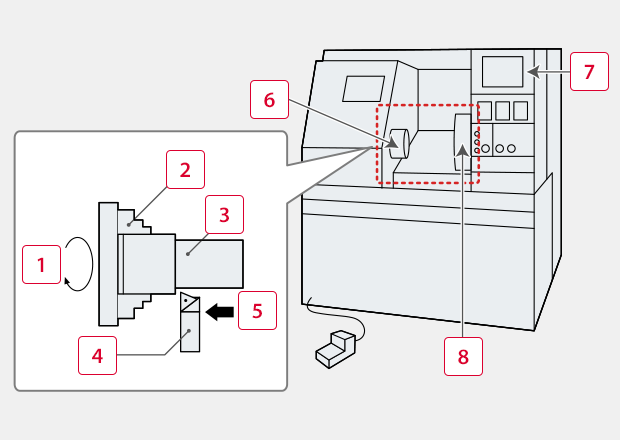
Basic Structure of an NC Lathe
-
1Spindle rotation
-
2Chuck
-
3Workpiece
-
4Tool bit
-
5Turning
-
6Spindle *1
-
7Control panel
-
8Turret *2
*1 A chuck restrains the workpiece.
*2 Holds a number of tools.
What Is a Computer Numerically Controlled Machine?
A computer numerically controlled machine operates according to coded machine instructions. These instructions determine axis movements, feed rates, and tool selection, and most CNC systems use programming languages like G-code to describe the steps the machine needs to take during operation.
The machining process typically begins with a digital part model or engineering drawing. Programmable software converts the design into instructions that guide the machine’s motions. Once the program is loaded, the CNC machine coordinates axis movement and spindle rotation while the cutting tool works.
Types of NC and CNC Lathes
Common CNC lathe machine configurations include turret lathes, Swiss-type lathes, vertical lathes, and horizontal lathes.
- Turret lathes support multiple cutting tools that are mounted on a rotating turret, which allows for tools to be changed out rapidly during a machining cycle.
- Swiss-type lathes are commonly used for small-diameter components where supports near the cutting area reduce workplace deflections.
- Vertical lathes accommodate larger and/or heavier parts with a vertically oriented spindle.
- Horizontal lathes are widely used for general turning purposes like working on shafts and bar stock.
Selecting between these types of NC or CNC equipment depends on part geometry and machining requirements. The machine’s configuration affects how easily tools can access the workpiece and determines the range of operations that can be performed in a single setup.
Turning Processes in Lathes Machining
Turning is the primary operation performed in lathes machining. During this process, a stationary cutting tool removes material from the other diameter as the workpiece rotates. Feed rate and depth of the cut will determine how much material is removed during each pass.
Machining cycles commonly begin with rough turning to remove larger amounts of material, and finishing passes follow to achieve the final dimensions and surface finish required for precision machining.
A CNC lathe machine can also perform additional operations during the same machining cycle. These operations include:
- Facing: Creating a flat surface at the end of the workpiece
- Drilling and Boring: Form internal features
- Threading: Used to produce screw threads
- Parting: Separated the finished piece from the remaining stock
Many CNC lathes use a tool turret to hold multiple cutting tools that are automatically indexed by the machine as the program progresses. This allows several machining steps to be completed without removing the workpiece or manually changing equipment.
Precision Measurement in Automated Machining
Dimensional verifications support precision machining by confirming that finished parts match all of the design specifications. During lathe machining, operators measure features such as diameter and hold size to confirm that the machining operation remains within tolerances.
Standard inspection tools for lathe machining include calipers and micrometers, allowing machinists to compare their finished product dimensions with the initial engineering drawing. When a computer numerically controlled machine produces parts in large quantities, periodic inspections are used to help confirm that machining conditions and settings remain stable.
Standard inspection tools for lathe machining include calipers and micrometers, allowing machinists to compare their finished product dimensions with the initial engineering drawing. When a computer numerically controlled machine produces parts in large quantities, periodic inspections are used to help confirm that machining conditions and settings remain stable.
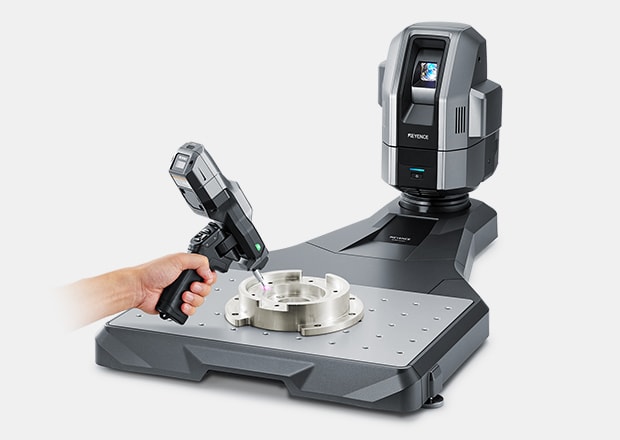
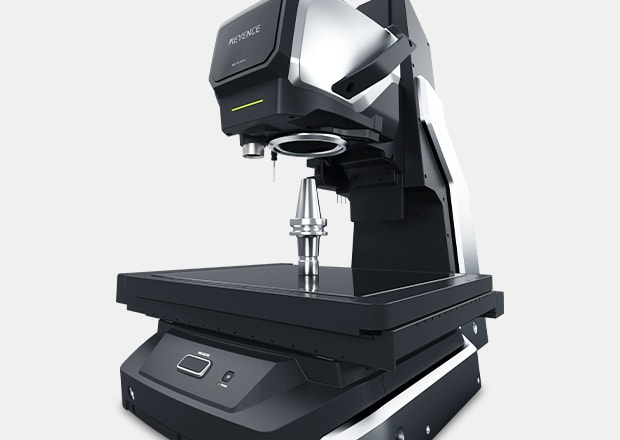
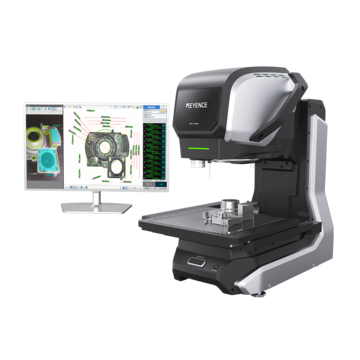
Improve lathes machining accuracy with advanced inspection and measurement systems from KEYENCE.